
What does a bald-faced hornet nest look like from a distance?
From a distance, a bald-faced hornet nest looks like a fully enclosed, teardrop or oval papery structure with a weathered-wood or cinder-block gray color. It usually hangs suspended from tree branches, tall shrubs, or porch eaves. The structure can range from the size of a small embryo nest up to a basketball-sized fortress.
What is actually going on
Imagine walking out to pull the garden hose away from the hydrangea bushes, glancing up into the bare branches overhead, and spotting what looks like a giant gray football swaying gently in the breeze. That teardrop or oval shape hanging in plain view is the calling card of the bald-faced hornet. From a distance, a bald-faced hornet nest looks like a fully enclosed, papery structure with a distinct weathered-wood or cinder-block gray color. It usually hangs suspended from tree branches, tall shrubs, or the upper eaves of a porch.
People often picture a messy cluster of open-faced honeycomb cells when they think of stinging insect nests, but this one is built like a sealed paper piñata. The builders chew up weathered wood fibers from fences and dead trees, mix those fibers with their saliva, and apply the pulp in thin, overlapping layers. This creates a multi-layered, waterproof outer shell that completely hides the internal horizontal tiers where the larvae grow.
You might wonder why these insects get called hornets when they are actually something else entirely. Taxonomically speaking, the bald-faced hornet is a large aerial-nesting yellowjacket rather than a true hornet. Even so, the vernacular name sticks because of their size and defensive nature. By late summer, a colony that started out as a small embryo nest in May can expand into a heavy, basketball-sized fortress packed with hundreds of workers.
How to tell for sure
Telling a bald-faced hornet nest apart from other hanging structures usually comes down to color, envelope architecture, and placement. If you are looking at a nest from a safe distance through binoculars or a camera zoom, check its visual traits against a few specific benchmarks.
First, look at the envelope color and texture. A bald-faced hornet nest is uniformly gray and resembles layered papier-mâché or a wet gray egg carton. If the paper envelope has a distinct reddish or muddy brown hue, you are usually looking at the nest of a different species entirely. If it is a rich, swirled brown or tan and tucked into a hollow tree or an attic wall void rather than dangling from an open branch, it typically belongs to the European hornet.
Next, check for exposed cells. Paper wasps build single-layer, umbrella-shaped combs that leave every hexagonal cell completely open to the air, often looking like an upside-down showerhead. Bald-faced hornets never leave their combs exposed. Their nest is completely wrapped in that protective gray paper wall, usually featuring a small entrance hole near the lower third of the structure where workers fly in and out.
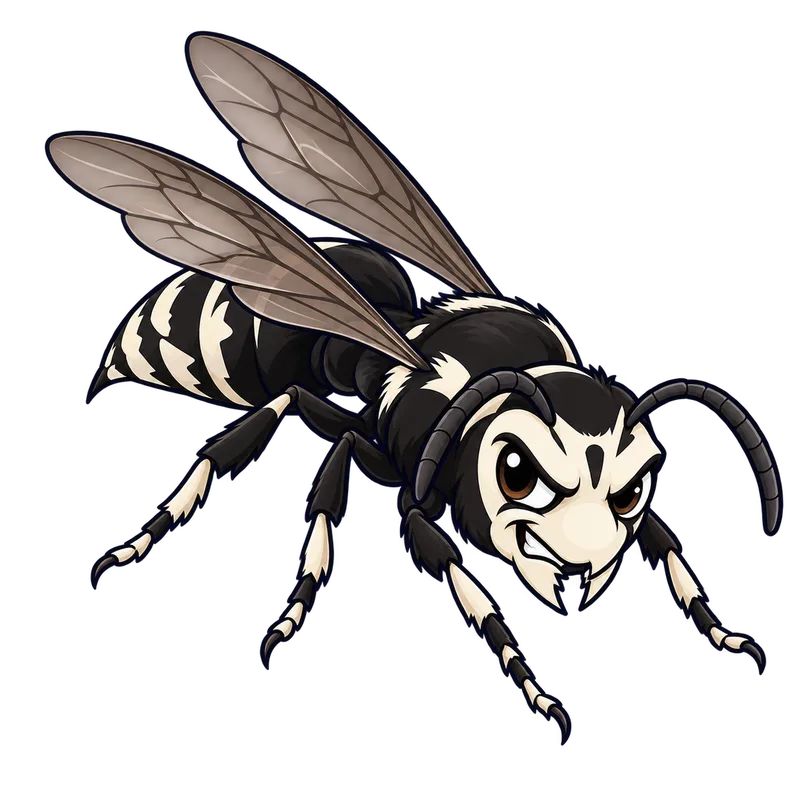
If you manage to spot the adults resting near the entrance, their markings help settle any doubt. They display a mostly black body with striking ivory-white markings across the face and the tip of the abdomen. This stark white-and-black contrast separates them from standard yellow and black yellowjackets.
What usually comes next
Finding one of these gray paper structures hanging off a backyard maple or a garden shed usually forces a quick decision about whether to leave it alone or take action. Nests located high in mature trees or far out in the corners of a large property often present minimal danger and can simply be left to complete their annual life cycle. In fact, the workers act as beneficial predators that hunt nuisance flies and caterpillars throughout the warm months.
When a nest hangs directly above a high-traffic walkway or right beside your back door, leaving it in place stops being a reasonable option. Keep in mind that these colonies are strictly annual. Once hard autumn frosts arrive, the workers and the old queen die off, and the abandoned nest naturally weathers away over the winter. They never reuse an old nest the following spring.
If removal is necessary, remember that pesticide products applied to wasp nests must strictly follow the official product label directions. The label dictates the required application distance, timing, and personal protective equipment. Never guess at a mixture or invent an application method, and if the label instructions call for a licensed applicator, let a professional handle the treatment.
When to get help
Bald-faced hornets defend their nests aggressively if anything vibrates, bumps, or disturbs their hanging home. Because they possess smooth stingers, individual workers can sting multiple times, and their venom causes sharp, burning pain followed by localized swelling.
If someone is stung and shows signs of a systemic allergic reaction such as widespread hives, facial or throat swelling, dizziness, or difficulty breathing, call emergency services immediately and administer an epinephrine auto-injector if one has been prescribed.
You should also bring in a licensed pest control professional if the nest is larger than a softball, sits in a precarious spot that requires working off a ladder, or stands too close to daily foot traffic. If the nest displays non-typical features like a reddish or muddy brown paper envelope, stop what you are doing, take a photograph from a safe distance, and report the finding to your state agricultural extension or department of agriculture, as unusual nests can indicate the presence of high-priority invasive species requiring official management.