
How is a bald-faced hornet nest dealt with?
Dealing with a bald-faced hornet nest depends on its location, and the smartest move is often to do nothing if it hangs safely in a remote tree. If the nest sits in a high-traffic area, you can spray a low nest at night using an EPA-registered aerosol product, or call a professional for hard-to-reach spots.
What is actually going on
Picture stepping out onto the back porch on a warm Tuesday morning, coffee mug in hand, only to notice a grey, papery globe the size of a basketball dangling right beneath the gutter. Before you panic or reach for a broom handle, dealing with a bald-faced hornet nest is less about rushing into battle and more about figuring out if you even need to touch the thing at all.
What you are looking at is essentially a single-season pop-up city built by a native North American social wasp species. Despite the common name, they are not true hornets. They are actually a type of aerial-nesting yellowjacket that constructs its home by chewing up weathered wood fibers, mixing them with saliva, and layering the resulting grey pulp into a tough, football-shaped envelope with a single entry hole near the bottom.
If that nest is hanging high up in a remote tree canopy where nobody walks, the smartest move is usually to do nothing. These colonies are strictly annual affairs. A lone queen starts the nest in the spring, the worker population swells through the summer, and the first hard frost of late autumn finishes off the entire colony for good. Once winter sets in, the workers, males, and founding queen die off naturally, leaving behind an empty paper shell that is never reused the following year.
How to tell for sure
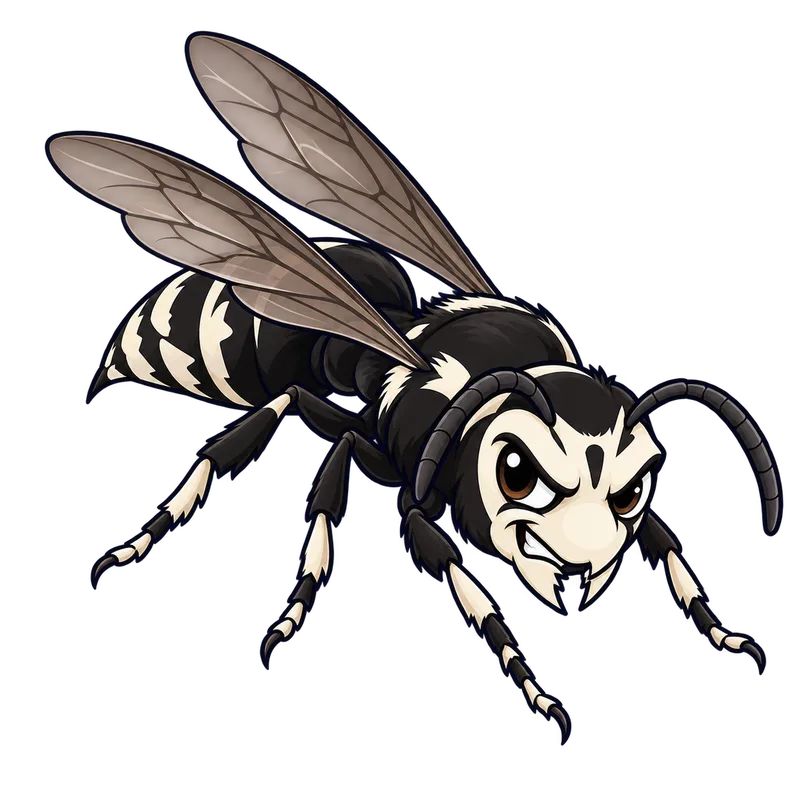
Before deciding on a plan, you need to confirm what kind of insect you are dealing with because not all stinging pests are managed the same way. Adult bald-faced hornets usually measure between zero point five and zero point seven five inches long, and they wear a distinct black-and-white tuxedo pattern rather than the typical yellow-and-black caution stripes of ground-nesting yellowjackets. Their faces and lower abdomens bear striking ivory-white markings.
You also want to rule out invasive lookalikes that trigger state agricultural alerts, such as the yellow-legged hornet, which features distinctive bright yellow feet and builds a massive muddy-brown nest high in trees. If the insects hanging around your eaves are black and white and the nest is an enclosed grey paper sphere, you are looking at the native bald-faced hornet.
Do not rely on a sting or a mark on your skin to identify the pest. Always observe the nest from a safe distance of ten to fifteen feet using binoculars or a camera zoom if necessary. If the creatures you see have bright yellow legs or a massive body measuring nearly two inches long, stop right there. That points toward an invasive species, and you should snap a photo from afar and report it directly to your state department of agriculture or extension service rather than trying any do-it-yourself tactics.
What usually comes next
When a nest ends up right over the front porch, near the kids swing set, or dangling low by the back door, leaving it alone stops being an option. That is when you have to make a practical choice between calling in help or handling a low, accessible nest yourself.
If you decide to take care of a low nest on your own property, timing is everything. Trying to spray a nest in the middle of a sunny afternoon is a reliable way to get swarmed by hundreds of defensive workers, so the work has to happen at night. Cool nighttime temperatures act like pressing pause on the colony, forcing all the foraging workers inside the nest where they stay sluggish and clustered together.
Federal law mandates that any pesticide product label is the governing law, meaning you must buy an EPA-registered aerosol product labeled specifically for hornet or wasp nests and follow every word on that container. Throwing together homemade mixtures, hosing the nest with water, or swinging a baseball bat at it will only invite an immediate, painful counterattack. Before you spray, put on proper protective clothing like long sleeves, heavy pants, closed-toe boots, and thick gloves, and never stand directly underneath the nest while treating it.
When to get help
Sometimes a nest sits in a spot that demands a professional touch, or the situation crosses into medical territory. If the grey envelope is attached high on a third-story roofline, tucked deep inside a wall void, or hovering right over a high-traffic entryway where people cannot avoid it, call a licensed structural pest control company. Professional operators carry specialized extension equipment and heavy-duty protective gear designed for these exact scenarios.
You should also hand the job over to a professional if anyone in your household has a known allergy to insect stings, or if the property operates a sensitive facility like a school or a daycare where strict state notification rules and re-entry intervals apply.
Stings from these hornets cause acute pain, local swelling, and redness. If multiple stings occur, or if someone takes a sting to the head or neck, watch closely for signs of a severe systemic allergic reaction or anaphylactic shock. If a person experiences difficulty breathing, throat itching, facial swelling, or dizziness, seek emergency medical services or administer an epinephrine autoinjector immediately. For non-emergency sting questions or minor exposure concerns, you can reach out to the Poison Control Center Helpline at one-eight-hundred-two-two-two-one-two-two-two.