
Are bald-faced hornets aggressive?
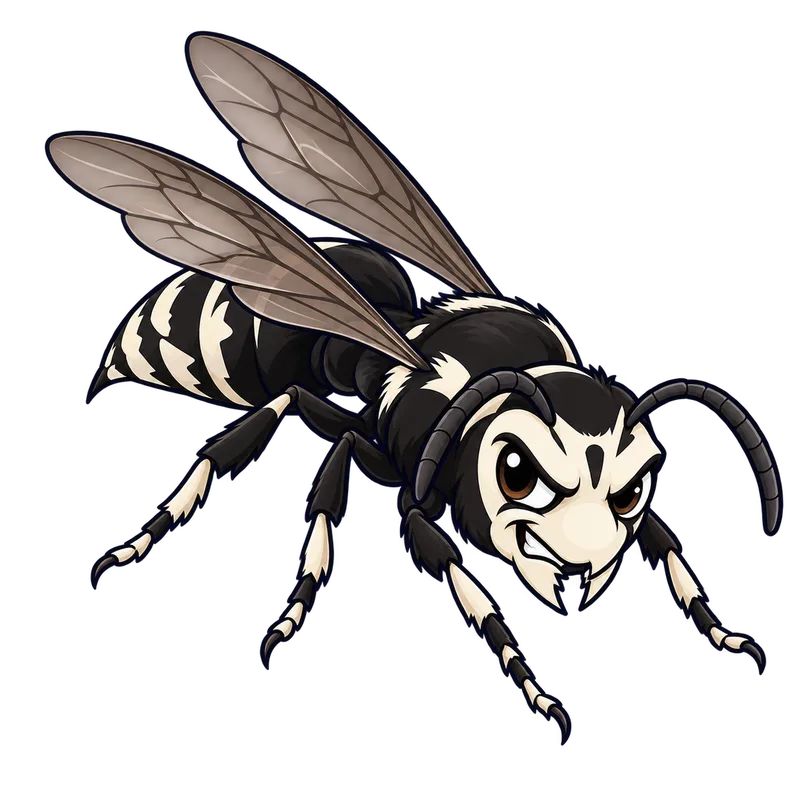
Yes, bald-faced hornets are aggressive when defending their homes, but they are harmless when foraging away from the nest. A foraging insect will ignore humans unless someone swats at it, steps on it, or traps it against bare skin. However, disrupting their large paper nests triggers an immediate and coordinated defense.
What is actually going on
Picture yourself out on a warm Saturday afternoon, moving back and forth across the lawn with a trimmer, or perhaps reaching deep into a garden shrub to snip off a few dead branches. Suddenly, a group of dark, fast-moving insects erupts from above, and before you can process what is happening, you take a sharp, burning sting to the wrist. It feels personal, as though an uninvited squad flew out specifically to ruin your afternoon. But the reality of the insect commonly known as the bald-faced hornet is a bit more nuanced than a simple vendetta against humanity.
Are they aggressive? The short answer is yes and no, depending entirely on where you find them. If you spot one of these insects lazily landing on a garden flower or investigating a glass of sweet liquid on your deck, it is practically harmless. Foraging bald-faced hornets are entirely focused on gathering nectar, tree sap, or other insects to feed their colony. They ignore humans completely unless someone physically swats at them, steps on them, or traps them against bare skin. A foraging hornet is like a customer focused on grocery shopping, ignoring everyone else in the aisle until someone accidentally bumps into them.
Your lawnmower vibration, a stray baseball, or a hedge trimmer hitting the wrong branch changes the equation entirely. Those large, gray, paper-like nests suspended from tree branches or house eaves act as high-security fortresses. If something disrupts the nest structure, guard workers sound a chemical alarm and mount an immediate, coordinated defense. Unlike honey bees, which leave their stingers behind and die after a single defensive strike, these insects possess a smooth stinger. They can sting a perceived threat repeatedly, injecting venom with each pass without damaging their own bodies.
How to tell for sure
If you are trying to figure out what kind of insect is buzzing around your property, you need to look past the popular name. Despite being called a hornet, the bald-faced hornet is actually a North American aerial yellowjacket belonging to the family Vespidae. True hornets belong to an entirely different biological genus, but the local name has stuck for generations across the United States. Adults usually measure between 0.5 to 0.75 inches long, sporting a mostly black body accented by striking white or ivory-white markings across the face, thorax, and lower abdomen.
You can usually identify them by their architecture alone. They build distinctive aerial nests out of chewed wood pulp mixed with saliva, creating a durable, grayish, paper-like shell that often grows to the size of a football or a basketball by late summer. If you see a gray football-shaped structure hanging high in a tree canopy or tucked under a roof eave, you are usually looking at the home of these insects rather than paper wasps, which build open-faced, umbrella-like nests without a protective outer envelope. For a definitive identification of look-alike species, a hand lens might be needed to examine facial patterns, but the combination of size, black-and-white coloration, and a suspended gray paper nest usually points straight to this species.
What usually comes next
When you discover an active nest on your property, the primary decision involves proximity and risk. If a nest is hanging thirty feet high in a mature oak tree at the back of your property, it poses virtually no threat to daily human activity and usually requires no intervention at all. The colony will complete its life cycle through the warm months and die off naturally with the winter frost.
Conversely, a nest constructed right above your front porch or tucked into a low garden shrub near a children's play area presents a serious sting hazard. When a nest sits in a high-traffic zone, do not attempt a do-it-yourself removal using household sprays or long sticks. Striking or disturbing a mature colony will almost certainly trigger a severe defensive attack. Instead, contact a licensed pest control professional equipped with the right protective gear and equipment to handle the removal safely.
Remember that any chemical treatments applied to wasp or hornet nests are strictly governed by registered product labels. The label dictates the exact application parameters, safety gear, and environmental conditions required by law, and deviating from those instructions is a regulatory violation enforced by state agencies.
When to get help
Stings from these insects cause immediate, intense pain, burning, and localized swelling. If a sting victim experiences systemic warning signs of an allergic reaction, such as chest pain, swelling of the lips, tongue, or throat, difficulty breathing, dizziness, lightheadedness, or widespread hives, seek emergency medical attention immediately.
Stings also break the skin barrier, creating a risk for secondary bacterial infections or tetanus. Anyone who has not received a tetanus booster within the previous 5 years should consult a healthcare professional. For general questions about sting management or mild reactions, you can contact the national Poison Control Center Helpline in the United States at 1-800-222-1222. Do not attempt to diagnose or prescribe home medications for severe reactions, and always leave high-risk nest removals to trained professionals.