
What are blue mud daubers?
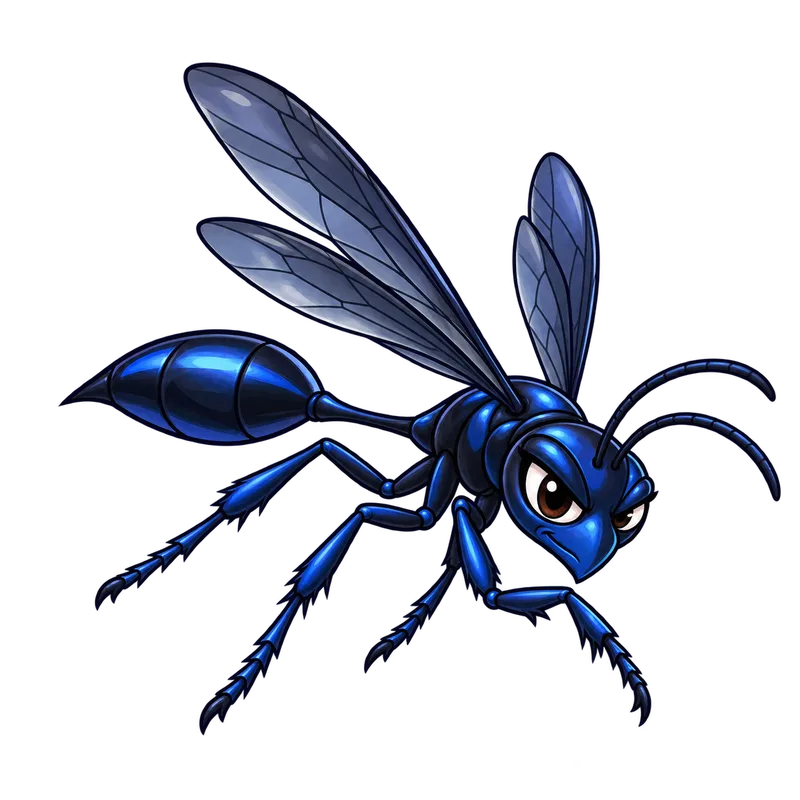
Blue mud daubers are solitary wasps with a striking metallic blue black or deep purple sheen and an exceptionally long, thread-like waist. These insects measure between 10 to 23 mm in length and typically take over pre-existing mud nests built by other wasps rather than constructing them from scratch.
What is actually going on
Picture walking out to the back patio on a warm afternoon, reaching up to check the porch ceiling, and noticing a dull gray clump of dried mud left behind by some previous insect tenant. Suddenly, a streak of metallic cobalt zips past your ear, flashing like a polished piece of jewelry in the sunlight. That dazzling visitor is a blue mud dauber, and its approach to homeownership is remarkably practical. Instead of gathering wet mud from a puddle to build a fresh nursery from scratch, this solitary wasp plays the ultimate fixer-upper game.
The female wasp carries water droplets in her mouthparts over to that old, hardened mud nest, regurgitating the liquid onto the clay to soften it up. She chews open the hardened chambers, clears out whatever debris or old residents remain inside, and redecorates the space. But she does not just move in empty-handed. She goes out hunting, tracks down spiders, paralyzes them with a quick sting, and stuffs the rooms with fresh provisions before laying a single egg and sealing the doorway shut.
That habit of hijacking pre-existing mud tubes built by other wasps is why entomologists call these insects kleptoparasitic renovators. People often assume that any wasp buzzing near a house must be part of an angry, stinging mob ready to defend a massive shared paper nest. Blue mud daubers do not live that way. They are strictly solitary creatures. There is no queen, no worker caste, and no committee of angry neighbors waiting to swarm your porch if you walk too close. Each female operates entirely on her own schedule.
How to tell for sure
Spotting one usually comes down to a combination of color and architecture. Adult blue mud daubers typically measure between 10 to 23 mm in length, which translates to roughly 0.4 to 0.9 inches of sleek, elongated insect. Their entire body carries a striking metallic blue-black or deep purple sheen that catches the light, paired with dusky or slightly iridescent wings. You will also notice an exceptionally long, thread-like waist, known as a petiole, connecting the thorax to the abdomen.
Regarding nests, things get a bit nuanced. Blue mud daubers usually do not manufacture the original mud tubes themselves. They take over hardened structures built by black and yellow mud daubers or organ-pipe wasps. If you see a wasp that looks like a flying piece of polished blue metal poking around old, weathered mud lumps on your brickwork, garage rafters, or eaves, you are almost certainly looking at a blue mud dauber.
Confusing them with social stinging insects happens all the time, but the differences are hard to miss once you know what to look for. Paper wasps and yellowjackets build open umbrella-shaped or enclosed gray paper combs, and they will fiercely attack if you disturb their home. Blue mud daubers ignore you entirely. They are too busy hunting spiders or sipping floral nectar from garden weeds to care about your presence.
What usually comes next
Deciding how to handle these insects rarely calls for breaking out the bug spray. Since blue mud daubers remain remarkably calm, live on flower nectar once they reach adulthood, and spend their days tracking down genuinely troublesome pests like black widows, the sensible move is usually letting them be. They double as free pest control and quiet garden visitors without asking for anything in return.
When those mud structures happen to end up right above the back patio table or right next to the front door where kids run around, you might not want them around. That is when physical removal steps in. Just take a stiff scraper, wait for a cool morning when the wasps are sluggish, and pop the old dried mud right off the brick. Because these solitary wasps do not organize a defense committee, knocking down a nest poses almost no risk of stinging.
Making your home a bit less welcoming to spiders also encourages the wasps to pack up and leave. Clear away dusty corners in the garage, sweep down old webs, and seal up gaps in the siding. If you still decide chemical controls make sense because of severe household allergies, that choice is yours, but every product must follow the exact directions written on the container label.
When to get help
Most close encounters with these solitary flyers pass without incident, but some scenarios require a professional touch. If you look closer at that nest and realize it actually belongs to aggressive yellowjackets or hornets rather than a solitary mud dauber, back away slowly. Those social colonies defend themselves fiercely, and getting rid of them usually demands specialized gear and training.
Bring in a professional if the nests sit high up on a steep roofline, near overhead power lines, or deep inside a wall cavity where reaching them safely is out of the question. You should also contact your local agricultural extension or state department of agriculture if you spot large hornets with distinctively bright legs buzzing around local trees or hives, since that points toward invasive species that demand official reporting.
As for medical concerns, stay alert for serious warning signs if a sting does occur. While a blue mud dauber sting usually brings only mild irritation similar to a minor ant nip, severe allergic reactions can happen with any insect sting. Get emergency medical help right away if someone shows signs of trouble breathing, throat tightness, widespread hives, dizziness, or swelling of the face. For non-urgent questions about a sting, call poison control or speak with a healthcare professional.