
Are mud daubers wasps?
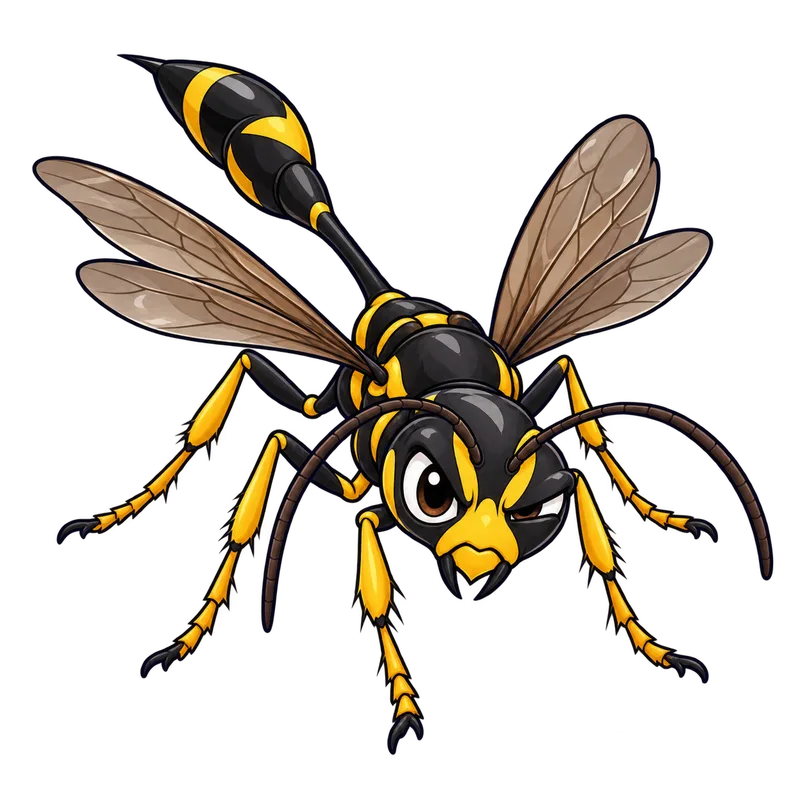
Yes, mud daubers are true wasps that belong to the order Hymenoptera, but they are solitary freelancers rather than colony dwellers. These slender insects feature a thread-thin waist and build hard clay nests without a workforce of thousands to defend them.
What is actually going on
You walk out to the porch on a warm Saturday morning, reach for the garden hose, and notice a strange, lumpy streak of dry clay stuck right underneath the eaves. Or maybe you spot a slender, jet black wasp with a thread-thin waist lazily hovering around your patio bricks, carrying a ball of mud like a tiny mason. Your first instinct might be to back away slowly, expecting a swarm of angry stingers ready to defend their territory.
Relax, because you are not dealing with yellowjackets or hornets here. Yes, mud daubers are true wasps belonging to the order Hymenoptera, but they are the solitary freelancers of the wasp world. They do not live in colonies, they do not answer to a queen, and they certainly do not have a workforce of thousands standing by to attack you. Each fertile female works entirely on her own. She spends her summer gathering wet soil, sculpting individual tubes or lump nests, hunting spiders to pack inside them, and sealing the whole thing up without ever throwing a single office party.
People often confuse them with social paper wasps because both insects build exterior nests on houses. But a mud dauber operates more like a solo artisan working from a home office than a corporate headquarters. Because they lack a shared nest to defend, they have no collective anger management issues. They use their venom strictly to paralyze spiders for their developing larvae, not to chase you across the lawn. Unless you accidentally trap one under your shirt or squeeze it hard in your bare hand, a mud dauber will simply ignore you and go about its business.
How to tell for sure
If you are staring at a nest or a hovering insect and want to know what you are looking at, you usually only need to check a couple of visual clues. Mud daubers typically fall into three common North American groups, and they all look quite different from your average social pest. The black and yellow mud dauber grows up to an inch long, sports bright yellow bands on its legs and body, and builds fist-sized lumps of mud. The organ pipe mud dauber constructs neat, parallel vertical tubes that look a bit like a miniature set of church organ pipes. Then you have the blue mud wasp, which features a striking, metallic blue-black iridescent coat and a habit of taking over old nests built by other species.
You can also tell them apart by how they behave. A social wasp nest usually looks like an open papery comb or an enclosed gray football with dozens of workers buzzing angrily around the entrance. A mud dauber nest is hard, made entirely of dried clay or mud, and usually houses just one quiet occupant at a time. If you see a single wasp calmly flying back and forth with a ball of wet dirt or a paralyzed spider in its jaws, you are almost certainly watching a mud dauber. Their signature physical trait is the petiole, which is an unusually long, narrow thread waist connecting the thorax to the abdomen. Stumpy yellowjackets do not have that slender silhouette.
What usually comes next
When you discover a mud dauber nest on your porch ceiling, behind a shutter, or tucked inside the corner of your garage, you have a simple choice to make. You can leave them alone, or you can scrape the nest down. Because these wasps are non-aggressive and do not defend their homes, you usually do not need to run out for a chemical spray. You can just grab an old putty knife, a stiff broom, or a scraper, and pop the clay nest right off the surface.
Before you scrape, consider what the wasp is actually doing for your yard. Female mud daubers hunt down spiders, including orb-weavers, crab spiders, and occasionally black widows, stuffing six to fifteen paralyzed arachnids into each mud cell as live food for their young. In that sense, they act as free pest control. If the nest is in a spot where it genuinely bothers you, such as right above your front door or inside the burner tube of a gas grill where it could cause a mechanical blockage, scraping it away is entirely safe to do during the cooler morning or evening hours when the adults are less active. If you do decide to use an aerosol wasp spray because a family member has severe sting allergies, always read the product label first and follow the instructions precisely, since the label is federal law.
When to get help
While mud daubers are remarkably mellow insects, certain situations call for an outside hand or immediate medical attention. If a sting triggers a systemic allergic reaction, meaning you experience facial swelling, trouble breathing, dizziness, or widespread hives, seek emergency medical help right away or use an epinephrine autoinjector if you have one prescribed. Standard stings usually only cause mild, temporary discomfort comparable to a fire ant, but allergic reactions are an entirely different category.
You should also know when you are looking at the wrong insect entirely. If you spot large wasps measuring up to two inches long building massive paper nests in trees or under eaves, or if you notice them hunting honeybees aggressively, step back immediately. Those can be invasive hornets like the yellow-legged hornet, which require professional identification and a call to your state department of agriculture. For standard mud daubers, though, a bit of common sense and a putty knife are usually all the help you will ever need.