
What do mud daubers eat?
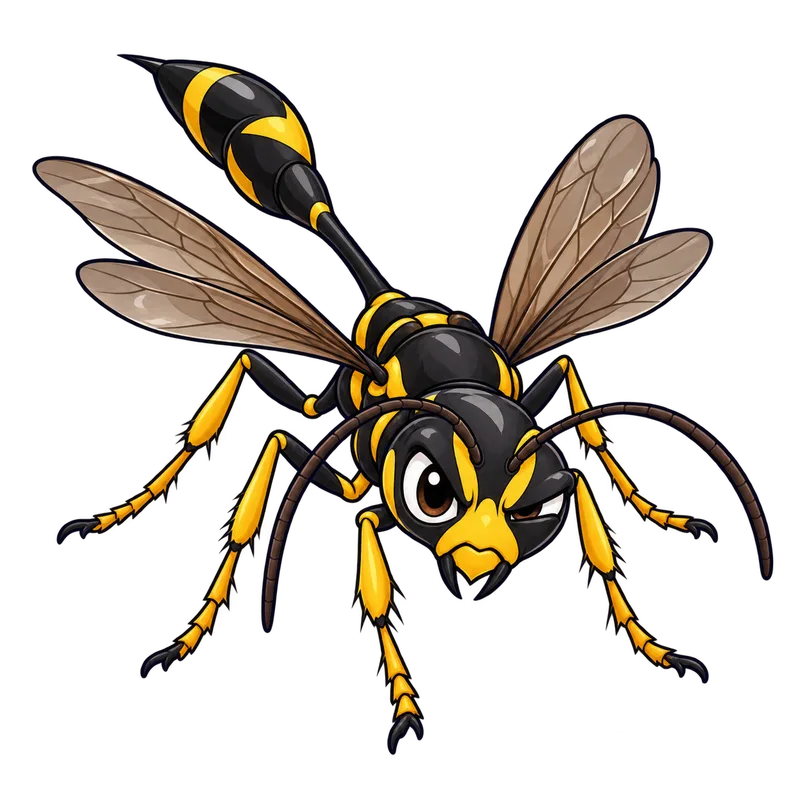
Adult mud daubers eat floral nectar, tree sap, and plant fluids. In contrast, mud dauber larvae eat spiders that the adult female hunts and paralyzes. What these wasps eat depends entirely on their life stage, as adults are strict vegetarians while their growing offspring are carnivores.
What is actually going on
You are standing on a stepladder in the late afternoon sun, wiping down the garage eave before painting, when your scraper hits something hard. You look closer at a clump of dried dirt clinging to the siding. It looks like someone glued a handful of miniature clay tubes right to your house. You are probably wondering what on earth built that thing, and more importantly, what it is storing inside. If the culprit is a mud dauber, the answer depends entirely on whether you are asking about the adult or its offspring.
Adult mud daubers live on a completely different diet than their young. Once these wasps trade their larval life for wings, they become strict vegetarians of the insect world. They spend their days visiting flowers, sipping on floral nectar, tree sap, and plant fluids to get the sugars and carbohydrates they need to fly, forage, and build their nests. They do not eat solid animal protein at all. They have zero interest in your hamburger, your picnic sweet tea, or the other insects buzzing around your yard.
So what are those clay tubes actually for if the adults are just eating flowers. That mud nursery is a dedicated pantry and crib for the next generation. Unlike the adults, mud dauber larvae are strict carnivores that need heavy-duty animal protein to grow. To solve this menu mismatch, the adult female acts as a solitary hunter. She tracks down spiders, stings them just right to induce a permanent, flaccid paralysis without killing them, and packs them tightly into her clay cells.
This is where the biology gets fascinating. The venom acts as a biological preservative. Because the spider is paralyzed rather than dead, its tissues remain fresh, soft, and un-decayed inside the sealed mud chamber. The female lays a single egg on top of this twitching spider hoard and caps the cell. When the larva hatches, it has a fresh, living meat locker waiting for it. It consumes the paralyzed spiders entirely over several days before spinning a cocoon and turning into an adult.
How to tell for sure
If you want to know which neighbor built the mud sculpture on your porch, you usually need to look at the wasp itself or the shape of the clay. Not all mud daubers look or act the same way.
The black and yellow mud dauber is usually the one responsible for those lumpy, fist-sized clay masses under eaves and bridges. The adult measures up to an inch long, featuring a very long, thread-like waist, a black body with striking yellow markings, and banded legs. Females collect wet balls of mud to build cylindrical cells, hunting orb-weaver spiders, crab spiders, and wolf spiders to pack inside each one.
Then you have the blue mud dauber, a metallic and iridescent blue-black wasp that often catches people off guard. Unlike its black and yellow cousin, this wasp usually skips building new mud nests from scratch. Instead, it brings water to soften, clean out, and hijack old or active nests built by other species. It also specializes in hunting black widow spiders, which makes it an unsettling neighbor if you are nervous about venomous pests, but a surprisingly effective hunter if you prefer fewer widows lurking around your foundation.
A third common builder is the organ pipe mud dauber. This is a sturdy, shiny black solitary wasp that constructs distinct vertical mud tubes side by side, looking remarkably like a miniature musical instrument. You typically find them on smooth exterior walls, bridge supports, and porch overhangs. As she molds the damp earth into place, the female often produces a distinct, audible buzzing sound.
What usually comes next
Once you spot a mud nest, you generally face a straightforward choice: leave it alone or scrape it off. It helps to remember that mud daubers are solitary wasps, meaning they do not live in massive colonies with a queen to defend. They lack a collective home defense instinct and rarely sting unless you accidentally press one directly against your skin. Their sting is quite mild, usually compared to a minor ant bite.
If the nest sits in an out-of-the-way spot like a shed wall or a back fence, you can safely leave it alone. These wasps actually do a lot of heavy lifting by keeping local spider populations in check. They serve as free pest control, quietly hunting your yard for garden spiders you might not want around anyway.
If the nest sits right beside your front door or in a busy spot where family members might brush against it, you can easily remove it without any chemical spray. Grab a stiff putty knife and slide the blade behind the dry mud mass. Because the wasps do not defend these old structures aggressively, physical removal is usually quick and painless. Once the nest is gone, seal up minor exterior gaps and sweep away old spider webs to make your siding less appealing for the next generation.
When to get help
There are times when a casual do-it-yourself approach is the wrong move, and you should bring in outside help. If anyone in your household has a known severe allergy to stinging insect venom, do not attempt to scrape or spray nests yourself. Even solitary wasps can deliver a sting, and systemic allergic reactions demand immediate medical care. If someone experiences facial swelling, hives, or trouble breathing after an encounter, contact emergency services or a clinician right away.
You should also look for professional pest control when nests end up tucked deep inside complex or dangerous structural zones. If mud daubers have packed their clay tubes into high rooflines, commercial equipment housings, or vital heating and cooling openings that require extension ladders or specialized access, call a licensed pest operator. They have the proper safety gear and training to handle structural work safely without risking a fall or damaging sensitive equipment.