
Are mud daubers dangerous?
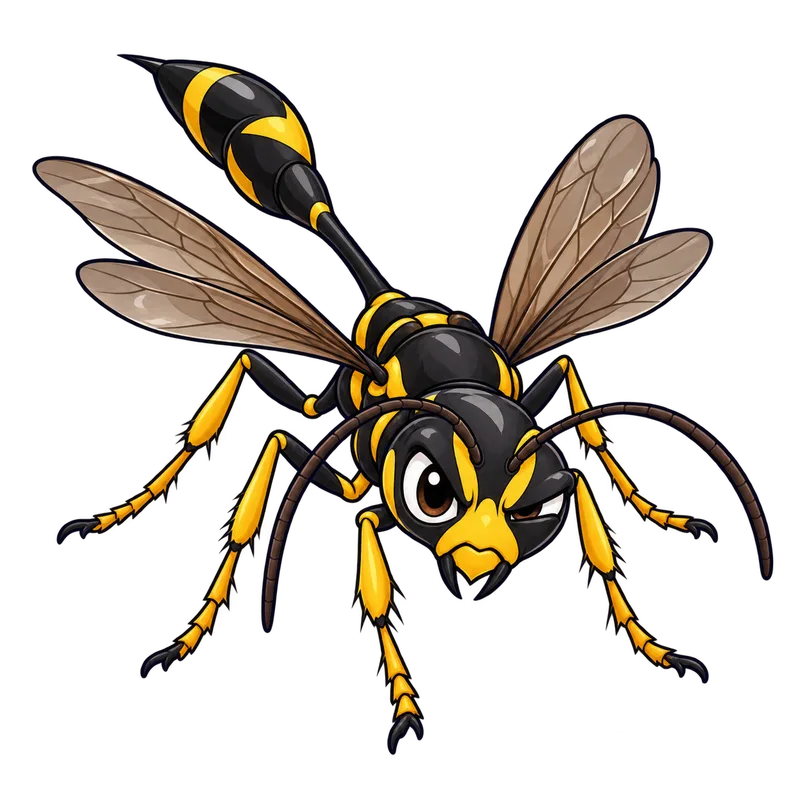
No, mud daubers are not dangerous. These solitary wasps have no colony or workers to defend a nest, so they simply ignore people walking by. A female can sting if trapped against skin, but her venom only rates a mild one on the pain scale.
What is actually going on
You're on the porch with a coffee, and there it is again: a long, skinny black wasp with a waist so thin it looks drawn on, flying slow loops under the eave where a little lump of dried mud has appeared. It looks like trouble. It flies like trouble. So, are mud daubers dangerous?
Short answer: no, not in any way that should change your day. Mud daubers are solitary wasps, and that one word, solitary, explains almost everything. The wasps that earn their bad reputation, yellowjackets, paper wasps, hornets, live in colonies full of workers whose job includes defending a shared nest. Get too close and you're dealing with an organized response. A mud dauber has no colony, no workers, and no nest-defense instinct at all. One female builds her own mud cells, stocks them, seals them, and that's the entire operation. Walk under her nest and she'll simply go about her business, because from her perspective you are a large, irrelevant piece of weather.
She does have a stinger, so let's be fair about that. But her venom is built to paralyze spiders, not to hurt large animals, and it shows. On the Schmidt sting pain scale, which rates insect stings from 1 to 4, the black and yellow mud dauber sits at a 1, roughly on par with a fire ant sting. The realistic way to get stung is to trap her against your skin: pulling on a glove she crawled into, grabbing a piece of stacked lumber she's resting on, that sort of thing. She is not looking for a fight, and she will not chase you off the porch.
Here's the part people usually don't expect: that wasp is working for you. Mud daubers hunt spiders to feed their young, and the metallic blue one, the blue mud wasp, specializes in black widows. She finds a widow, paralyzes it, and tucks it into a mud cell as live, preserved food for her larva. The adults also visit flowers for nectar, so they're doing a bit of pollination on the side. You could hardly design a better tenant.
How to tell for sure
The classic worry goes like this: "It's black and yellow and buzzing near my house, so it must be dangerous." That's the mix-up worth fixing, because mud daubers get mistaken for aggressive social wasps all the time, and the differences are easy to see once you know where to look.
Start with the waist. A mud dauber has a petiole, a long, thread-thin stalk connecting the middle of the body to the abdomen, which gives the whole insect a stretched, dangly silhouette. Yellowjackets and paper wasps look thick and compact by comparison, built like little linebackers. Behavior helps too. A mud dauber usually flies alone, slowly and purposefully, often with her legs hanging down. Yellowjackets tend to be busy, twitchy, and very interested in your sandwich.
Color narrows it further. The black and yellow mud dauber is black with yellow markings and banded legs, roughly an inch long. The blue mud wasp is a striking metallic blue-black, hard to confuse with anything else. The organ-pipe mud dauber is solid shiny black. All three share that skinny-waisted look.
Then there's the nest, which is often the giveaway. Mud dauber nests are exactly what the name says: dried mud. The black and yellow species builds a smooth, fist-sized mud blob on a sheltered wall or eave. The organ-pipe species builds neat vertical tubes side by side, like a row of clay pencils or a tiny pipe organ. If you're looking at gray, papery material instead, an open umbrella-shaped comb or a big enclosed football, that's a social wasp nest, and the safety rules change completely. One more quirk: if you see a blue wasp around an old mud nest, she didn't build it. Blue mud wasps carry water to soften abandoned nests, clean them out, and move in, evicting the previous occupant's larvae in the process. Recycling, with an edge.
What usually comes next
For most people, the right move is simply doing nothing, and I know that sounds like lazy advice. Extension services usually advise letting mud daubers be since the danger is low and the spider cleanup is free. That quiet visitor minding her own business while hunting black widows near your garage isn't really a problem.
If the nest still gets on your nerves, maybe right above the front door or on the patio chairs, taking it down is easy and doesn't need heavy protective gear since nobody will defend it. Scrape the mud away with a putty knife, wash the spot with soap and water, and you are finished. Doing this work in the evening when the wasp slows down makes the whole process quiet. Afterward, seal cracks and cover small openings if the same spot keeps drawing builders, and think about clearing out old spider webs nearby, because a wall full of spiders acts like an open invitation to a hunting wasp.
Two situations actually call for action instead of patience. First, mud daubers pack wet mud inside tiny spaces: patio furniture tubes, equipment vents, exhausts, or even aircraft pitot tubes. A mud plug in the wrong spot can break machinery, so check those areas before starting up engines that have sat idle. Second, look around carefully before you start scraping. Mud dauber nests often hide right next to paper wasp or yellowjacket colonies under the same roofline, and messing with the spot could stir up the real aggressors. That is when a quick chore turns complicated.
Sprays are mostly unnecessary, and that is not just softhearted thinking. Chemical treatment only makes real sense if someone living in the house has a confirmed wasp venom allergy or the nest sits right in a heavily traveled walkway. When you do use a spray, the product label controls everything: when to use it, what gear to put on, and how to throw away the container. The label is the law, not a casual hint, and no article online can replace it.
When to get help
A mud dauber sting, on those rare times it occurs, is usually just a wash it with soap, put ice on it, and forget it sort of thing. The situation changes entirely with an allergic reaction, which has zero to do with how gentle the wasp is. Anyone sensitive to venom can react badly to any sting. If someone shows signs like chest tightness, swelling around the face or mouth, trouble breathing, hives everywhere, extreme dizziness, or a rapid heartbeat after a sting, treat it immediately: call 911 or Poison Control at 1-800-222-1222 for help. Do not wait to see if things improve on their own.
Bring in a licensed pest professional when nests sit in spots you cannot safely reach, when a family member has a known allergy, or when mud nests mix with an active yellowjacket or hornet colony. That last reason is critical, because the real danger was never the mud dauber; it's the paper nest tucked two feet away that caught you off guard.
One last thing about lookalikes. If you spot a huge dark wasp with a black chest and yellow-tipped legs, particularly around beehives, stay away and do not try handling it yourself. Take a picture from far off and call your state department of agriculture, because tracking invasive hornets is their job and they rely on those tips. The skinny-waisted mud dauber on your porch, though? Let her finish her masonry work in peace. She has earned it.