
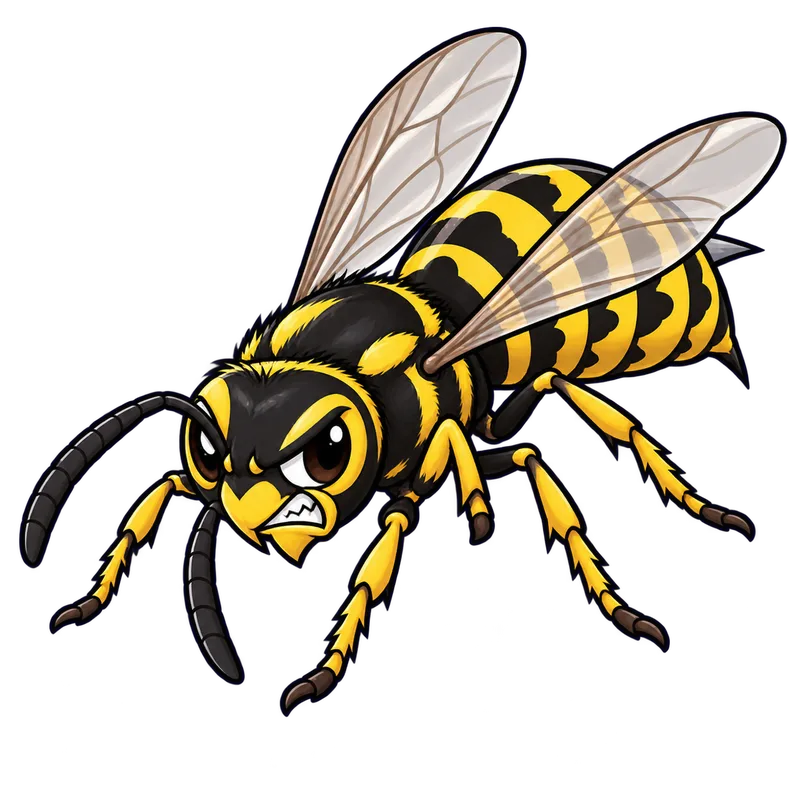
Western yellowjacket
Vespula pensylvanica
- Size
- ~0.5 inches (~13 mm) long for workers
- Color
- Bold black and bright yellow bands
- Habitat
- Subterranean burrows and structural wall voids
- Diet
- Adults eat sugars; larvae require insect protein
- Life cycle
- Annual colony cycle collapsing in late fall
If you are trying to figure out what just buzzed into your lemonade, look for the sharp, high-contrast black and yellow bands splashed across a bare, completely hairless body. Workers measure about half an inch long. They have a narrow waist connecting the middle section to the abdomen, and females carry a smooth, unbarbed stinger.
Identity
People frequently confuse these wasps with honeybees, but bees look like they are wearing a wool sweater because they are covered in dense, fuzzy hairs. Yellowjackets look polished and smooth. You might also worry that you are looking at one of those headline-grabbing giant hornets you hear about on the news. Rest assured, yellowjackets are much smaller than the northern giant hornet or the yellow-legged hornet, neither of which share the distinct yellow-and-black abdominal banding pattern in the same way. Paper wasps look somewhat similar, but they hang their long legs down in flight and build open, umbrella-shaped nests without a paper shell. Yellowjackets keep their legs tucked closer and enclose their entire nest in paper.
Most of the time, you will not notice a yellowjacket colony until mid-to-late summer, when their numbers peak. They prefer to build their nests underground, often taking over abandoned rodent burrows or settling beneath landscape timbers. Sometimes they choose wall voids or attics in your house, which is where things get complicated. Their social structure revolves around an annual cycle. A single queen survives the winter, wakes up in the spring, and starts a small paper nest from chewed wood and saliva. Once her first batch of workers hatches, they take over the foraging and building.
Habitat & behaviour
Early in the season, workers are hunting caterpillars and flies to feed the hungry, protein-loving larvae back at the nest. That makes them great for your garden. But by August and September, the colony priorities shift. The larvae stop needing as much protein, and the adult workers go searching for carbohydrates. That is when they crash your backyard barbecues, plunge into soda cans, and swarm around fallen fruit in the orchard. They are not acting out of spite. They are just trying to fuel up before the cold weather kills off the colony.
Visual variations
Inside the nest, the life cycle moves through four distinct stages. It starts as an egg laid inside a hexagonal paper cell. That egg hatches into a legless, white, grub-like larva that relies entirely on adult workers to bring it chewed-up meat. The larva spins a cap over its cell and pupates, eventually emerging as a fully winged adult.
You will see three different castes in an active colony. The queen is the largest individual, responsible for founding the nest and laying every egg. Workers are sterile females making up the vast majority of what you see buzzing around your yard, measuring right around that half-inch mark. Males, or drones, appear late in the season. Their only job is reproduction, and unlike the females, they lack a stinger entirely.
Why it matters
A yellowjacket nest in a high-traffic area of your yard or inside a structural wall void creates an immediate safety hazard. Because they have smooth stingers, unlike honeybees, a single individual can sting you repeatedly if the nest is disturbed. Lawn mowers passing over a hidden underground entrance routinely trigger defensive swarms.
For most people, a sting means localized pain, redness, and swelling that subsides after a few hours. However, stings can trigger severe, life-threatening allergic reactions in sensitized individuals. If anyone stung shows signs of widespread hives, facial swelling, or difficulty breathing, get emergency medical help right away or contact the Poison Control Helpline at 1-800-222-1222. Do not attempt home medical remedies for systemic reactions.
When nests are tucked deep inside wall voids or attics, leave them alone. Trying to seal the entrance from the outside often forces the trapped wasps straight into your living spaces. If you need to use an insecticide, remember that the product label is a legal document under federal law. Never use unapproved mixtures or exceed label rates, and call a licensed pest control professional if the nest is in a tricky structural spot or if you prefer to hand off the risk entirely.
Similar species
 Bald-faced hornetDolichovespula maculata
 European hornetVespa crabro
 Yellow-legged hornetVespa velutina
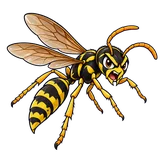 European paper waspPolistes dominula
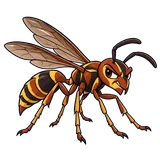 Paper waspsPolistes species
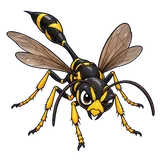 Mud daubersSceliphron and Chalybion species