
Flying ants vs termite swarmers in Florida: which features matter?
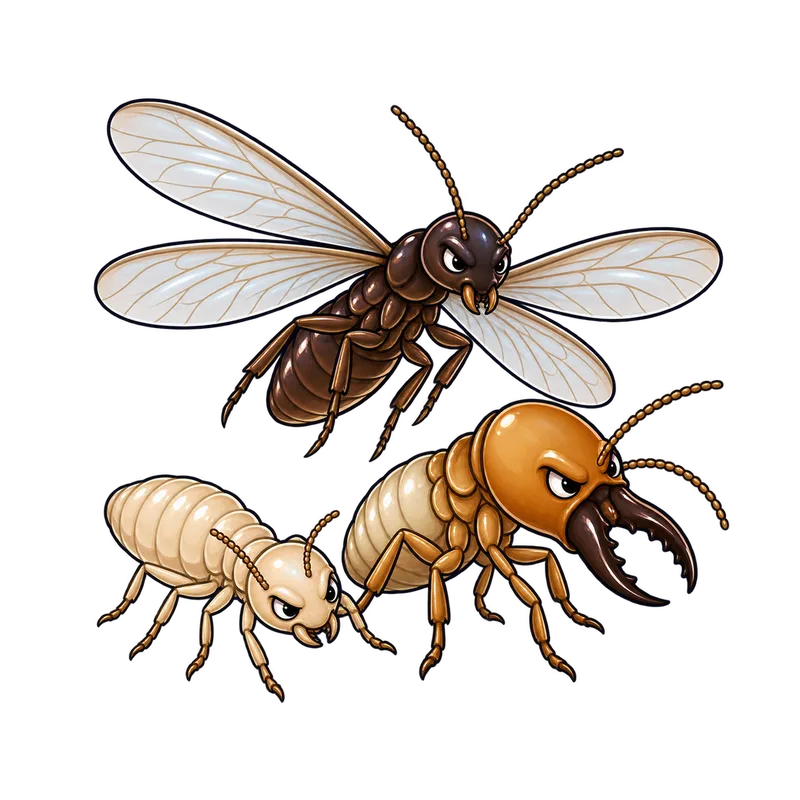
To tell flying ants and termite swarmers apart in Florida, you need to check three physical features. A termite has a thick waist, straight bead-like antennae, and four wings of equal length. An ant features a pinched waist, elbowed antennae, and front wings that are longer than the back pair.
What is actually going on
Imagine stepping into your living room on a warm spring morning and spotting a dozen small insects fluttering toward the sunny window, or crawling in a small heap on the sill. Panic usually sets in right about here because everyone knows those little bugs might be the heralds of an expensive structural nightmare. You reach for a rolled-up magazine, but before you start swinging, you need to know what you are actually looking at. In Florida, the humid climate gives a warm welcome to both winged reproductive ants and termite swarmers looking to start new colonies.
The main point of confusion happens because both pests grow wings at certain times of the year and take to the air in massive swarms. They look remarkably similar to a quick glance, especially when they are buzzing around a floor lamp. Yet, their underlying biology is miles apart. Termites belong to an ancient lineage tied closely to cockroaches, while ants belong to the insect order that includes bees and wasps. Understanding which one has invaded your space changes everything about how you respond, because treating an ant invasion like a termite crisis is a waste of time and money, and vice versa.
People often assume that if an insect has wings and crawls inside a house, it must be an ant, or conversely, that any bug chewing on wood is automatically a termite. Neither assumption holds up under scrutiny. Florida plays host to native subterranean termites, aggressive invasive species like the Formosan termite, and hefty carpenter ants that all make their presence known during the warmer months. To sort them out, you have to look past the general panic and focus on a few specific physical traits that never change.
How to tell for sure
Telling a winged termite from a flying ant usually comes down to three straightforward anatomical checks that you can perform with your naked eye or a basic magnifying glass. First, look at the waist. A termite possesses a thick, broad midsection where the abdomen joins the thorax, much like a straight cigar. An ant features a pinched, narrow waist with a distinct hourglass shape or a small node, giving it that classic separation between body segments.
Second, examine the antennae. Termite antennae are straight and flexible, resembling a tiny string of beads from end to end. Ant antennae are distinctly elbowed, featuring a long first segment with a sharp bend in the middle like a human arm bending at the joint.
Third, check the wings. Termites carry four wings of equal length and identical shape that fold completely flat and extend well past the tip of the abdomen. Ants also have four wings, but the front pair is visibly longer and larger than the hind pair.
You should also look for clues left behind in the environment. Termite swarmers shed their wings almost immediately after landing and pairing off, leaving large, uniform piles of translucent wings on window sills or near baseboards. If you find a neat little drift of identical discarded wings that look like dropped cellophane wrappers, you are usually looking at termite evidence. Carpenter ants, by contrast, rarely leave behind uniform wing piles. Timing matters too, as native subterranean termites usually swarm during daylight hours in spring after a warm rain, while Formosan termites and drywood species prefer the cover of warm, humid evenings and are strongly drawn to outdoor porch lights.
What usually comes next
Once you have checked the specimens and figured out whether you are facing ants or termites, you have to decide what practical step to take next. If you confirm flying ants, your attention shifts toward finding where they are nesting in damp or decaying wood, while keeping in mind that carpenter ants do not actually eat wood for sustenance. They just carve out smooth galleries for housing and push out coarse, sawdust-like debris as they work.
If you confirm termite swarmers inside your living areas, you are usually looking at a sign of an established, mature colony nearby or hidden deep inside your structural framing. Spraying an aerosol insecticide on the flying bugs you see buzzing around a ceiling light gives you a temporary sense of control, but it only kills the messengers. The main colony, potentially housing millions of workers and an egg-laying queen, stays safely tucked away underground or far inside the wall voids.
At this point, your smartest move is a careful, non-destructive check. Inspect accessible timber by tapping it softly with a screwdriver handle to listen for hollow sounds, and check along foundation walls for flattened earthen mud shelter tubes built by subterranean species. For drywood termites, watch for tiny, hard, six-sided droppings gathering in small cone-shaped piles beneath tiny exit holes in wood trim. Note down where you spotted the insects, drop a few intact specimens into a small container if you want to show someone later, and hold off on drilling random holes or applying random store-bought chemicals.
When to get help
There comes a time when a do-it-yourself fix stops making sense and calling a professional becomes the only real option. If you see large numbers of termite swarmers pushing out from indoor wall voids, baseboards, or ceiling cracks, or if you find structural wood that gives way easily to a probe, you need to bring in a licensed structural pest control operator. Professional technicians use specialized tools like moisture meters, sounding equipment, and thermal imaging cameras to track down hidden galleries behind drywall and beneath concrete slabs.
Treating a serious subterranean termite infestation often requires specialized liquid treatments applied in continuous barriers around foundations or the careful placement of slow-acting bait systems built to wipe out the entire colony. Drywood termites might need whole-structure tent fumigation or targeted localized treatments depending on how far the infestation has spread. All pest control applications must strictly follow the product label directions set by federal and state regulatory agencies, ensuring that treatments are handled safely and effectively.
If you or anyone in your household is dealing with skin irritation, suspected insect bites, or allergic symptoms, keep in mind that pest control technicians do not diagnose medical conditions. Any health worries, skin marks, or adverse physical reactions mean you should talk right away to a licensed clinician, visit an urgent care facility, or call your local poison control center.