
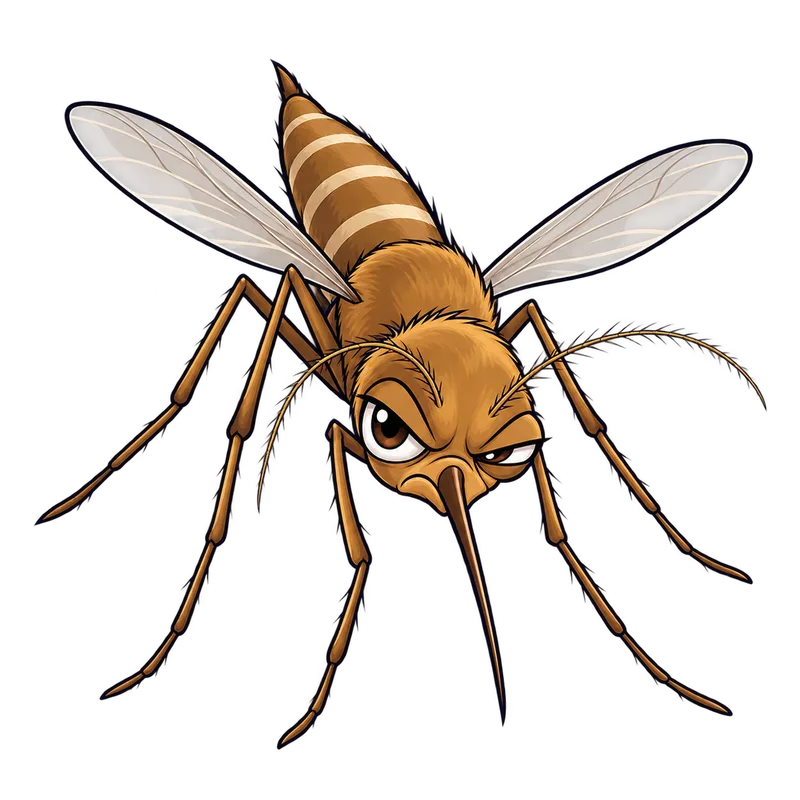
Northern house mosquito
Culex pipiens
- Size
- 4 to 10 mm
- Color
- Brownish to dull greyish-brown
- Habitat
- Standing water and sheltered structural voids
- Diet
- Plant nectar, bird blood, and mammalian blood
- Life cycle
- Holometabolous, taking 7 to 10 days
The Northern house mosquito is a widespread, unassuming insect that you usually notice only when it starts humming near your ear in the dark. It belongs to a complex of closely related species and variants that look nearly identical to the naked eye. Finding one indoors usually means a sheltered breeding spot is hiding nearby, whether that is a clogged gutter, an unkept rain barrel, or a saucer beneath a potted plant.
Identity
The Northern house mosquito is not a single, neatly defined animal. It is a cosmopolitan species complex, meaning it gathers a family of sibling species and physiological variants under one heading.
To the naked eye, identifying this pest is tricky because it shares traits with many other flies. You are looking at a creature measuring 4 to 10 mm in body length with slender legs and a pair of 3 to 6 mm membranous wings fringed with small scales. Its coloration is a nondescript brownish to dull greyish-brown, lacking the bold white or silver bands found on other common biting mosquitoes.
Under magnification, the resting posture gives it away. The adult holds its abdomen parallel to the resting surface, unlike certain other mosquitoes that tilt their entire bodies at a sharp angle. Females possess short maxillary palps and a long, forward-projecting proboscis, while males carry densely plumose or feathery antennae and feed exclusively on plant juices instead of blood.
Habitat & behaviour
This mosquito needs standing or still water to complete its early life stages. Natural bodies of water like ponds, swamps, and sluggish drainage ditches serve as seasonal nurseries, but urban settings provide equal opportunity.
Catch basins, unmaintained swimming pools, discarded tires, birdbaths, and clogged rain barrels act as magnets for egg-laying females. The water does not even need to be clean. These mosquitoes happily colonize nutrient-rich, polluted water in man-made containers.
Adult activity peaks from dusk to dawn, making them strictly nocturnal and crepuscular hunters. During bright daylight, they retreat to cool, dark, and humid harborage areas such as dense grass, shrubs, outbuildings, cellars, and crawl spaces. Their flight range typically spans close proximity to their breeding pool, though they can travel up to 2 miles under favorable wind conditions.
Visual variations
The life cycle rolls through four distinct forms. The journey begins on the surface of standing water, where a female deposits 100 to 300 dark, elongated eggs glued vertically together into a rigid, boat-shaped floating raft.
Once those eggs hatch in warm weather, out pop the larvae, commonly known as wrigglers. These legless aquatic creatures feature a dark head capsule, a widened thorax, and a slender abdomen ending in an elongated breathing tube called a siphon. They hang head-downward at an angle from the surface film, using the siphon as a snorkel.
After four growth stages, the larva transforms into a pupa, or tumbler. This comma-shaped aquatic form has an enlarged cephalothorax equipped with a pair of respiratory trumpets. Tumblers do not feed, but they react to shadows by diving rapidly in a tumbling motion.
The adult emerges from the pupal skin ready to fly. Females require sugar for energy and periodic blood meals to mature their eggs. In contrast, males live short lives feeding only on plant nectars, fruit juices, and sap.
Why it matters
The presence of the Northern house mosquito in a yard or structure is more than a nocturnal nuisance. While the male poses no threat, the blood-seeking female inflicts itchy, localized skin reactions through an immune response to her injected saliva.
More critically, this species serves as a primary amplification and bridge vector for West Nile virus, St. Louis encephalitis, and other pathogens that move from bird populations to humans and domestic animals. They also vector canine heartworm to dogs and equine encephalitis to horses.
As autumn temperatures drop, mated female mosquitoes seek shelter from the cold by aggregating on sun-exposed exterior walls and slipping into structural gaps, attics, and wall voids to enter a state of reproductive diapause. When indoor heating or winter warm spells wake them early, they wander into living quarters, collecting on windowsills as dormant houseguests rather than active breeders.
When trying to separate this pest from lookalikes, look at the wings and posture. Anopheles mosquitoes rest at a 45-degree angle with spotted wings and long palps, while Aedes species feature striking white leg bands and bite aggressively during the daytime. Crane flies and non-biting midges are often mistaken for giant mosquitoes, but crane flies lack biting mouthparts entirely, and midges lack the characteristic wing scales of true mosquitoes.
Similar species
 Southern house mosquitoCulex quinquefasciatus
 Western encephalitis mosquitoCulex tarsalis
 Eastern treehole mosquitoAedes triseriatus
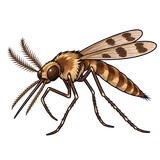 Common malaria mosquitoAnopheles quadrimaculatus
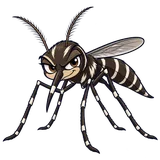 Saltmarsh mosquitoesAedes species
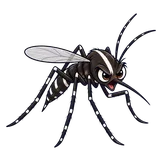 Asian tiger mosquitoAedes albopictus