
What does an Asian tiger mosquito look like?
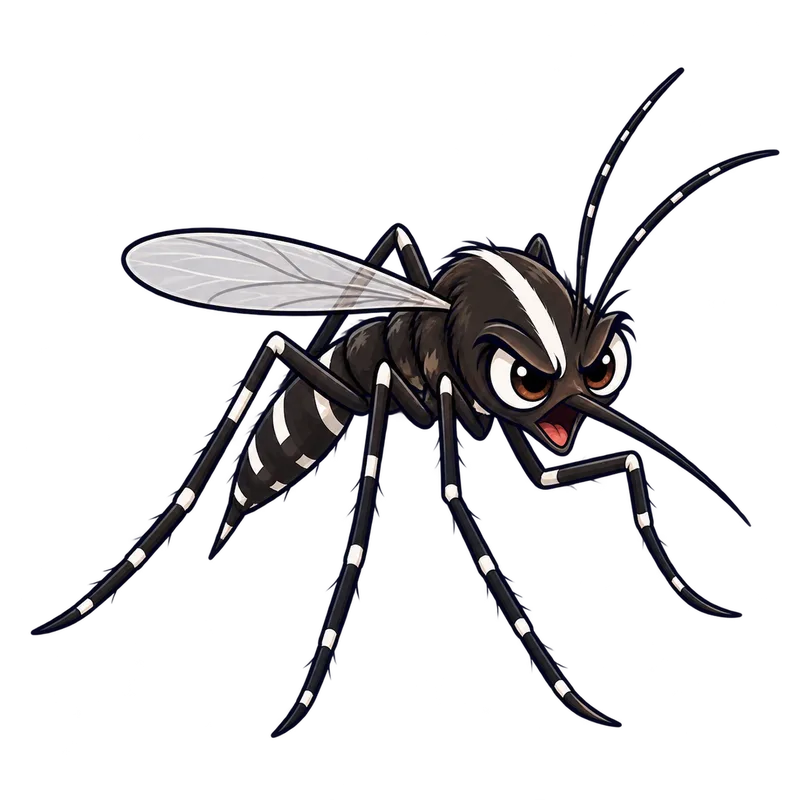
The Asian tiger mosquito is a small insect about 5 mm long with jet black or dark gray coloring. It features distinct white rings on its legs and one single, solid white stripe running down the middle of its dark back.
What is actually going on
Picture a Saturday afternoon on the patio. The sun is still high, the iced tea is sweating on the table, and something keeps landing on your ankle. You look down and see a small black mosquito with what look like white stripes on its legs, calmly feeding at three in the afternoon. That is the moment most people first meet the Asian tiger mosquito, and it is also the moment most people get confused, because everyone knows mosquitoes come out at dusk. This one did not get the memo.
Here is the short answer. The Asian tiger mosquito, Aedes albopictus, is a small mosquito, roughly 5 mm long in the body, about the thickness of a pencil lead, with black-and-white banded legs and one single, solid white stripe running down the middle of its dark back. That stripe is the tell. Think of a black sports car with one white racing stripe painted down the hood. If you can see that line, you are almost certainly looking at a tiger mosquito and not one of the dozen other banded mosquitoes in your yard.
The legs deserve a second look, because they are what most people notice first. They are long and black with bright white rings, as if the insect is wearing tiny striped knee socks. The abdomen carries white bands and spots too, so the whole insect reads as sharply black and white rather than the brownish, muddy look of an ordinary house mosquito. And then there is the behavior, which is half the identification: this species bites in daylight, hardest in the early morning and again in the late afternoon, and it has a fondness for ankles and feet.
One more thing that surprises people. It did not fly in from a swamp across town. Tiger mosquitoes are weak fliers that usually stay within about 200 meters of where they hatched, and they hatch in containers: the saucer under a flowerpot, a forgotten bucket, a clogged gutter, the folds of a tarp. If they are biting you on your patio, they were almost certainly raised within a short walk of your chair. That is useful information, as we will get to.
How to tell for sure
Start with size and color, because those you can judge with the naked eye. The body is about 5 mm, noticeably smaller than the big, lumbering mosquitoes people call skeeter hawks, and the base color is a true jet black or very dark gray, not tan or brown. If the insect on your arm is large, brownish, and droning, it is something else.
The legs come next. Look for clean, alternating black and white bands, like striped socks pulled up to the knees. Plenty of mosquitoes have some pale markings on their legs, though, so do not stop there. This is where most backyard identifications go wrong.
The decisive check is the stripe on the back, and for that you usually want a 10x hand lens, the cheap kind sold for looking at plants or stamps. Catch the mosquito without crushing it, ideally in a small container or a pill bottle, because squashing rubs off the tiny scales that create the pattern, and a rubbed specimen can become genuinely hard to identify. Under the lens, look at the top of the thorax, the section just behind the head. An Asian tiger mosquito has one single, unbroken white line running down the center. Not two lines, not a pattern, not a curve. One stripe.
That detail matters because its closest lookalike, the yellow fever mosquito, Aedes aegypti, also has the black body, the striped socks, and the same daytime biting habit. The difference is on the back: the yellow fever mosquito wears a white marking shaped like a lyre, two curves that fork outward, instead of one straight line. If you are squinting at a curved, wishbone-like pattern, that is not the tiger. Several native American mosquitoes also have banded legs or pale spots, but they lack that single central stripe, so the stripe remains your anchor.
A quick word about the giant mosquito that bangs around your porch light and terrifies everyone. That is a crane fly, and it is not a mosquito at all. It can be 15 to 25 mm long, several times the size of a tiger mosquito, with absurdly long, fragile legs, and it has no biting mouthparts whatsoever. It cannot bite you, your kids, or your dog. If the insect is huge and clumsy, relax and open a window for it.
Two smaller details can help if you get a good look. Males have noticeably feathery antennae, bottle-brush affairs they use to hear females, while females, the ones that bite, have thin, thread-like antennae. And if you watch one resting, tiger mosquitoes hold their body more or less parallel to the surface, head tipped down toward the skin, rather than sticking their rear end up at an angle the way some other mosquitoes do. None of these alone settles the question, but together with the stripe they build a solid case.
What usually comes next
So the stripe checks out, or close enough that you are fairly sure the ankle-biter is a tiger mosquito. Fair enough. Now what? Here is the part people get backwards: the real question is not which spray to buy, it is where the water is. This species breeds in small containers and barely travels, so the ones biting you grew up nearby. Annoying, yes, but it also means you can usually do something real about them yourself.
Take a walk around your property the way you would after a rainstorm, hunting for anything that holds water for more than a few days. The usual suspects: saucers under potted plants, a bucket abandoned by the hose, kids' toys flipped the wrong way, birdbaths nobody has scrubbed since spring, sagging tarps over the grill or the firewood, clogged rain gutters, and the classic offender, a tire or two behind the garage. One wrinkle worth knowing: the eggs are laid just above the waterline and can survive dry for months, so that innocent-looking empty pot that held water last month is not off the hook. Dump what you can, scrub what you keep, store what you can upside down, and refresh birdbaths and pet bowls regularly. A weekly lap around the yard during the warm months is genuinely the core of controlling this species. Not glamorous, but it works.
While you are at it, fix your expectations about timing. The standard advice to stay inside at dusk is aimed at other mosquitoes. Tiger mosquitoes do most of their biting in the morning and again in the late afternoon, which means the patio coffee and the after-work gardening are your exposure windows. Long sleeves, repellent used according to its label, and screens without holes are the boring, effective answers, as usual. Boring tends to win here.
One honest caveat before you declare victory: if half the neighborhood has standing water, your clean yard only buys you partial relief, because 200 meters of flight range happily includes the neighbor's clogged gutter. At that point the problem stops being a one-household job.
When to get help
Most of the time this is a nuisance you can manage with a hand lens and a weekly water patrol. A few situations, though, stop being a DIY question.
If you have emptied everything you can find and the daytime biting is still relentless, that points to breeding sites you cannot see or cannot reach, and that is a reasonable moment to call your local mosquito control district or a licensed pest control professional. Many areas run surveillance programs for this species, and in places where it is newly arriving, your report actually helps them map it. Anything beyond what you do yourself, especially treatment applied on a larger scale, belongs to licensed applicators working from the product label, not to backyard improvisation.
On the health side, keep a level head without being dismissive. A normal bite is an itchy welt caused by your reaction to the mosquito's saliva, and it fades on its own. What warrants a call to a clinician is anything past that: a bite area that becomes increasingly red, swollen, warm or oozing, which can signal infection, a severe or spreading allergic reaction, or a fever, headache, rash or joint pain showing up in the days after bites. Tiger mosquitoes are capable of carrying a long list of viruses, including dengue, chikungunya, Zika and West Nile, though actual transmission depends heavily on where you live, so symptoms plus recent bites are a conversation for a doctor, not for a search engine. And if a reaction looks severe or sudden, treat it as urgent and contact emergency services or poison control as appropriate.
The short version: learn the stripe, dump the water, and hand the rest to the professionals when it outgrows your yard.