
What would happen if mosquitoes went extinct?
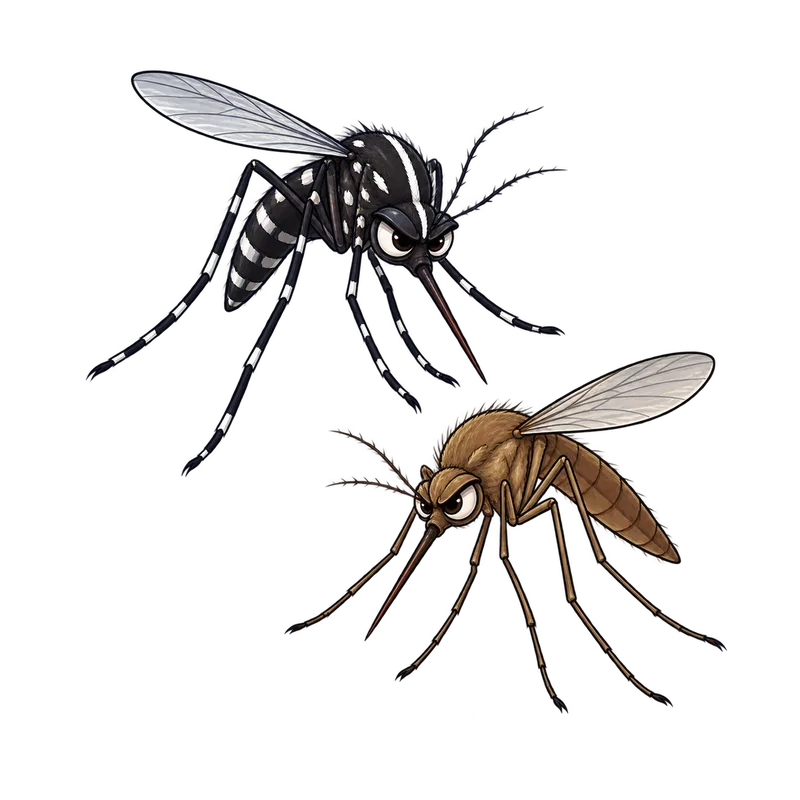
If every mosquito on Earth vanished tomorrow, human and animal health would improve dramatically, and most ecosystems would barely shrug. The transmission cycles for diseases like malaria, dengue, and West Nile virus would stop entirely. Freshwater food webs would survive just fine because other insects like midges would easily fill the gap.
What is actually going on
Picture a July evening on the back porch. The grill is cooling down, the dog is flopped in the grass, and something whines past your ear at exactly the pitch that makes a grown adult swat at the air like a malfunctioning windmill. In that moment, a world with zero mosquitoes sounds less like an ecology question and more like a fantasy worth funding.
Here is the honest answer: if every mosquito on Earth vanished tomorrow, human and animal health would improve dramatically, and most ecosystems would barely shrug. Those are the two halves people tend to get backwards. We assume wiping out an entire insect family would unravel the food web, and we underestimate how much disease would disappear. It is closer to the opposite.
Start with the disease side. Mosquitoes are the only creatures on the planet that transmit malaria, because the malaria parasite must complete part of its life cycle inside an Anopheles mosquito before it can infect a person. Take away the mosquito and the parasite has nowhere to go. The same logic applies to dengue, Zika, chikungunya, yellow fever, West Nile virus, and the heartworm that ends up in dogs. These pathogens do not float around in the air waiting for a ride. They depend on specific mosquito species as living incubators, and without those species the transmission cycle simply stops. For the roughly half of humanity living in malaria-risk regions, and for every dog owner who pays for heartworm prevention, that is not a small thing.
Now the food web. Mosquitoes do feed other animals, especially in their larval stage, when they wriggle around in ponds and puddles getting eaten by fish, dragonfly nymphs, and anything else with an appetite. But here is the part that surprises people: mosquitoes are a side dish, not the main course. Non-biting midges, the harmless swarming specks you bike through at dusk, vastly outnumber mosquitoes in most freshwater habitats. Their larvae, called bloodworms, form one of the biggest food bases for freshwater fish anywhere. If mosquitoes disappeared, midges, mayflies, caddisflies, and their cousins would fill the space with barely a ripple. Birds and bats are opportunists. They eat whatever flies thick and slow, and mosquitoes have never been the only item on that menu.
How to tell for sure
Part of judging the claim that mosquito extinction would collapse nature is knowing what an actual mosquito is, because most of the flying specks people blame on mosquitoes are not mosquitoes at all.
Take the crane fly, the big gangly thing that blunders into your porch light like a glider that lost its pilot. It looks like a mosquito scaled up to horror-movie size, and plenty of people call it a mosquito hawk and assume it either bites or hunts mosquitoes. It does neither. Crane flies cannot bite, have no interest in your blood, and the adults mostly sip nectar or eat nothing at all during their short lives. They are decoration with wings.
Then there are the midges, the clouds of tiny flies hovering over the yard at dusk. Most are chironomids, non-biting midges, and they are the real workhorses of the aquatic food supply. A true mosquito is usually a more deliberate flier: slender body, long legs, a visible needle-like mouthpart called a proboscis, and that unmistakable high whine. If it lands on you and you feel nothing until the itch shows up later, that was a female mosquito. If it swarms in a column over the patio and never lands on anyone, it is usually a midge.
One more identity check worth having: only female mosquitoes bite, and only because they need the protein in blood to develop their eggs. Males, of every species, spend their whole lives on flowers sipping nectar, which means the male mosquito is technically a pollinator and a complete innocent. And out of the more than 3,500 mosquito species in the world, only a small slice, mostly in the Anopheles, Culex, and Aedes groups, ever bite humans or carry human disease. North America has somewhere around 150 to 170 species, and the vast majority want nothing to do with you. When people talk about getting rid of mosquitoes, they usually mean a handful of species. The rest are bystanders.
What usually comes next
Since nobody is actually going to push the extinction button, the useful question is what to do about the mosquitoes you already have. And here is where the good news hides: the ones biting you at home are usually the ones breeding in your own yard, which means you have real leverage over them.
Mosquito larvae need standing water, full stop. You have probably seen them without knowing it: little dark comma-shaped wrigglers twitching up and down in a neglected birdbath, a clogged gutter, a flowerpot saucer, or that bucket behind the shed you keep meaning to deal with. Dump, scrub, or empty anything holding water once a week and you break the cycle before the biting generation ever hatches. It is unglamorous work, and it beats almost every gadget ever sold. On that note, bug zappers kill almost no mosquitoes compared to the harmless insects they fry, and ultrasonic repellent devices have flunked every controlled test thrown at them. The mosquitoes, reportedly, are unbothered.
For water you cannot dump, like a rain barrel or an ornamental pond, there are larvicides based on Bti, a naturally occurring soil bacterium sold as dunks or granules. Bti is oddly elegant: it makes proteins toxic specifically to the larvae of mosquitoes and a few close relatives, while leaving fish, birds, pets, and people alone. As with any pesticide, the label is the instructions, not a suggestion. For protecting your skin, repellents with DEET, picaridin, IR3535, or oil of lemon eucalyptus are the ones that hold up in testing, with the usual age caveats for young children, and permethrin is for treating clothing and gear only, never skin.
The bigger point is that nobody serious is proposing to erase all 3,500 species. Humans have never actually eradicated a single insect species, and current research programs aim much narrower: they go after the specific disease carriers, like the main African malaria mosquitoes, using genetic tools or sterile male releases that leave the rest of the family, and the food web, untouched. That is the realistic version of your porch fantasy.
When to get help
Most mosquito bites are an itchy nuisance and nothing more. But there are lines you should not try to manage on your own.
If someone develops swelling of the face or throat, trouble breathing, or dizziness after bites, that is an emergency, not a wait-and-see. If fever, severe headache, stiff neck, confusion, or joint pain shows up within about two weeks of being bitten, especially after travel, that needs a doctor, because those are the calling cards of West Nile, dengue, and malaria, and only a clinician can sort out which, if any, is involved.
Your dog counts too. Heartworm arrives by mosquito, and prevention and testing belong to your veterinarian, because starting preventive medication on an already infected dog can go badly.
Finally, if the problem is bigger than your birdbath, say a flooded field, a neighborhood outbreak, or a public space, that is licensed vector-control territory. Community spraying and large-scale treatment are professional decisions, made by people accountable for what drifts onto the bees and the garden next door. Your job ends at the gutter and the screen door.