
Are mosquitoes attracted to light?
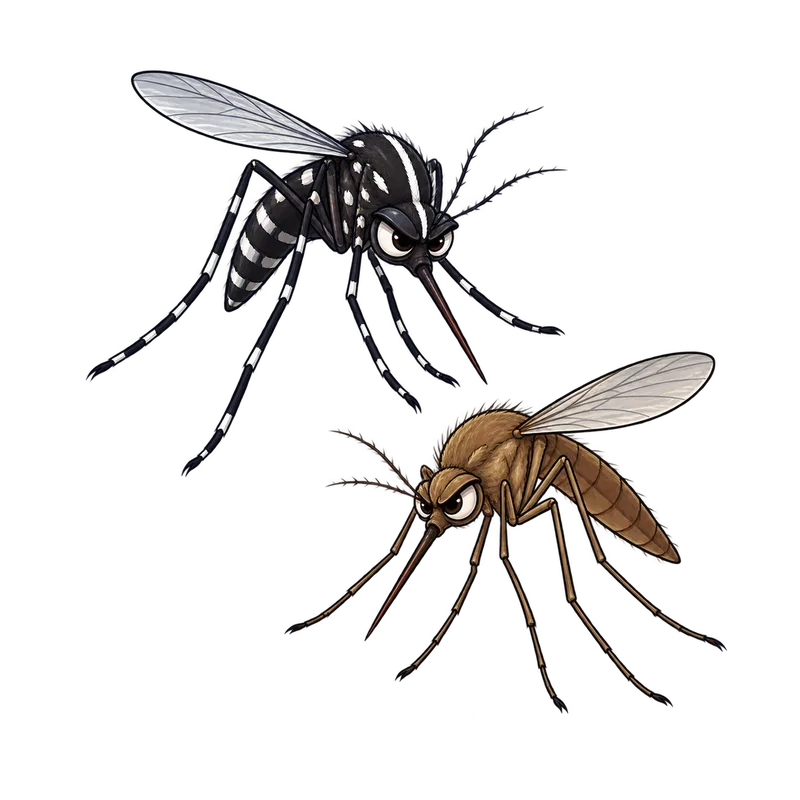
No, mosquitoes are not meaningfully attracted to light. A female mosquito finds people by following the carbon dioxide in their breath, then body heat and the compounds in sweat, so she flies right past a porch bulb. The swarm around outdoor lights is usually non-biting midges, moths and other night-flying insects.
What is actually going on
Picture a summer evening on the back porch. You flip on the light, and within minutes there is a whole cloud of tiny insects swirling around the bulb, tapping the glass, bouncing off the siding. Naturally you assume the mosquitoes are in that crowd, queuing up for their turn at your ankles. So here is the short answer: not really. Mosquitoes are not meaningfully attracted to light, and most of the bugs mobbing your porch fixture are something else entirely.
The confusion is understandable, because a white porch bulb genuinely works like a neon billboard for night-flying insects. Moths, midges, beetles and mayflies navigate by light and will happily swarm a bright fixture all evening. But a female mosquito looking for a blood meal is running a completely different program. She finds you by following an invisible trail of carbon dioxide, the gas you exhale with every breath. That plume drifts downwind and she rides it in like a homing signal, sometimes from dozens of feet away. As she closes in, she switches to visual contrast and movement, and on the final approach she zeroes in on your body heat and the chemical cocktail coming off your skin, things like lactic acid and other compounds in sweat. Light appears nowhere on that menu. A glowing bulb does not smell like breath and does not feel like a warm body, so she will fly straight past it to reach the person sitting underneath it.
Now, to be fair, mosquitoes are not totally indifferent to light. Some species show a weak tendency to orient toward or away from it, and ambient light can nudge their activity patterns. But that is background behavior, not a hunting strategy. It also matters which mosquito we are talking about. The common house mosquitoes in the Culex group bite at dusk and through the night, so they are at least out and about when your lights are on, which is probably where the myth gets its fuel. The Aedes group, including the Asian tiger mosquito with the white-striped legs, bites in daylight and twilight, meaning your porch light is irrelevant to them before it even gets dark. Either way, the light is not what draws them in. You are.
You might reasonably object here: but I always get bitten when the porch light is on. Sure, because that is when you are outside, sitting still, breathing. The light is just the witness, not the accomplice.
How to tell for sure
If the swarm at your light is not mosquitoes, what is it? Usually it is non-biting midges, delicate little flies that look mosquito-ish but lack the long piercing mouthparts and do not bite at all. Near lakes, ponds or rivers, these swarms can be enormous in spring and summer, often joined by mayflies and other aquatic insects. Crane flies, the big gangly ones that look like mosquitoes on stilts, also drift toward lights and also do not bite. Indoors, the tiny flies hovering around your lamp or laptop screen in a dark room are usually fungus gnats from overwatered houseplants, and the fuzzy little moths resting on bathroom walls are drain flies. None of them are after your blood.
A real mosquito is usually identifiable by a few things working together. It has a long, needle-like proboscis sticking out in front (the piercing tube it feeds through), scaled wings, and that whining flight sound you often hear near your ear before you see anything. When it lands, it tends to sit still and probe rather than bounce around the bulb. Timing helps too. If you are getting bitten at dusk or after dark, that is typically a Culex-type mosquito. If the bites come in the morning or late afternoon, an Aedes type is more likely. And one winter exception worth knowing: sluggish, dark flies clustering around windows and light fixtures in January or February are almost always cluster flies waking up in your attic or wall voids, not mosquitoes. Mosquitoes do not overwinter as buzzing adults in your living room.
The practical test is simple. Watch whether the insects at the light ever actually land on people and bite. If the cloud stays glued to the fixture and nobody is getting bitten, you are looking at light-loving lookalikes, and the fix is about the bulb, not about mosquitoes.
What usually comes next
So if the light is innocent, what do you actually do? Start by retiring two gadgets that have been coasting on reputation for decades. The electric bug zapper is the great backyard placebo: it snaps and crackles all night, sounds wonderfully productive, and when researchers have emptied the tray to see what it caught, mosquitoes made up less than 1 percent of the kill. The rest were harmless or beneficial insects, fried for nothing, while the mosquitoes bit you quietly under the patio table, unbothered. Ultrasonic repeller devices are worse, because they do not even put on a show. Controlled tests show they do nothing at all.
Yellow bug bulbs are a different story, though you should calibrate your expectations before buying a multipack. They do not repel anything, and there is no secret anti-mosquito frequency hiding in the glass. Think of them as stealth mode for your porch: the yellow wavelengths are simply harder for most night-flying insects to see, so fewer bugs notice the light and crash your evening. Swapping white bulbs for yellow near doors, adding motion sensors, and aiming fixtures downward instead of out into the yard will genuinely thin the swarm at the entry. It just will not stop a hungry mosquito, because she was never coming for the light in the first place. She was coming for you, remember.
For the mosquitoes themselves, the single most effective move has nothing to do with bulbs: dump the standing water. Once a week, empty birdbaths, flowerpot saucers, buckets, toys, clogged gutters and anything else holding water, because that is where the next generation is quietly growing up. For water you cannot drain, like an ornamental pond or rain barrel, larvicide products containing Bti, a naturally occurring bacterium, kill mosquito larvae specifically and are considered safe for people, pets, birds and fish when used as the label directs. Then protect the person: an EPA-registered repellent with DEET, picaridin, oil of lemon eucalyptus or IR3535, applied exactly as the label says, plus loose long sleeves in light colors when you are out at biting hour. Permethrin-treated clothing adds another layer, but it goes on fabric, never on skin. And keep your window screens tight, because the best mosquito is the one stuck outside wondering what happened.
When to get help
Most mosquito situations are a weekend of water-dumping and a decent repellent away from manageable. Sometimes, though, the sensible move is handing it off. If you have done the source reduction and exclusion work and your yard is still swarming, a licensed pest control professional or your local mosquito abatement district can find breeding sites you cannot see and treat resting vegetation properly. During a public health alert for something like West Nile virus, community-level spraying is coordinated by local agencies, and that is their call to make, not a DIY project with a ladder and good intentions.
Take the same no-heroics approach on the health side. Most bites are just itchy, but mosquitoes in the United States can carry diseases like West Nile virus, and severe reactions happen. If someone develops fever, confusion, severe headache, muscle weakness, dramatic swelling or any sign of anaphylaxis after bites, skip the internet diagnosis and get to a clinician or emergency care. And whichever products you use, the label is the law: follow it exactly, and never improvise your own mixtures or concentrations. The porch light, at least, you can stop worrying about. It was never the problem.