
How can you identify an Asian tiger mosquito without assuming every striped mosquito is one?
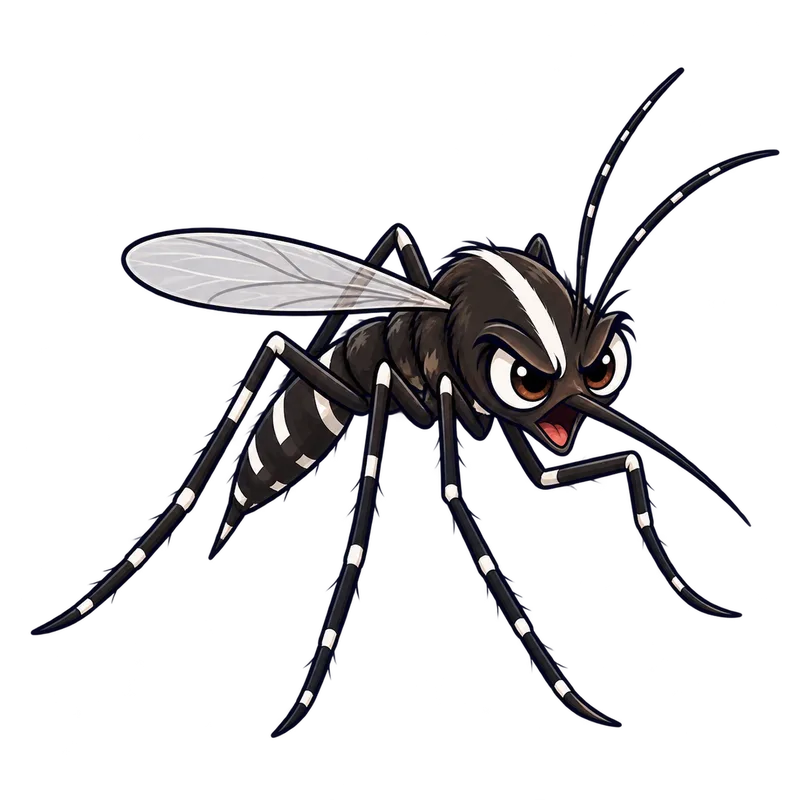
You can identify an Asian tiger mosquito by looking for its small size of about five millimeters and a single sharp silver-white stripe running straight down the center of its head and back. Plenty of harmless flies and native mosquitoes also have striped legs, so you must spot this distinct central line to be sure.
What is actually going on
You are sitting on your back patio on a warm July afternoon, trying to read a book, when a sharp sting on your ankle interrupts you. You look down and swat away a small, neatly patterned insect with distinct black and white stripes on its legs. Naturally, your mind jumps to the Asian tiger mosquito, especially with all the warnings on the news about invasive pests. But before you start dumping out every container in the yard, it helps to pause and ask whether every striped insect you see in broad daylight actually belongs to that notorious species.
The short answer is no, because plenty of harmless flies, native mosquitoes, and fruit-seeking insects sport similar black and white bands. People often assume that any striped daytime biter must be an Asian tiger mosquito, but that shortcut leads to plenty of false alarms. To get it right, you need to look past the obvious leg stripes and focus on the finer details of the insect's body.
Imagine a bright white racing stripe running straight down the hood of a dark sports car. That is the exact visual signature of an Asian tiger mosquito. Its body is about 5 millimeters long, which is roughly the size of a single grain of rice, and features a solid black background. Running down the center of its head and back is a single, sharp silver-white line. If you do not see that distinct central line, you are likely looking at a different creature entirely.
How to tell for sure
When you want to know what you are dealing with, identification usually starts with a clear look at the insect before it flies off. At arm length, you will notice its small size and dark coloring, paired with stark white bands around its legs and abdomen. You will also usually notice its behavior, as these mosquitoes are notoriously aggressive daytime biters, unlike many native species that wait for dusk.
If you capture an intact specimen in a small glass jar and examine it under a 10x hand lens, you can confirm the key diagnostic traits. You are looking for tiny scales along the wing veins, which prove it belongs to the true mosquito family, and that single unbranched white stripe on the top of the thorax, which is the middle section of the body. If the white markings on the back form a curved, lyre-shaped pattern instead of a straight center line, you are actually looking at the yellow fever mosquito.
Common mistakes happen because other insects share parts of this look. Common house flies or stable flies have striped bodies, but they are stocky, have short antennae, and lack the long piercing proboscis, which is the slender mouthpart used for feeding. Invasive fruit flies like the spotted wing drosophila also feature dark body bands and red eyes, but they lack mouthparts designed for biting. Crane flies look like giant mosquitoes on stilts, but they are completely harmless and do not bite at all. If the specimen has been smashed against a wall, the delicate scales on its back usually rub off, making visual identification nearly impossible without specialist laboratory tools like DNA testing.
What usually comes next
Once you spot a suspected tiger mosquito in your yard, the most practical decision you can make is to hunt for standing water within a short radius. These insects have a very limited flight range, and they usually stay within a couple of hundred feet of where they hatched. If they are biting you on your deck, their nursery is almost certainly sitting right in your own garden or your immediate neighbor's yard.
Take a walk around your property and check every artificial container that can hold even a tiny puddle of water. Look inside clogged rain gutters, discarded plastic buckets, unmaintained birdbaths, plant pot saucers, and old tires. Emptying these receptacles and scrubbing their inner walls once a week breaks the breeding cycle entirely. Because these mosquitoes lay drought-resistant eggs just above the waterline, simply tipping out the water is not always enough, so a stiff brush is your best tool for dislodging stuck eggs.
Avoid relying on gadgets like electronic bug zappers or ultrasonic devices, as scientific studies show they do not effectively control mosquito populations and mostly end up killing harmless beneficial insects. Sticking to hands-on source reduction is the most reliable way to lower the local population without overcomplicating things.
When to get help
There are times when handling the situation yourself is no longer the right path. If you or a family member suffer a severe local allergic reaction, develop secondary skin infections from scratching, or experience systemic symptoms such as high fever, severe headaches, or unusual joint pain following insect bites, you should consult a clinician or seek urgent care right away.
If you keep livestock or pets, keep in mind that tiger mosquitoes can transmit canine heartworm to dogs and cats, making it wise to speak with a veterinarian about approved preventive treatments. For municipal-scale issues, or if you suspect an introduction of an exotic invasive species in a region where they are heavily monitored, capture an intact specimen in a secure vial and contact your local vector control agency or university extension office for official confirmation. Regarding chemical control treatments in public spaces or commercial properties, leave those decisions to licensed pesticide applicators who follow strict product label guidelines.