
Asian tiger mosquito vs other Aedes mosquitoes: what can a homeowner identify?
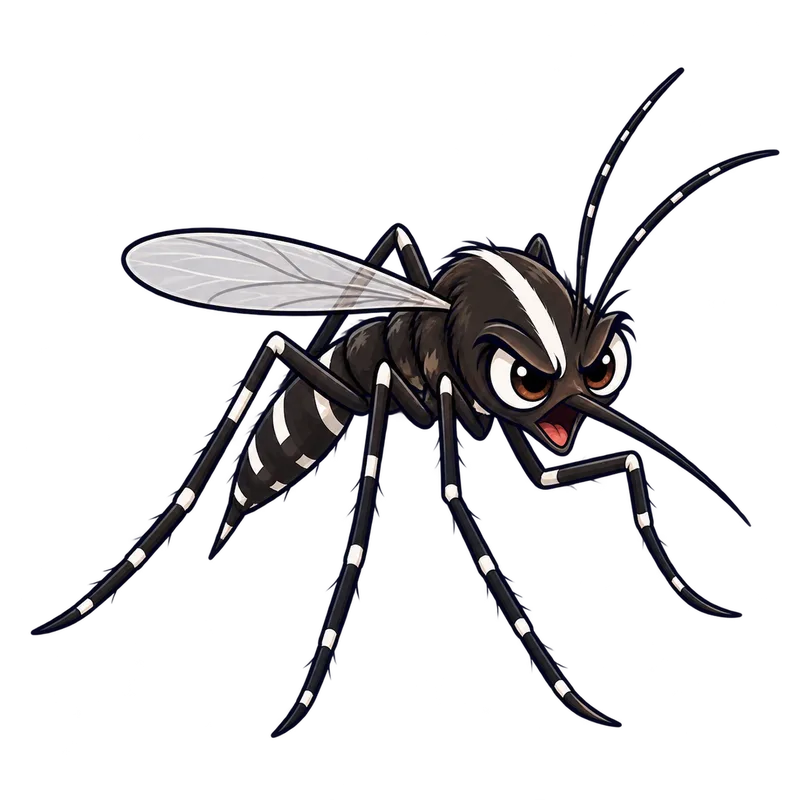
You can identify an Asian tiger mosquito by using a ten-power hand lens to look for a single, sharp, silver-white stripe running down the center of its black thorax. Homeowners can easily narrow the culprit down to the genus level with the naked eye, but confirming the exact species depends on checking those tiny body markings.
What is actually going on
Picture yourself standing on the back patio on a warm Tuesday afternoon. You are trying to enjoy a quiet cup of coffee or pull a few weeds from the flowerbed, but your ankles are taking a beating. You swat at the offender and catch a glimpse of something small and dark, banded with crisp black-and-white stripes on its legs. Naturally, you wonder if you are dealing with the infamous Asian tiger mosquito.
The short answer is that you can safely narrow the culprit down to the genus level with your naked eye, but confirming the exact species takes a bit more effort. Asian tiger mosquitoes belong to a large family of true flies called Culicidae. Unlike many of their nocturnal cousins that prefer to hunt after the sun goes down, these little invaders are aggressive daytime biters. They do not drift in from a swamp a mile away either. Because their typical flight range spans less than two hundred meters, or about six hundred fifty feet, the mosquito biting you in your garden likely hatched somewhere in your own yard or right next door.
This brings us to a common point of confusion. People often assume that any mosquito with striped legs must be an Asian tiger mosquito. In reality, several native and exotic species share those striking black-and-white bands. To complicate matters further, you are usually looking at an insect about five millimeters long, which is roughly the size of a single grain of rice. Trying to check the markings on something that small while it is actively trying to bite you is an exercise in frustration.
How to tell for sure
If you want to move past a guess and know for certain what you are looking at, you usually need to capture a specimen and reach for a ten-power hand lens. Under bright light, inspect the upper side of the middle section of the body, known as the dorsal thorax. An Asian tiger mosquito displays a single, sharp, silver-white longitudinal stripe running right down the exact center of that black surface from the head backward.
This single stripe is the main feature separating the Asian tiger mosquito from its famous relative, the yellow fever mosquito, which instead wears a pair of curved white lines shaped like a lyre. Native floodwater mosquitoes and treehole dwellers lack that solitary solid median line entirely, usually showing a much more muddled mix of brown and gray scaling.
Of course, nature rarely cooperates with our desire for easy identification. If an adult mosquito is old, battered, or has been caught in a sticky trap, the delicate scales on its thorax easily rub off. Once those scales are gone, even a hand lens will not help you, and the insect just looks like an unidentifiable dark speck. Furthermore, if you are trying to identify wrigglers in a bucket of rainwater, forget about using your eyes alone. Larvae require ten to thirty times magnification under a stereo microscope to examine their tiny comb scales and mouthparts. When specimens are damaged or belong to a tricky sibling species, local vector control labs rely on molecular DNA tests to settle the question.
What usually comes next
Finding a striped biter in the yard usually prompts a frantic search for the nearest standing water. Since these mosquitoes deposit individual eggs on damp surfaces just above the waterline in artificial receptacles, your best move is a thorough backyard audit rather than a trip to the hardware store for random gadgets.
Take a walk around the property and look for anything that can hold a cup of water. Flowerpot saucers, clogged roof gutters, discarded plastic tarps, the folds of an old tire, and forgotten pet bowls make ideal nurseries. Emptying, scrubbing, and turning these items over once a week breaks the breeding cycle entirely. If you have an ornamental rain barrel or a permanent water feature that you cannot empty, you can treat it with a biological larvicide containing bacteria that target mosquito larvae without harming birds or pets, making sure to follow the exact instructions printed on the product label.
When to get help
Most of the time, backyard mosquito management is a do-it-yourself exercise in sanitation and personal protection, such as wearing long sleeves and using an approved insect repellent. However, there are clear boundaries where you should hand the job over to someone else.
If aggressive daytime biting continues unabated despite your best efforts to drain every drop of standing water on your property, a hidden neighborhood breeding source is likely fueling the population, and local public health or vector control districts should be notified. You should also contact your local agricultural extension office or health department if you suspect you have found a new population of invasive mosquitoes in an area where they have not previously established.
On the health side of things, mosquito bites are more than an itchy nuisance because these insects can vector various pathogens. If you or a family member develops severe localized reactions, secondary skin infections from scratching, or systemic symptoms like a sudden high fever, severe headache, confusion, stiff neck, or joint pain, stop guessing and contact a healthcare clinician or urgent care facility right away.