
Do mosquito yard sprays work?
Mosquito yard sprays do work, but only for a brief moment and never as a standalone fix. Sunlight, heavy rain, morning dew, and high heat break down the chemical residue within a few days to two weeks. The sprays only target adult mosquitoes that land on treated surfaces and do not stop new insects from flying in or hatching.
What is actually going on
You walk out to the back patio on a warm July evening, carrying a plate of burgers for the grill, and before you even reach the picnic table, three mosquitoes find your ankles. It is the sort of annoyance that makes you reach for your phone to search for a heavy-duty fix, wondering if paying a company to blast your entire yard with chemicals will finally let you sit outside in peace.
To answer the question plainly, mosquito yard sprays do work, but only for a brief moment and never as a standalone magic trick. When you apply a chemical barrier spray to the shady shrubs and tall grass where adult mosquitoes rest during the day, you get an immediate knockdown of the bugs currently hanging out in your yard. The active ingredients, usually synthetic pyrethroids like bifenthrin or permethrin, leave a temporary film on the foliage. When a resting mosquito touches that leaf, it absorbs a lethal dose and drops out of commission.
The catch is that outdoor chemical deposits have a short shelf life. Sunlight, heavy rain, morning dew, and high heat break down the residue within a few days to two weeks. More importantly, chemical sprays only target adult mosquitoes that happen to land on treated surfaces. They do nothing to stop new waves of insects from flying in from neighboring properties or hatching out of unmanaged water sources right in your own yard.
Thinking of a yard spray as a permanent fix is a bit like putting up a temporary shade canopy for a Saturday afternoon barbecue. It creates a comfortable window for your guests on party day, but no one expects that pop-up tent to shield the backyard from winter weather. If you rely on spraying alone without dealing with where mosquitoes breed, you will find yourself paying for repeated treatments every couple of weeks all summer long without ever getting ahead of the problem.
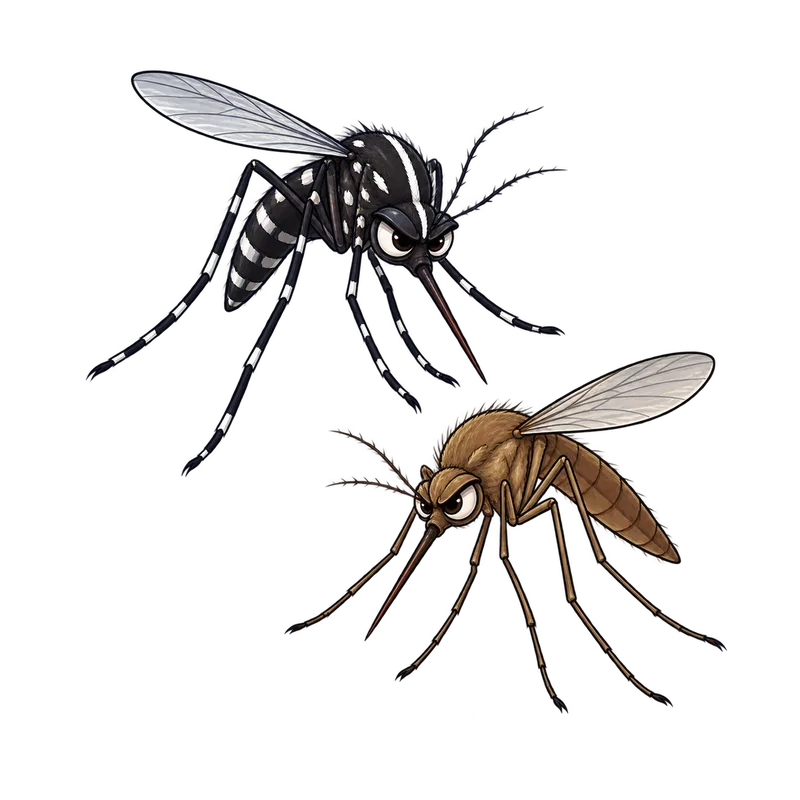
Before you spray or buy anything, you usually need to figure out what kind of biting pests you are actually dealing with, because not everything that buzzes and bites around the yard is a standard mosquito. True mosquitoes belong to the family Culicidae, featuring slender bodies, long and delicate legs, and a distinct piercing mouthpart used for feeding. Non-biting midges look remarkably similar at a glance, but they lack those piercing mouthparts entirely, while tiny biting midges are much smaller, stocky flies with arched thoraxes that demand a completely different control approach.
When you spot a true mosquito resting on an exterior wall or a shady fence post, pay attention to its posture, because it usually tells you a lot about its habits. Mosquitoes in the Culex and Aedes genera rest with their bodies held parallel to the surface, hugging the wall or leaf. If you notice a mosquito tilting its entire body and abdomen upward at a steep forty-five-degree angle relative to the surface, you are usually looking at an Anopheles species.
Knowing your specific nuisance pests helps you track down their local hideouts. If you are being mobbed by aggressive daytime biters, the culprit is usually the Asian tiger mosquito, a compact creature with distinct black and white stripes. These insects are homebodies that usually stay within a short radius of your patio, breeding in tiny artificial receptacles like flowerpot saucers, discarded tires, or clogged rain gutters. On the other hand, if heavy biting starts right at dusk and continues through the night, you are usually dealing with Culex mosquitoes that commute up to two miles from a distant storm drain, marsh, or unmaintained retention pond to reach your porch.
How to tell for sure
Once you realize that sprays only handle half the equation, the most sensible practical decision you can make is to pair any adult treatment with a weekly source reduction routine. If you want fewer mosquitoes in your yard without constantly reapplying chemicals, you have to break their breeding cycle by removing standing water every seven days. Take a Sunday morning walk around your property with a bucket, empty every water-collecting saucer and children's toy, scrub out birdbaths, and clear the leaves blocking your roof gutters so water has nowhere to pool.
This approach forces you to confront a common objection, namely the feeling that walking around dumping water is too minor of a chore to make a noticeable dent in a massive bug population. Yet that weekly discipline is precisely what starves container-breeding mosquitoes of their nurseries. When you combine that physical cleanup with targeted biological controls in permanent water features, such as floating dunks containing bacterial larvicides that safely target developing larvae without harming fish or pets, you cut off the supply of new adults. Spraying the adult resting sites then becomes an occasional backup plan for a special evening rather than a desperate, endless treadmill.
What usually comes next
There are times when a weekend DIY approach is simply not enough, and you need to hand the problem over to trained professionals or public health authorities. If your property shares boundaries with large bodies of standing water, dense wetlands, or agricultural drainage areas that require heavy commercial equipment, call a licensed pest control professional who understands local regulations and commercial application safety.
You should also look to official municipal agencies when local health authorities issue warnings regarding vector-borne disease outbreaks, such as West Nile virus or Eastern Equine encephalitis, which are monitored through regional mosquito trapping networks. Municipalities manage wide-scale truck or aerial treatments during these public health events because individual yard spraying cannot halt a widespread community transmission cycle.
When to get help
On the personal health front, you must consult a clinician or urgent care medical facility immediately if you experience high fever, severe headache, confusion, muscle weakness, or a stiff neck in the weeks following mosquito bites. While ordinary local swelling and itching are normal reactions to insect saliva, severe systemic symptoms require proper medical evaluation. In the event of an accidental pesticide spill, skin absorption, or ingestion while handling yard treatments, call Poison Control right away or seek emergency medical assistance.