
Which standing-water containers should be checked for mosquito larvae?
You should check pretty much anything outside that can hold stationary water for more than four or five days. Common culprits include decorative flowerpot saucers, discarded soda bottle caps, birdbaths, clogged roof gutters, and old tires.
What is actually going on
Picture coming home on a warm Tuesday evening, walking out to the back patio, and noticing that decorative plastic saucer sitting under your potted geranium. It caught a heavy downpour three days ago, and now a tiny soup of dead leaves and stagnant water is sitting in the shade. If you lean in close, you will see a miniature frenzy of tiny hair-thin organisms twitching up and down. That innocent little tray is a luxury maternity ward for mosquitoes, and those little creatures are active larvae ready to launch into your yard by the weekend.
So which standing-water containers should actually be checked? The short answer is pretty much anything outside that can hold even a tiny splash of stationary water for more than four or five days. Mosquitoes do not need a pristine pond or a deep swamp to multiply. A discarded soda bottle cap, a neglected birdbath, a clogged roof gutter twenty feet above your head, or an old tire tossed behind the shed can all produce hundreds of biters in less than a week. If the water sits still and lacks turbulent wave action, it is fair game.
The main reason this happens so fast comes down to simple math. In warm summer weather, a female mosquito lays her eggs either in floating rafts right on the water or tucked neatly just above the waterline on damp container walls. Once those eggs hatch, the larvae feed on suspended organic particles and algae, racing through their growth stages in about five to seven days. They then spend a couple of days as non-feeding pupae before emerging as winged adults. That tight, seven-day window is why occasional rain checks matter more than a once-a-season yard cleanup.
How to tell for sure
When you inspect a suspicious container, you usually know you have mosquito larvae by how they move. People often call them wrigglers because they propel themselves through the water with sharp, jerky body undulations, darting downward whenever a shadow hits the surface. When they stop swimming, they usually hang out right at the surface film because they need atmospheric oxygen to breathe.
Depending on the exact type, they usually hang in specific ways. Common yard mosquitoes, like the Culex species, possess an elongated breathing siphon that pokes through the surface film, leaving the larvae hanging head-downward at an angle. Other varieties, like Anopheles, lack that siphon altogether, so they lie completely horizontal right against the surface. If you see comma-shaped forms that look like tiny aquatic acrobats rather than straight wrigglers, those are pupae, which are just one step away from taking flight.
It helps to clear up a couple of common mix-ups while you are looking around. People frequently panic over crane flies, those giant, gangly insects bouncing against the porch light that look like overgrown mosquitoes. They do not bite, and their larvae live in lawn soil or rotting wood, not in your birdbath. Drain flies and fungus gnats also get mistaken for backyard mosquitoes, but those prefer indoor sink slime or overwatered houseplant soil instead of open rain puddles.
What usually comes next
Once you spot larvae in a container, you generally have one main practical decision to make: can you dump the water right now, or is it attached to something permanent like a rain barrel or an unmaintained garden feature? If it is a flowerpot saucer, a bucket, a children's wading pool, or an old tire, the best move is a weekly draining protocol. Tip it over, scrub the inside walls to wash away any stuck-on eggs, and let it dry out completely.
If the water cannot be drained, such as a backyard water butt or a decorative pond, you usually need a targeted biological larvicide. Products containing Bacillus thuringiensis israelensis, often sold as floating briquets or granules, release a natural bacteria that specifically targets mosquito larvae without harming pets, fish, birds, or humans. If you prefer a physical fix in a closed, non-potable container, a thin film of horticultural oil on the surface can block their breathing tubes and stop them from maturing.
People often wonder if spraying general pesticide bug sprays across the lawn will solve the problem. It usually does not, because barrier sprays only knock down adult mosquitoes resting in the shade while leaving the breeding nursery in the patio saucer completely untouched.
When to get help
There are times when a backyard bucket check turns into a situation that requires a professional or a local agency. If you are dealing with a neglected swimming pool, a failing septic system, or a public catch basin in your neighborhood, those require commercial larvicides or municipal oversight rather than a quick flip with a garden hose.
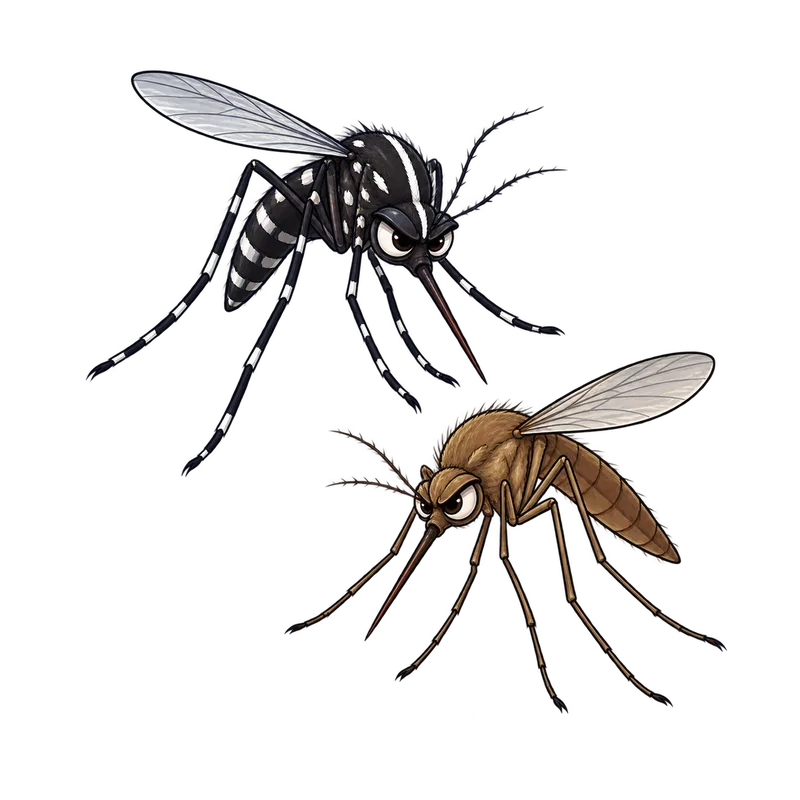
You should also check with local public health authorities if you live in an area tracking specific vector-borne illnesses, or if you find invasive mosquitoes like the Asian tiger mosquito, which features distinct white stripes on its black legs and bites during daylight hours. Whenever pesticide applications require treating storm sewer networks or large structural water systems, leave the job to a licensed pest control operator who follows strict product label rules and environmental safety boundaries.