
Why do mosquitoes bite some people more than others?
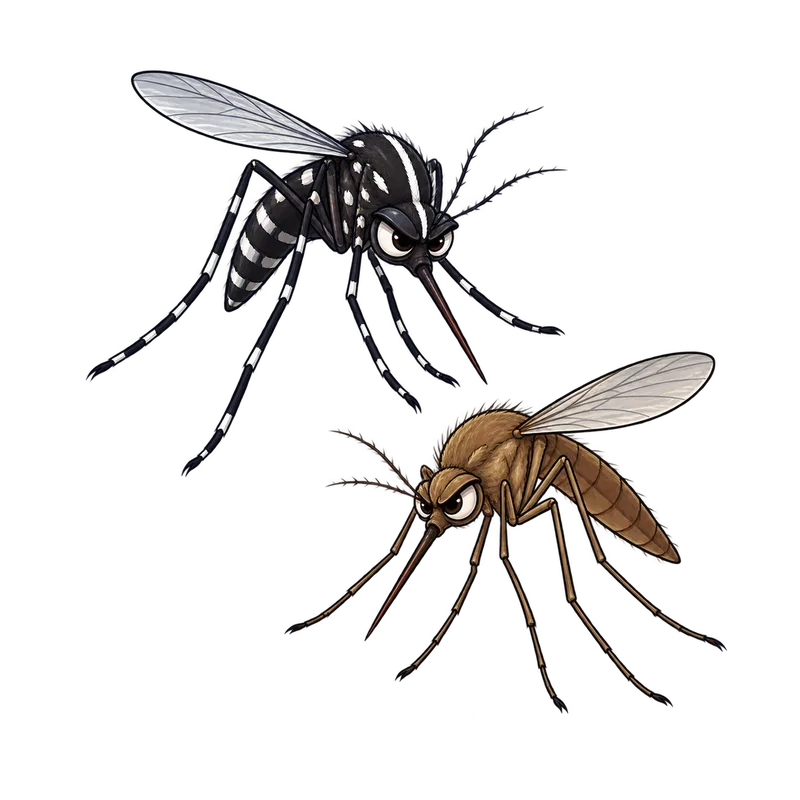
Female mosquitoes bite some people more than others because individuals release different amounts of carbon dioxide, moisture, and heat through their metabolic rate and body mass. Host preference also depends heavily on the specific species of mosquito fluttering around your yard, as many common house mosquitoes have an innate preference for feeding on birds.
What is actually going on
You are sitting on the patio with a friend on a warm evening. Within minutes, you are swatting away half a dozen bugs and scratching your ankles, while your friend sits there completely unbothered, sipping a cold drink. It feels personal, as if the insects simply prefer your company over everyone else at the table. As it turns out, your suspicion is entirely correct, though it has nothing to do with your personality or the sweetness of your blood.
Individual human attractiveness to mosquitoes comes down to a matter of physics and chemistry. Only female mosquitoes bite, because they need the protein and nutrients found in blood to develop their eggs. Male mosquitoes are entirely harmless vegetarians that feed on plant nectar. To find a host, a hungry female uses a built-in sensory hierarchy, acting much like a thermal-homing aircraft tracking invisible plumes of carbon dioxide that you exhale with every breath.
When you breathe faster, generate a higher body temperature, or perspire heavily, you release a larger volume of these chemical and thermal cues. Someone with a higher metabolic rate or a larger body mass naturally puts out more of the carbon dioxide and moisture that mosquitoes use for long-range navigation. As the insect draws closer, your skin surface temperature and the specific organic compounds in your sweat serve as the final landing lights, guiding the bite site selection.
Host preference also depends heavily on the specific species of mosquito fluttering around your yard. While aggressive daytime biters like the Asian tiger mosquito actively hunt humans and mammals, many common house mosquitoes have an innate preference for feeding on birds. If you happen to be sitting near a population that prefers feathered hosts, you might escape attention even if you are radiating plenty of heat and carbon dioxide.
How to tell for sure
Trying to figure out which pest is biting you by looking at the resulting welt is usually a losing battle. Human skin reactions are merely an immune response to the salivary proteins and anticoagulants injected during a feeding, meaning two people bitten by the exact same insect can end up with entirely different marks. A puffy red welt on your arm tells you that you were bitten, but it usually cannot identify the culprit.
For a reliable identification, you usually have to look at the insect itself, though distinguishing between closely related species often requires a microscope or specialist laboratory tests. If you catch a resting adult, you can check its posture. Mosquitoes in the genus Anopheles usually rest at a distinctive forty-five-degree angle with their abdomens pointed up into the air, whereas Culex and Aedes species typically rest parallel to the surface.
You can also look for distinct physical markings. Some species show off bold black-and-white leg bands and a single white stripe down the back, while others stay plain brown with clear, unspotted wings. If the biting pest turns out to be microscopic instead of full mosquito size, you are likely dealing with biting midges, which are tiny flies that pack a surprisingly sharp, burning bite that makes no sense for something so small.
What usually comes next
Faced with an evening of relentless biting, your smartest move is to set up a reliable personal defense routine using a registered bug spray instead of wasting money on unproven gadgets. Skip the bug zappers and ultraviolet traps, since they mostly catch harmless moths and beetles and barely touch the local mosquito population. Instead, grab a proven personal repellent with an active ingredient like DEET, Picaridin, Oil of Lemon Eucalyptus, or IR3535.
When you reach for that bottle, keep in mind that higher concentrations do not give you stronger protection. Products with more than thirty percent DEET, for example, do not repel bugs any better, they simply last longer on your skin before you need another application. If you are heading straight into thick brush, you can also treat your outer layers of clothing with a permethrin spray, which kills insects on contact. Just remember that permethrin belongs strictly on fabric and should never touch bare skin.
When to get help
Most mosquito bites heal on their own within a few days with little more than a bit of annoying itchiness and mild redness. Even so, certain symptoms mean you need to drop everything and call a clinician or head to emergency services right away. Seek professional medical help immediately if you spot signs of a severe allergic reaction or anaphylactic shock, which can look like trouble breathing, a tight throat, swelling around the face or lips, dizziness, or a sudden drop in blood pressure.
You should also check in with a healthcare provider if you develop a secondary bacterial infection from scratching open sores, which usually shows up as pus, spreading redness, or red streaks running out from the bite. In regions where mosquito-borne illnesses are active, any sudden flu-like symptoms, high fevers, pounding headaches, or confusion popping up within two weeks of heavy exposure deserve a prompt medical visit.
When you are dealing with property-wide problems like persistent swarms or standing water in shared spaces, decisions about broad pesticide treatments or professional abatement belong strictly to licensed pest control operators or local public health agencies.