
Do male mosquitoes suck blood?
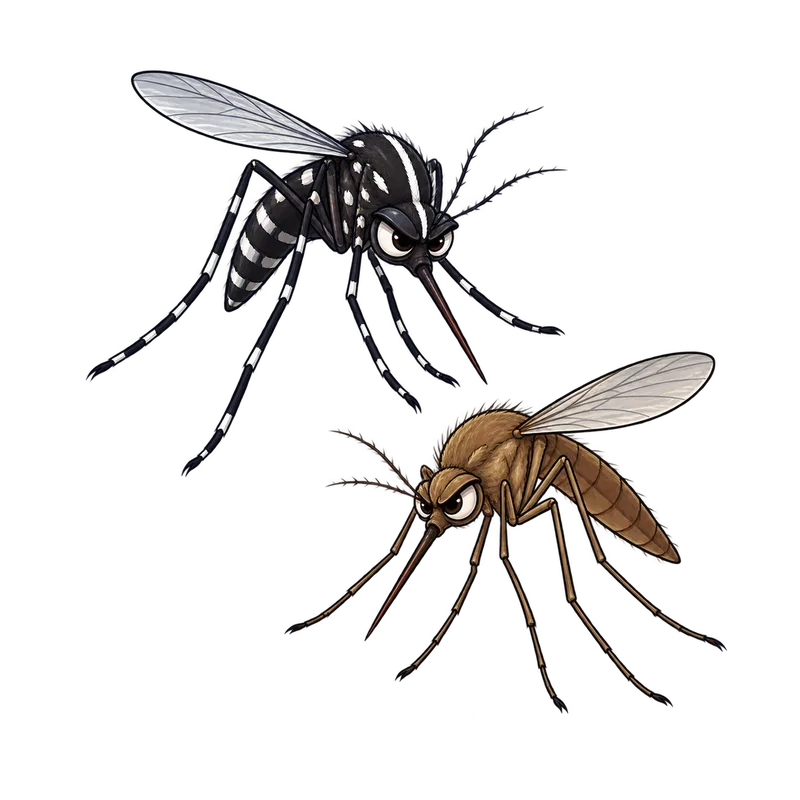
No, male mosquitoes do not suck blood because their mouthparts lack the cutting parts needed to slice skin. Instead, male mosquitoes sip exposed liquids like flower nectar, plant sap, and juice from soft fruit. Because they never take blood, male mosquitoes cannot transmit diseases.
What is actually going on
Picture a summer evening on the back porch. The grill is cooling down, somebody left the porch light on, and a small column of insects is hovering over the hydrangeas like it pays rent there. Someone at the table says the classic line: great, the mosquitoes are out. Here is the answer you can deliver with your lemonade: if those insects are dancing in a swarm like that, they are almost certainly males, and male mosquitoes do not suck blood. Not a little, not when they are desperate, not ever.
This is not good manners on their part. It is equipment. The female mosquito has a mouthpart built like a tiny surgical kit, a bundle of needle-like parts hidden in a sheath, made to slice skin and draw blood. The male does not have the cutting parts. His mouthparts are made for sipping exposed liquids such as flower nectar, plant sap, and juice from soft fruit. You could park a male mosquito on your arm and wait all night. He would not know what to do with you, which must be a strange feeling for an insect with that reputation.
So why is the female the one whining near your ear at 2 a.m.? Because she is not mainly feeding herself. Both sexes run on sugars from flowers for everyday energy, the way people run on coffee and hope. The female needs the protein and iron in blood to develop her eggs. No blood meal, no next generation. She is not attacking out of spite. She is building a nursery, and your ankle is the supply store.
The useful consequence is simple: because males never take blood, they cannot transmit mosquito-borne disease. West Nile, dengue, malaria, all of that moves through the female's blood feeding, not through the male's nectar habit. Epidemiologically speaking, he is a bystander with a sweet tooth.
How to tell for sure
You do not need a laboratory to make a decent call, and the best clue is almost charming. Look at the antennae. A male mosquito carries a pair of conspicuously bushy, feathery antennae, like two tiny bottle brushes or an extravagant mustache. He uses them to hear the wingbeat of females, which is a whole other soap opera. A female's antennae are thin and plain, with only sparse short hairs. Usually you can see the difference with the naked eye if the insect is calm and close, and a cheap hand lens makes it obvious.
Behavior is the second cue. Males gather in those hovering swarms at dusk, often over grass, a shrub, or a marker such as a porch light, waiting for females to fly through. They also linger on flowers. A mosquito working over clover or resting on a bloom is very likely male, since females visit flowers too but spend their hunting time tracking breath and body heat. If an insect lands on you and bites, that settles it in the other direction: it was female, period.
Now the lookalikes, because this is where people get needlessly alarmed. The big, gangly giant mosquito that bumps around the kitchen ceiling in late summer is usually a crane fly, sometimes called a daddy longlegs in the UK. It looks like a mosquito that hit a growth spurt, all legs and clumsiness, and it cannot bite at all. Neither sex has biting mouthparts. The non-biting midges that form huge swarms near ponds and lakes also lack the piercing equipment. Then there is the genuine exception worth filing away: the stable fly, which looks like a slightly grim house fly and hangs around ankles, barns, and beaches. In that species both males and females bite, and it stings like a needle. So the rule that males never bite is rock solid for mosquitoes, horse flies, and black flies, but the stable fly did not get the memo.
If you are thinking, fine, but I got bitten near a swarm, so the swarm must be guilty, that is a fair doubt. Swarms can be near females without being made of females. Males gather where females are likely to pass, and females can be hunting around the edges while the visible cloud is mostly harmless. The swarm is the sign, not necessarily the culprit.
What usually comes next
Once you know the cloud over the lawn is more bachelor party than raiding party, the next move gets easier. Leave the males alone. Blasting a hovering mass of non-biting insects mostly kills insects that were never going to touch you, and it walks right past the actual problem.
The actual problem is still water, because that is where biting females come from. A female lays eggs in quiet water, and the larvae, those little wrigglers jerking around in a forgotten bucket, can grow up there in days. The useful chore is a slow lap around the property once a week in warm weather. Dump the birdbath and refill it, empty plant saucers, check the clogged gutter, flip the wheelbarrow, sort out the tarp that holds a puddle. It is not glamorous, and it is still the single most effective thing a homeowner can do, because it hits females before they ever get wings.
For females already on the wing, protect the person before you declare war on the yard. Use an EPA-registered repellent with DEET, picaridin, or oil of lemon eucalyptus on exposed skin, follow the label, and add long sleeves at dusk when you can. While you are at it, check window and door screens for tears. Ordinary screening keeps mosquitoes out, though the tiniest biting midges can slip through and need finer mesh. The goal is not to turn the yard into a chemistry set. It is to make biting females work harder than they feel like working.
When to get help
A swarm of feathery-antennaed males does not need a professional. A few situations cross the line from interesting trivia into make the call.
On health, keep one limit clear: you cannot tell what bit you from the mark it left. Reactions vary enormously from person to person, and a photo of a welt tells a clinician almost nothing about the species involved. If a bite area swells dramatically, if scratching has broken the skin into open or weeping sores, or if anyone gets hives, spreading redness, fever, dizziness, or trouble breathing after bites, that is a medical question, not a pest question. See a clinician or, for severe reactions, get urgent care. For accidental pesticide exposure, call Poison Control at 1-800-222-1222.
On the pest side, call backup if you are still being bitten hard after dumping standing water, or if the property sits next to a marsh, retention pond, or neglected pool you cannot control. That is the moment for the local mosquito control district or a licensed pest professional. Many municipalities run surveillance programs and will treat breeding sites or respond when virus activity shows up in local mosquitoes. If you truly need the species named, say because someone in the home is at higher risk from mosquito-borne illness, that call belongs to an entomologist or vector control lab with a microscope, not to a guess over a squashed specimen.
Keep the pocket version: the boys drink nectar, the girls want blood for their eggs, and the feathery antennae usually tell you which is which.