
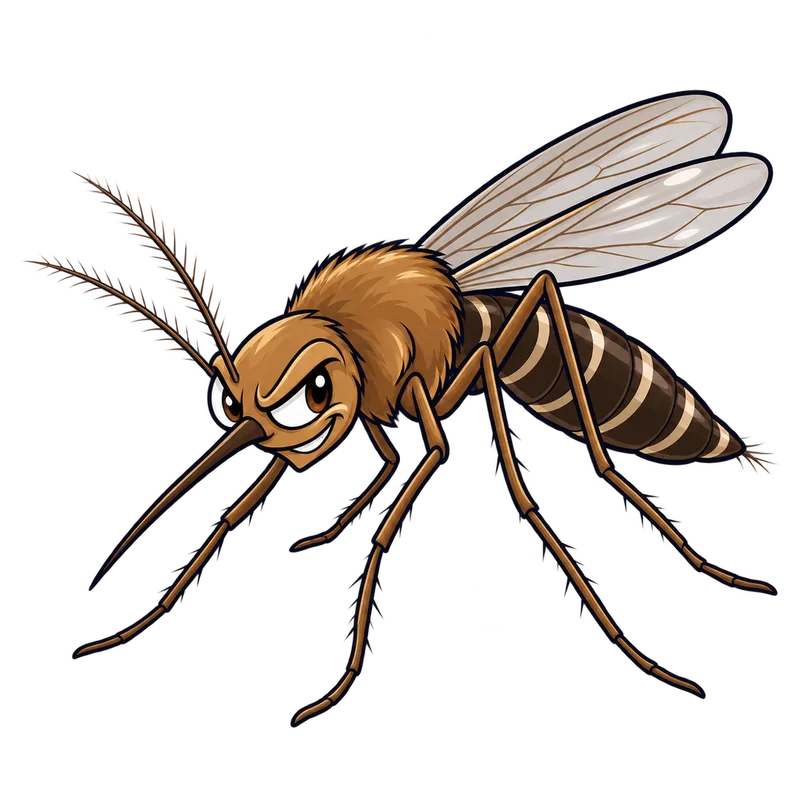
Southern house mosquito
Culex quinquefasciatus
- Size
- 3 to 6 mm up to 4 to 10 mm
- Color
- Plain brownish overall with brown to dark gray abdomen
- Habitat
- Stagnant water and humid indoor or outdoor resting sites
- Diet
- Plant nectar for males; plant nectar and vertebrate blood for females
- Life cycle
- 7 to 10 days from egg to adult in warm conditions
The Southern house mosquito is a plain brownish insect that you will usually notice only after it has started humming around your ear on a warm summer night. Measuring between 3 and 6 mm, with some individuals reaching up to 10 mm, this creature lacks the flashy markings that make other mosquitoes easy to spot from a distance. Its body is brown to dark gray without any distinct silvery-white scale patterns, and its legs do not have the prominent white bands you might see on yard pests like the Asian tiger mosquito.
Identity
If you were to look at it under a hand lens, you would see clear, unspotted forewings with tiny scales along the veins, paired with minute, club-like balancing organs called halteres where the hind wings used to be. Males have distinctly feathery antennae and reduced mouthparts that cannot pierce skin, meaning they feed only on plant nectar and live for about a week. Females have simple, sparse hair whorls on their antennae and an elongated proboscis for piercing and feeding.
Telling this species apart from its northern cousin is nearly impossible in the field since they belong to the same species complex and look almost identical, usually requiring molecular testing or geographic context to separate. More visibly, you can tell it apart from the band-legged house mosquito because it lacks the white ring around its proboscis. Malaria mosquitoes of the Anopheles genus are easily told apart by their spotted wings and the way they rest at a forty-five degree angle with their tails in the air, while the Southern house mosquito rests with its body completely horizontal to the surface. Asian tiger mosquitoes display bold silver-white stripes on their black legs and thorax and prefer to bite during the day, whereas our house mosquito stays unpatterned and hunts mostly after dark. Crane flies are sometimes mistaken for giant mosquitoes, but they are completely harmless, grow up to 38 mm long, and lack biting mouthparts entirely.
Habitat & behaviour
You will find these mosquitoes wherever water stays still long enough to collect organic waste. They are strictly aquatic during their early stages, choosing wastewater lagoons, unmaintained swimming pools, storm drains, birdbaths, planter saucers, and clogged rain gutters over rushing streams or open lakes. Female mosquitoes glue between 100 and 300 eggs together into a tiny, dark floating raft that looks like a speck of soot on the water surface.
From that egg raft hatches the larva, commonly called a wriggler, which hangs head-downward at an angle from the surface film using a prominent breathing tube called a respiratory siphon. When disturbed, the comma-shaped pupa dives downward rapidly using terminal paddles before returning to rest just beneath the surface.
Adults are nocturnal and crepuscular feeders, meaning their peak activity window runs from dusk to dawn. During the bright daytime hours, they avoid sunlight, wind, and dry air by hiding in cool, dark, humid places like dense shrubs, tall grass, crawlspaces, basements, and wall voids. When they enter buildings, they seek out these same sheltered spots to rest or, in the case of mated females, to overwinter until spring.
Visual variations
This mosquito moves through four distinct life stages, changing its shape completely from water to air. The eggs start the process in warm weather by hatching in a couple of days, grouping together vertically into a spindle shaped raft that floats on the surface without any side air sacs.
As a larva, the creature spends its time feeding on tiny bits of organic matter in the water through four growing phases, turning from a pale, almost see through shape into a darker, segmented wriggler with a large head and a chunky chest.
The pupa takes a break from eating, hanging out in the water as a comma shaped form that breathes air using two short horns on its back that poke right through the surface film.
When it reaches the adult stage, the insect steps out through a split in its old skin as a slender fly with long legs, and you can easily tell the boys from the girls. Males show off bushy antennae and live short lives fueled only by plant sap, while females sport simple antennae and a piercing snout that needs a blood meal to develop her eggs.
Why it matters
Finding these mosquitoes around your house brings more trouble than a simple itchy bump, since the species acts as a main carrier for West Nile virus, St. Louis encephalitis, and Eastern equine encephalitis locally, along with canine heartworm for your pets. The females change who they bite as the months go on, feeding mostly on birds early in the year before moving on to people and other mammals when summer heats up, which helps spread diseases from animals to humans.
You cannot name a mosquito species just by looking at a red mark on your skin or a quick photo, and nobody should try to diagnose an illness or figure out a skin reaction from a bite alone. Anyone dealing with a bad reaction, an infected sore, or serious warning signs like a high fever, severe headache, stiff neck, or confusion needs to see a doctor or call poison control right away.
Getting rid of standing water around your yard is the most practical way to cut down where they breed, and any bug sprays or water treatments must follow the product label word for word because those directions are the law. When a property needs heavy duty pest control, that job belongs to licensed mosquito control experts and public health authorities.
Similar species
 Western encephalitis mosquitoCulex tarsalis
 Eastern treehole mosquitoAedes triseriatus
 Common malaria mosquitoAnopheles quadrimaculatus
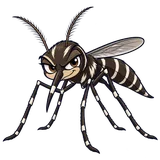 Saltmarsh mosquitoesAedes species
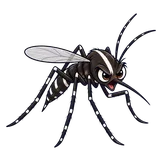 Asian tiger mosquitoAedes albopictus
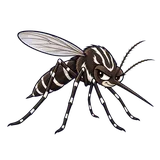 Yellow fever mosquitoAedes aegypti