
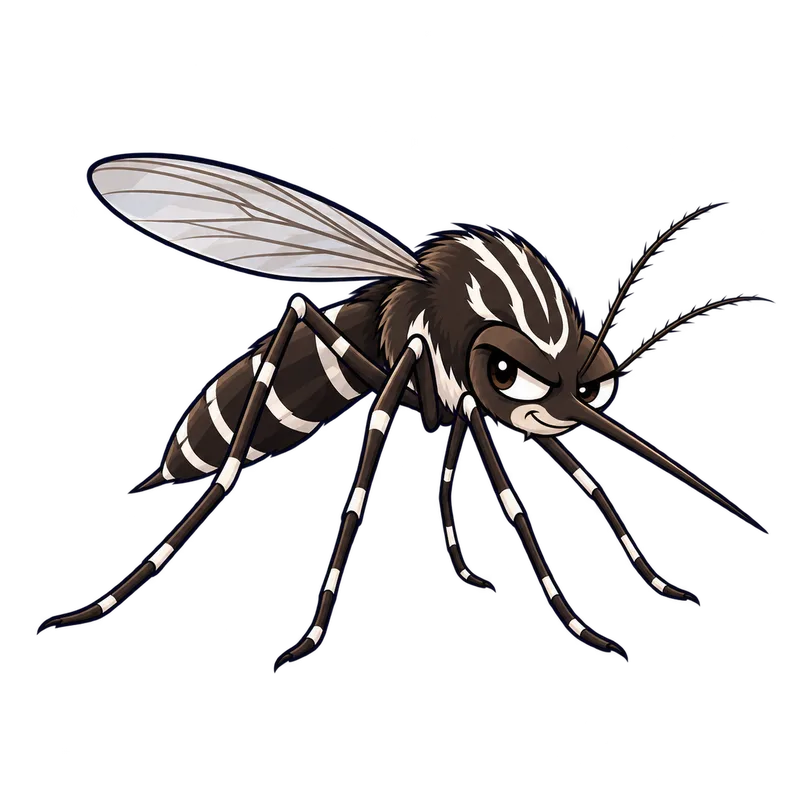
Yellow fever mosquito
Aedes aegypti
- Size
- 3 to 6 mm
- Color
- Dark gray to black with white or silver scale patches
- Habitat
- Tropical and subtropical zones, urban artificial water containers
- Diet
- Females feed on vertebrate blood, males feed on plant nectar
- Life cycle
- Complete metamorphosis through egg, larva, pupa, and adult stages
You are looking at a small, slender fly with a body length stretching anywhere from 3 to 6 mm, though its striking black and white pattern makes it look far more purposeful than its size suggests. The background of the body is a dark gray to nearly solid black, splashed with distinct patches of white or silver scales that wrap around the abdomen and create crisp white bands across the legs. Under a decent magnifying glass, you can see that the single pair of clear, membranous wings has tiny scales lining the veins.
Identity
The head carries a long, slender proboscis used by females for piercing skin, flanked by very short maxillary palps. If you catch one resting on a wall, notice how the longitudinal axis of its body sits completely parallel to the surface. It does not tilt its tail up into the air like an amateur gymnast. Male and female antennae tell a quick story under magnification. Females sport simple whorls of short hair, while males carry dense, feathery antennae designed to tune in to the flight hum of the opposite sex.
Habitat & behaviour
This mosquito is thoroughly domesticated, preferring the company of humans to the deep woods. You will find it in warm, humid southern states and tropical regions worldwide, often hiding indoors in the cool, dark corners of closets, basements, and outbuildings, or lingering on shaded exterior walls and foundation bushes.
Forget the midnight buzz that wakes you up in the dark. This is strictly a daytime biter. Its feeding activity peaks during the early morning hours and late afternoon just before dusk. Females need a protein-rich blood meal to help their eggs mature, which explains why they hunt during active daylight hours when people are moving around yards or sunlit rooms. Males keep entirely to a vegetarian diet, visiting flowering plants to sip nectar, plant sap, and honeydew. Adults rarely travel far from home, usually staying within about 200 meters of the water source where they hatched.
Visual variations
The life of this insect is a tale of complete body transformation, moving through four distinct stages that look nothing alike. It starts as an individual egg, minute and dark, shaped like an elongate oval with a smooth shell that lacks the air floats found on other mosquito eggs.
When the egg floods with water, it hatches into the larval stage, commonly called a wriggler. This aquatic, legless creature features a hardened head capsule, a widened thorax, and a segmented abdomen ending in a rigid breathing siphon tube. The larva hangs head-downward at an angle from the water surface film to breathe, shedding its skin four times as it grows.
Next comes the pupa, known as a tumbler. This stage does not feed at all. It is a comma-shaped creature with an enlarged cephalothorax, breathing through a pair of trumpet-like structures at the water surface while using a flexible abdomen to tumble downward whenever disturbed.
Finally, the adult emerges from the pupal skin. The winged adult splits the casing, rests briefly on the floating debris to let its wings expand and harden, and takes off. The visual divide between the sexes is sharp. Females carry piercing mouthparts and short palps, while males boast those trademark feathery antennae and blunt mouthparts that cannot pierce human skin.
Why it matters
Female bites cause immediate localized skin irritation, raised bumps, and persistent itching as your immune system reacts to the salivary proteins injected during feeding. More importantly, this species serves as a primary global vector capable of transmitting serious viral pathogens such as yellow fever, dengue, Zika, and chikungunya, alongside canine heartworm in pets. Its presence in a residential area means you are sharing space with a highly efficient, synanthropic container breeder that treats your yard as a nursery.
Similar species
 Northern house mosquitoCulex pipiens
 Southern house mosquitoCulex quinquefasciatus
 Western encephalitis mosquitoCulex tarsalis
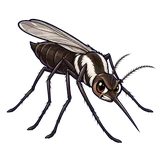 Eastern treehole mosquitoAedes triseriatus
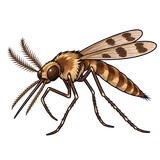 Common malaria mosquitoAnopheles quadrimaculatus
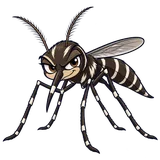 Saltmarsh mosquitoesAedes species