
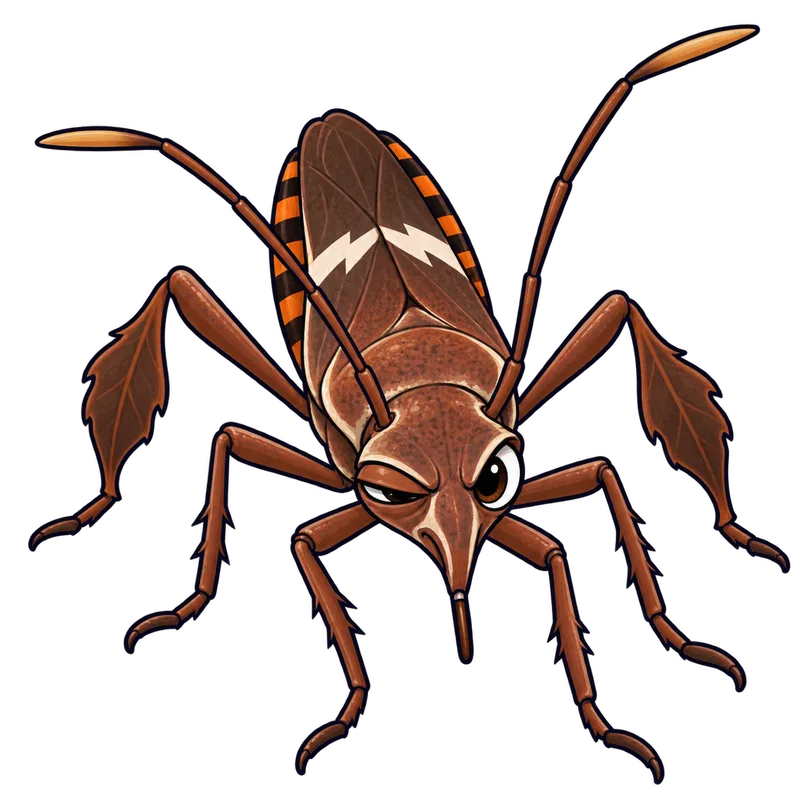
Western conifer seed bug
Leptoglossus occidentalis
- Size
- Not established
- Color
- Not established
- Habitat
- Conifer seeds, migrating to structures
- Diet
- Plant saps and seed contents
- Life cycle
- Incomplete metamorphosis, 1 generation yearly
The Western conifer seed bug is an occasional invader that frequently startles homeowners when it marches indoors during seasonal weather shifts. To confirm its identity without a degree in entomology, look at its general build first. It is an oval, somewhat flattened insect belonging to the true bug order, which means it carries piercing and sucking mouthparts tucked away like a tiny straw beneath its head and thorax. When it is resting, you will notice its wings fold flat across its back. Those front wings are split into a leathery upper half and a dark, translucent membrane at the tip. To spot the finer diagnostic details, you will need a hand lens or a magnifying glass with about 10x magnification. Up close, you can inspect the four-segmented antennae and the minute scent gland openings tucked on the underside of the thorax between the second and third pairs of legs. It is frequently confused with the elm seed bug, which is smaller at roughly 6 to 9 mm long, carries dark reddish-brown coloring with rusty red markings, and has a distinctive black triangle on its back. People also mix it up with the boxelder bug, which grows to about 1/2 inch long and displays a black body bordered in red-orange with three distinct stripes right behind its head. The Western conifer seed bug lacks those specific red stripes and distinct back patterns, instead relying on its larger, sturdier frame and tendency to seek out structural shelter in droves.
Identity
The field marks that separate this species from its look-alikes depend heavily on structural traits and proportions rather than dramatic color patterns. While relative size helps set it apart from smaller look-alikes, confirming the species often requires checking the mouthparts and scent glands under a magnifying lens. The Elm seed bug measures 6 to 9 mm long and shows a dark reddish-brown body with rusty red markings, whereas the Boxelder bug reaches about 1/2 inch long and wears distinctive red-orange exterior margins and three thoracic stripes. The Western conifer seed bug lacks those precise red stripe patterns on the back. When examining specimens closely, field guides and extension entomologists rely on a hand lens with 10x magnification to inspect the minute scent gland openings on the underside of the thorax and the insertion point of the piercing-sucking mouthparts.
Habitat & behaviour
Out in the open, these bugs spend their time in conifer trees, using their mouthparts to puncture developing seeds and feed on the nutrient-rich liquids inside. They cause remarkably little grief to the trees themselves, leaving the landscape mostly untouched. The real friction starts when the weather turns. They are classic occasional invaders, meaning they live outdoors until seasonal shifts push them toward human architecture. During spikes in summer heat or when autumn drops the temperature, they abandon their tree branches and march toward the nearest vertical surface. You will often find them congregating en masse on south and west-facing exterior walls because those surfaces absorb and hold the day's solar heat. Once they soak up enough warmth, they start hunting for tiny cracks, gaps in siding, loose window screens, or utility penetrations to slip inside. They remain active through the summer months, feeding and building up energy reserves. As winter approaches, they slide into wall voids, attics, and window frames to ride out the cold. On unusually warm winter days, the residual heat of a home can fool them into thinking spring has arrived, causing them to crawl sluggishly out of the walls and directly into your living space.
Visual variations
True bugs like this one skip the pupa stage entirely, running straight from egg to nymph and finally to adult without ever taking a breather in a cocoon. The young immatures, known as nymphs, look remarkably different from the fully grown visitors you might spot crawling up your living room wall. Early nymphs hatch with brightly colored bodies, showing off vibrant red or orange tones next to dark heads. They lack functional wings entirely during these initial phases, carrying small wing pads that expand and lengthen with each successive molt. A growing nymph pushes through five distinct developmental stages, called instars, over a span of 4 to 6 weeks. As they shed their skins and put on size, their bright colors darken and shift toward the duller brown of the mature insect. Once they reach the final adult phase, they sport fully functional wings that overlap flat across the abdomen, letting them fly with a heavy, buzzing flight when disturbed outdoors. The adult frame is covered in fine hairs, carries prominent compound eyes, and sports those four-segmented antennae you inspected earlier. Because they do not form social colonies, they lack the complicated caste systems found in ants or termites. Every single adult you find inside is an independent traveler simply looking for a dry place to sit out the winter months.
Why it matters
Finding a cluster of these large bugs resting on your curtains can cause immediate panic, but you can breathe easy. They are entirely harmless to humans and domestic animals alike. They do not bite, they do not sting, they do not carry diseases, and they do not act as parasites on pets or people. Furthermore, they will never chew on your wooden framing, gnaw on your electrical wiring, or ruin your pantry goods because they do not feed or breed indoors. Their presence is strictly an exercise in finding thermal shelter from the dropping temperatures outside. The primary annoyance comes from what happens when they feel threatened. If you accidentally step on one or try to pick it up carelessly, those thoracic scent glands release a strong, unpleasant defensive odor that smells faintly of bitter almonds or pungent chemicals. Crushing them can also leave permanent dark stains on walls, drapes, and upholstery. Because they pose zero structural or medical threat, checking their identity is mostly useful just to rule out genuine wood-destroying pests or biting insects. For indoor removal, skip the heavy boots and simply reach for a vacuum cleaner. Suctioning them up and sealing the vacuum bag right away is the cleanest way to clear them out without filling your room with that sharp, defensive smell.
Similar species
 Southern chinch bugBlissus insularis
 Hairy chinch bugBlissus leucopterus hirtus
 Squash bugAnasa tristis
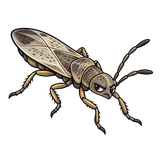 False chinch bugNysius raphanus
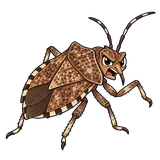 Brown marmorated stink bugHalyomorpha halys
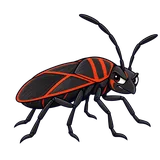 Boxelder bugBoisea trivittata