
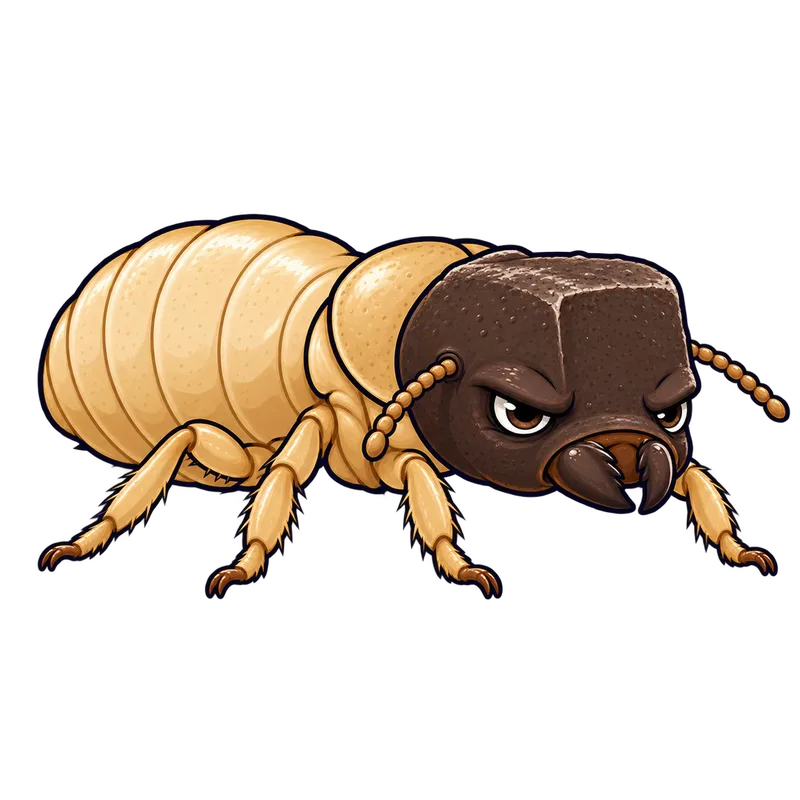
West Indian drywood termite
Cryptotermes brevis
- Size
- 10 to 11 mm long including wings
- Color
- Dark pigmented body with clear wings
- Habitat
- Strictly within dry, seasoned wood
- Diet
- Seasoned lumber and timber
- Life cycle
- Egg, nymph, soldier, alate
The West Indian drywood termite, known scientifically as Cryptotermes brevis, gives away its presence not by walking across the rug, but by the tiny artifacts it leaves behind. If you look closely at a suspicious little pile of debris under a wooden molding, you are likely staring at its fecal pellets. Under magnification, each pellet measures about 0.85 mm long and resembles a tiny seed with rounded ends. More importantly, it features six flattened or concavely depressed sides with sharp longitudinal ridges running along the angles. That geometry results from specialized rectal grooves in the insect that squeeze nearly every drop of moisture out of the waste before it is pushed out of the wood. When you catch an adult winged reproductive, known as an alate, it measures 10 to 11 mm in total length including its folded wings. Those wings are completely clear and transparent, marked only by distinct brownish veins along the leading edge, and they are equal in both length and shape. The body is heavily pigmented and dark, featuring straight, beadlike antennae and a broad waist that joins the thorax directly without any constriction. The soldier caste offers the most definitive physical identification. The soldier head is mostly black, nearly as broad as long, and uniquely modified into a flat, rough, strongly truncated shape on the front face. This blunt, plug-like head capsule acts as a living cork. The termites use it to physically block tiny gallery holes against invading predators like ants, much like a homeowner shoving a stopper into a bottle. This species is frequently confused with the western drywood termite, but the differences are clear if you know where to look. Western drywood termite alates are slightly larger, reaching up to 12 mm, and carry smoky-black wings paired with a reddish-brown head and thorax. Their soldiers possess a long, orange-brown head rather than the black, flat-fronted plug of the West Indian species. You might also mistake the damage or waste for that of powderpost beetles. Beetles leave behind fine, talcum-powder frass or gritty, bun-shaped pellets, whereas drywood termites produce those hard, six-sided pellets with longitudinal ridges. Furthermore, beetles chew circular exit holes and leave behind larval dust, while termites rely on tiny, oval kickout holes that they plug up with waste when not in use.
Habitat & behaviour
You will never find Cryptotermes brevis crawling around in outdoor soil, living trees, or fallen forest logs. This species lives a strictly cryptobiotic life, meaning it is entirely confined within dry, seasoned wood. It requires zero contact with the ground and builds no mud shelter tubes, which separates it entirely from the habits of subterranean termites. Instead of drawing moisture from wet soil or active plumbing leaks, this termite thrives in bone-dry lumber. While it prefers wood with about 10% moisture content, it can survive and chew through timber containing as little as 2.5% to 3% moisture. That incredible physiological tolerance allows it to colonize the dryest parts of human structures, including attic framing, flooring, window sills, door frames, ceiling joists, and imported wooden furniture. Activity inside the timber is hidden and deliberate. The insects excavate large, clean, smooth galleries that cut straight across the grain of the wood, chewing through soft springwood and hard summerwood alike. Because active feeding galleries must be kept clean, the inhabitants bore microscopic round holes through the outer surface of the wood. Through these access points, immature nymphs push out accumulated fecal pellets, creating the characteristic little conical piles on the floor or furniture surface below. Dispersal happens during swarming flights. In warm tropical and subtropical climates, winged adults emerge during the evening hours, sometimes in the spring and summer or year-round depending on ambient warmth. These alates are relatively weak fliers, but ambient air currents carry them across neighborhoods. Once they land, they shed their wings, find a narrow crack, crevice, or predrilled hole in dry wood, seal themselves inside with a tiny nuptial chamber, and start a new colony. Because they hitchhike easily inside small wooden items, picture frames, and shipping crates, they travel across oceans inside cargo just as easily as they move across town inside a secondhand table.
Visual variations
A colony of Cryptotermes brevis operates without a true, permanent worker caste. In many other social insects, workers are a distinct and permanent fixture, but this family relies entirely on immature nymphs, sometimes called false workers, to run the daily operations of the nest. These soft-bodied, whitish to cream-colored nymphs are wingless and eyeless, possessing thin skins through which the color of their latest wood meal often shows. They perform all the labor of the colony, including foraging, chewing galleries, grooming the royal pair, and feeding the soldiers. Because these immatures retain developmental plasticity, they can molt into soldiers, supplementary reproductives, or winged alates depending on what the colony needs at the moment. The royal pair sits at the top of the social structure. The primary king and queen are the founders of the nest, residing in the original nuptial chamber where the queen lays her very slow initial batch of about 10 eggs during the first year. These first-year eggs require roughly 60 days to hatch, and the king and queen must care for and feed the resulting nymphs directly, as no soldiers or winged forms exist yet. Soldiers represent a specialized defensive caste. They are sterile individuals with heavily sclerotized, black, blunt heads designed for plugging gallery holes. Because their specialized head structure leaves them incapable of feeding themselves, they rely entirely on the immatures to pass them regurgitated food through mouth-to-mouth liquid transfer. Winged alates represent the dispersal phase. They emerge with fully pigmented dark bodies, clear membranes, and functional compound eyes that help them navigate toward light during evening swarms. Once they land and pair up, they deliberately snap their wings off along basal fracture lines, shedding the flight apparatus entirely to begin their lives as dealates inside a new piece of timber.
Why it matters
The presence of Cryptotermes brevis inside a building means that a quiet, hidden structural hollow-out is underway. Because colonies start from small pairs entering through tiny gaps in attics or window frames, the damage accumulates deep inside structural timbers for years without showing any obvious outward signs. Over time, the termites consume the interior wood until only a wafer-thin outer shell remains, leaving framing and flooring vulnerable to sudden collapse under pressure. Despite the structural havoc they wreak, these insects pose no direct medical or physical threat to humans or household pets. They do not bite, sting, transmit diseases, or produce toxic secretions, and they have no interest in outdoor plants, living crops, or garden vegetation. Accurate identification matters because the biology of this species dictates whether localized fixes will work or fail. Because these termites require no soil contact and maintain multiple small, isolated colonies that eventually coalesce throughout a building, surface sprays or spot treatments frequently miss hidden gallery networks. In certain jurisdictions, discovering this invasive timber pest carries a legal mandate for immediate formal notification to government authorities.
Similar species
 Pacific dampwood termiteZootermopsis angusticollis
 Eastern subterranean termiteReticulitermes flavipes
 Western subterranean termiteReticulitermes hesperus
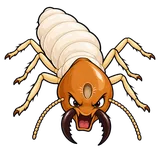 Formosan subterranean termiteCoptotermes formosanus
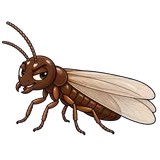 Asian subterranean termiteCoptotermes gestroi
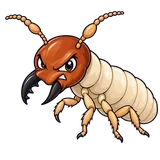 Western drywood termiteIncisitermes minor