
What do drywood termite droppings look like?
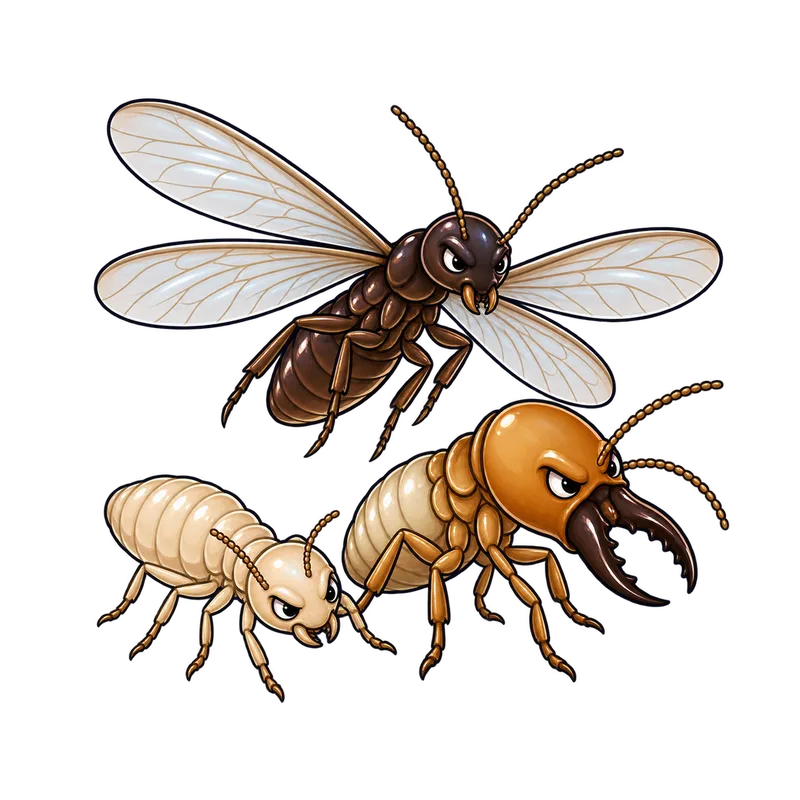
Drywood termite droppings are tiny, hard, dry grains about 0.85 millimeters long that look like coarse sand, poppy seeds, or ground pepper. Each pellet forms a miniature six-sided barrel with six fine ridges running lengthwise. Their color ranges from cream and tan to dark brown or black depending on the wood being eaten.
What is actually going on
Picture this: you're wiping down the windowsill in the spare room, the one you hardly ever open, and there's a tiny heap of what looks like spilled ground pepper sitting right under the window frame. You clean it up, because that's what you do, and two weeks later it's back. Same spot, same tidy little pile. Nobody cooked in there. Nobody spilled anything. That is the classic way people meet drywood termite droppings for the first time.
So what do they actually look like? Drywood termite droppings, called fecal pellets or frass in pest language, are tiny, hard, dry grains, each one about 0.85 mm long, roughly the size of a coarse grain of sand or a small poppy seed. Each pellet is elongated with rounded ends and, here's the part that makes them special, six slightly concave sides with six fine ridges running lengthwise along the edges. In plain terms, every single dropping is a miniature six-sided barrel. A pile of them looks like a spoonful of coarse salt, poppy seeds, ground pepper, or fine beach sand, depending on the color. And the color varies a lot, from cream and tan to dark brown or nearly black, because the pellets take on the shade of whatever wood the termites have been eating. Dark pellets from dark walnut, pale pellets from pale pine. The color tells you about the menu, not about the species or the severity, so don't let anyone scare you with the idea that the black ones are the bad ones.
The reason the pile shows up at all is oddly charming, in a horrifying sort of way. Drywood termites live their entire lives inside dry, sound wood, with no soil contact and no mud tubes, none of the construction projects their subterranean cousins are famous for. But they like a tidy home, so the workers cut a small round hole in the wood surface, about 1 to 2 mm across, and push the accumulated droppings out through it. Pest people call these kick-out holes, and the termites often seal them back up afterward with a paste of chewed wood. Think of it as a tiny maintenance door with a salt shaker behind it. The pellets drop straight down and form a neat little cone directly beneath the hole, which is why the pile keeps reappearing in exactly the same place on your windowsill.
How to tell for sure
The good news is you can get quite far with your eyes, your fingers, and a cheap magnifying glass. Start with the touch test, because it's the fastest. Pick up a pinch of the material and rub it between your thumb and forefinger. Drywood termite pellets feel hard, smooth and sandy, like dry seeds that roll around and hold their shape. If the stuff crushes into a fine, floury powder, you're almost certainly looking at powderpost beetles instead, since their frass is basically wood flour with no distinct grains at all. If it feels damp or muddy, that points toward dampwood termites or a moisture problem, which is a different conversation entirely.
Now for the confirmation step. Grab a hand lens, something around 10x magnification, and look at a few individual grains. What you want to see is that distinctive geometry: an elongated pellet with rounded ends, six slightly depressed faces, and six ridges running lengthwise. It sounds fussy, but under magnification it's surprisingly obvious, like the difference between a pebble and a tiny machined part. That six-sided shape is no accident, by the way. It's molded inside the termite's hindgut, where six muscular plates press the waste dry and squeeze out every drop of water before it's excreted. When you live your whole life in dry wood, you don't waste moisture, not even in the bathroom department.
One thing that trips people up: finding dry pellets rules out subterranean termites, full stop. Subterranean termites produce liquid excrement that they mix with soil and saliva to build their mud tubes, so they never leave dry grains lying around. If you have dry pellets, your suspect list is drywood termites or wood-boring beetles, and the finger rub plus the magnifier usually settles which one. Beetle frass tends to be gritty powder with irregular bun-shaped or cigar-shaped bits mixed in, not clean uniform six-sided grains.
Where the pile sits matters too. A kick-out hole just above a windowsill or shelf gives you that tidy cone. But if the hole is high up in an attic rafter, the pellets scatter as they fall, like a light pepper rain across the insulation or floorboards, and you might find only a thin dusting rather than a pile. So don't assume a neat heap is the only signature. You can also slide a piece of dark paper or cardstock under a suspicious spot for a few days to catch fresh falls and get a clean sample to examine.
What usually comes next
The next question is the obvious one: if there’s a pile, are the termites still in there? Short answer, maybe, maybe not. Pellets can sit trapped in wall voids and old galleries for years, and a little heap on the sill may have sifted out long after the colony died off or moved on. The check is blessedly low-tech. Sweep or vacuum the pile away, clean the surface, then watch that exact spot for a few weeks. If fresh pellets show up again in the same place, something alive inside the wood is still feeding and still tidying up after itself. If nothing returns, the evidence may be old, though old evidence still deserves a proper look from someone qualified, because your eyes stop at the paint and the trouble does not.
What you should not do is grab a can of household bug spray and blast the pile or the little hole. I know the urge. The can even promises to kill crawling insects on contact, which sounds very decisive until you remember the colony is not on the surface. It is living in chambers deeper inside the wood member, and a surface spray reaches exactly none of that. You end up with a clean-smelling windowsill and an untouched infestation, which is a lousy trade. The droppings are a symptom and a clue, not the pest itself, so treat them like information, not like the target.
The practical decision is pretty simple: use the clean-and-watch test to find out whether the activity is current, keep a small sample of the pellets, and get an identification and assessment from a licensed pest professional. If it turns out to be a small, localized infestation in an accessible piece of wood, there are targeted treatment options a professional can apply. If pellets are turning up in several rooms, in the attic, or around structural framing, the conversation shifts toward whole-structure treatment, and that belongs to licensed applicators, not to a free Saturday and good intentions.
When to get help
Call a licensed pest control professional as soon as you’ve confirmed fresh pellets are appearing, or any time you find droppings in more than one location. Multiple kick-out sites usually mean the infestation is spread across more wood than you can see, and once that’s the case, spot treatments stop being realistic. Whole-structure fumigation, the tenting process, is legally and practically a job for licensed operators. Any liquid or dust treatment also has to be applied strictly according to its product label, which is another reason this is not a do-it-yourself moment.
There are two more situations where you bring in someone beyond the pest company. First, if termites have been working on load-bearing wood, a pest inspector can document the damage but cannot tell you whether a beam is still safe. That judgment belongs to a qualified building contractor or structural engineer. Second, a little caution about your own detective work: termites and other wood pests are often active near wiring inside walls, so resist the urge to drill exploratory holes or inject anything into wall cavities yourself. The shock risk is real, and “I was just checking” is not a great thing to say to an electrician.
One last reassurance, because people worry about this: the droppings themselves aren’t dangerous to touch in small amounts, and cleaning up a pile is fine. But if frass dust has built up in living areas or ductwork and someone in the house is developing respiratory irritation or allergy-type symptoms, that is a question for a doctor, not for a pest article, including this one. Otherwise, the humble little six-sided pellet is genuinely useful evidence. Learn to read it, and it tells you who’s in the wood, whether they’re still there, and when it’s time to hand the problem to someone with a license.