
What are termite swarmers in a house?
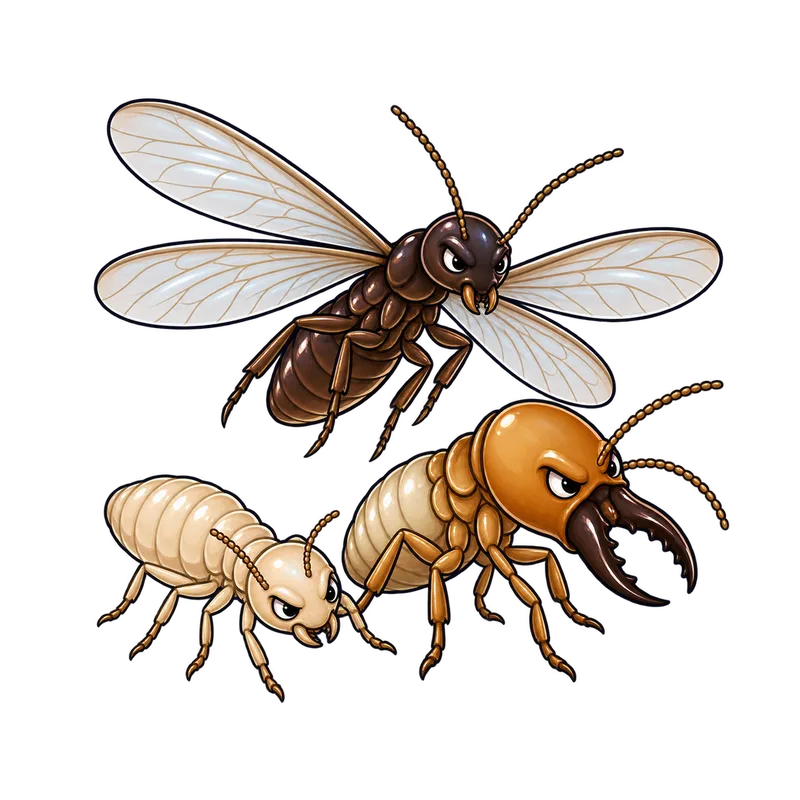
Termite swarmers in a house are adult, winged reproductive termites sent out from a colony that usually takes three to five years of quiet growth before producing them. Finding them indoors is a direct warning sign that a mature colony is living inside your structural timbers or foundation soil.
What is actually going on
You step into the living room on a warm spring afternoon, approach the window to open the blinds, and find a chaotic cloud of tiny, dark insects fluttering clumsily against the glass. An hour later, most of them are dead or crawling aimlessly along the sill, leaving behind hundreds of delicate, translucent wings scattered like discarded fish scales.
Those flying insects are termite swarmers, known scientifically as alates. They are adult, winged reproductive termites sent out from an established colony to fly a short distance, pair off with a mate, shed their wings, and try to start a new colony in moist soil or damp wood. Finding a few swarmers floating around your backyard tree stump or porch light on a humid May evening is entirely normal in nature. It simply means the local environment is doing what it has done for millions of years.
When you find them erupting inside your living room, baseboards, attic, or window sills, the situation changes. An indoor swarm or a pile of discarded wings on your hardwood floor is a direct warning sign that a mature termite colony is living inside the structural timbers or foundation soil directly beneath your house. Colonies usually take three to five years of quiet growth before they produce winged reproductives, so an indoor swarm is rarely a brand-new arrival.
The comforting news in the middle of this mess is that swarmers themselves cause zero physical damage to your home. They do not possess the strong, chewing mouthparts required to gnaw through wood, they do not feed on your framing during their flight, and they cannot bite or sting you. They are essentially biological messengers. The actual destruction is being carried out quietly by millions of pale, wingless worker termites hidden behind your drywall and under your subfloor. The swarmers are just the visible sign of a much larger, concealed population.
How to tell for sure
People frequently mistake flying ants for termite swarmers, and it is easy to see why. Both insects are small, dark, and suddenly appear in large groups around windows or lights. You can usually tell them apart with your bare eyes or a basic magnifying lens by looking at four simple physical details.
First, look at the waistline. A flying ant has a distinctly pinched, narrow waist between its middle and rear sections, giving it an hourglass shape like a wasp. A termite swarmer has a broad, uniform body with no pinch at all, looking more like a smooth, tiny cylinder.
Second, examine the antennae. A flying ant features elbowed antennae that bend sharply at an angle, like a tiny bent arm. A termite has straight, flexible antennae that look like a delicate string of microscopic beads.
Third, check the wings. A termite swarmer carries four wings that are completely identical in length, shape, and delicate veining. When folded flat over the back, these wings usually extend well beyond the tip of the insect's abdomen. A flying ant has two distinct pairs of wings where the front pair is noticeably larger and longer than the hind pair, and they rarely extend far past the abdomen.
Fourth, pay attention to discarded wings. Termites are weak, fluttering fliers that usually shed their wings along a built-in fracture line immediately after landing. Finding neat little piles of identical, translucent wings along window tracks or on floorboards without the insects attached is a classic sign of termites. Flying ants do not typically shed their wings in this uniform fashion right after a short flight.
What usually comes next
The typical reaction when finding dozens of bugs coming out of a baseboard is to grab a can of household insect spray and soak the gap until everything stops moving. That makes sense on instinct, but it turns out to be one of the least helpful choices you can make.
Aerosol sprays rely on chemical ingredients that repel insects strongly. Spraying the exit hole finishes off the few dozen swarmers unlucky enough to be out in the room, yet those same insects were going to perish naturally within a few hours anyway. At the same time, the leftover chemical warns the massive worker colony hidden deep behind the drywall to close off that particular tunnel and move their chewing operation to an entirely different structural beam. You end up destroying a handful of messengers that cannot harm your framing while pushing the actual wood-eaters deeper into the walls.
Rather than reaching for the spray can, focus on a few straightforward steps to secure the area properly. Begin by collecting a small sample. Scoop up five to ten whole insects along with a bunch of loose wings, and place them inside a secure plastic container. Having this physical sample lets a pest technician identify the exact species without relying on a vague description.
Next, bring out the vacuum cleaner. Clear away every dead insect, live crawler, and detached wing from the rugs, floors, and window tracks. Once you finish cleaning, take the vacuum bag or canister straight to an outdoor trash bin so nothing manages to crawl back out inside the house.
After that, mark the precise locations where you spotted the bugs appearing. Place a strip of colored tape right on the drywall crack, baseboard corner, or window frame where the swarmers broke through into the room. This gives the inspector a clear starting point when they arrive to check the property.
When to get help
Discovering an indoor termite swarm, finding a drift of shed wings in a quiet corner, or spotting muddy dirt tunnels running up your concrete foundation wall means you need to bring in a licensed pest control expert.
Wiping out a colony hiding in the soil or structural wood demands specialized tools, building expertise, and access to commercial-grade treatments. Subterranean species usually call for liquid soil applications that insects cannot detect or bait stations that workers share with the rest of the colony underground. Drywood colonies live entirely inside usable timber and often require targeted wood treatments, borate applications, or sealing the entire building for gas fumigation.
Trying to tackle a major wood-destroying insect problem with retail products from the garden center usually fails and can create safety risks. Chemical treatments around concrete foundations, utility lines, and heating ducts are strictly governed by product labels that carry legal force. Using unauthorized chemicals in those zones can lead to indoor air contamination or local water issues.
On the health side, termite swarmers are completely harmless because they do not bite, sting, or spread human illnesses. They present zero physical danger to people or domestic animals. Even so, if anyone in your home suffers from breathing trouble or accidental chemical exposure after heavy indoor spraying during a swarm, reach out to a medical clinician or your local poison control center right away.