
What are the signs of termites in walls?
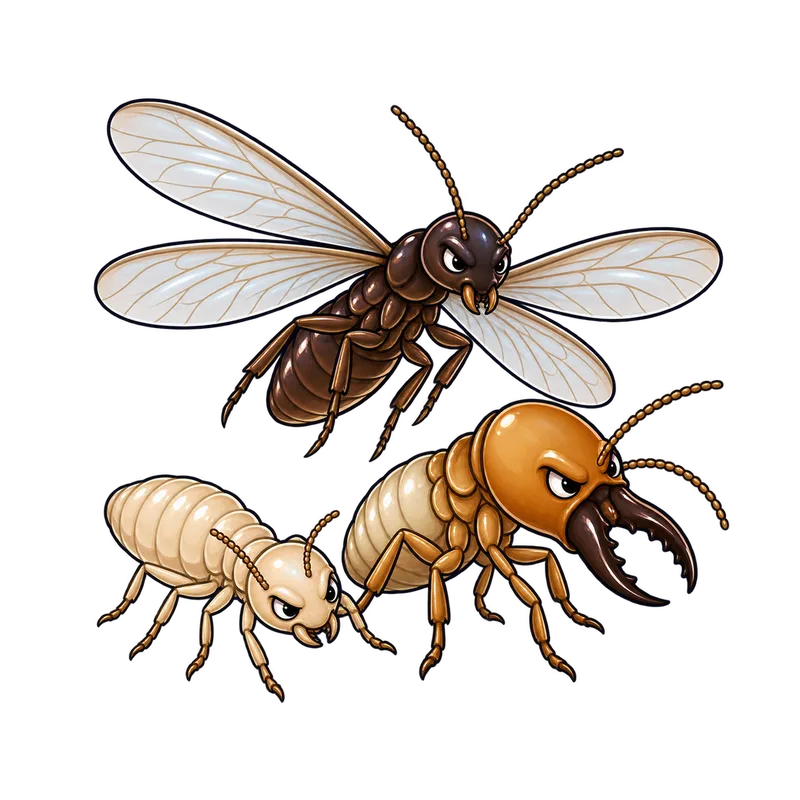
Termite infestation signs in walls include mud tubes on foundations, small piles of six-sided hard pellets that look like coarse sand, and wood that sounds hollow when tapped. You might also notice blistered paint or discarded wings on windowsills. Which signs appear depends on whether you have subterranean or drywood termites.
What is actually going on
Picture this: you are vacuuming along the baseboard in the hallway and you notice the paint looks a little rippled, like the wall got wet at some point and nobody told you. You press on it and it feels soft, almost papery. Or maybe you spot a thin brown line, about the width of a pencil, running up the foundation wall in the garage, and it looks suspiciously like it was put there on purpose. It was.
Those are the classic calling cards of termites working inside your walls, and the short answer is this: the main signs are mud tubes on foundations or walls, small piles of hard pellets that look like coarse sand or poppy seeds, wood or drywall that sounds hollow when you tap it, blistered or darkened paint, and discarded wings on windowsills. Which of these you actually see depends on which kind of termite moved in, and that part matters more than most people realize.
Subterranean termites, the ones responsible for most of the damage in the United States, live in the soil and cannot survive long in open air. Their skin dries out fast, so they build covered highways, little earthen tubes about a quarter to half an inch wide, to travel from the damp ground up to the wooden framing inside your walls. Once inside, they eat the soft part of the wood along the grain and leave the harder layers, which is why a stud can look perfectly fine from outside and be mostly gone inside. They also plaster their tunnels with a muddy paste, and when they chew right up behind the paper face of your drywall, the surface starts to look wrinkled, darkened or bubbled, a lot like water damage.
Drywood termites play a different game entirely. They do not need soil at all. They fly in through a gap around a window frame or a roof vent, set up housekeeping inside the wood itself, and push their droppings out through a round hole about the size of a pinhead, roughly 2 mm across. Those droppings, called frass, are hard little pellets with six sides, and they collect in neat conical piles on the sill or floor directly below the hole. People sweep them up for months thinking it is just dust. It is not dust.
How to tell for sure
Start with a slow walk around the outside of the house. Look at the foundation, the slab edge, around pipe penetrations and at any weep holes in brick veneer. You are looking for those earth-colored tubes climbing vertically, or crusts of dried mud along the base of the wall. Subterranean termites usually need that ground connection, so the tubes are often the first visible clue. Usually, though, is not always, and we will come back to that.
Then move inside and do the tap test. Take the handle of a screwdriver and knock gently along baseboards, window casings and the wall where you suspect trouble. Solid wood answers with a dull, firm thump. Wood that has been hollowed out sounds papery and empty, like tapping on a cardboard egg carton. If a spot sounds wrong, resist the urge to gouge it open. A gentle press is enough to tell you the surface has lost its backing.
Check the drywall itself for blistering paint, thin wavy lines under the surface, dark patches or areas that look swollen and damp. Termites bring moisture with them, so an active feeding zone can make plasterboard bulge the way a leak would. That is also why a moisture meter, if you happen to own one, can be a useful second opinion, though it will only flag currently damp areas and says nothing about old, dried-out damage.
Now, about those piles of "sawdust," because this is where people get confidently wrong. Drywood termite frass is made of uniform, hard, six-sided pellets, like coarse sea salt or poppy seeds, all roughly the same size. If what you see is a fine, flour-like powder drifting out of tiny round holes, that points to powderpost beetles, not termites. If it is coarse, fibrous shavings mixed with bits of dead ants, that is carpenter ants, which excavate wood but do not eat it. Three different pests, three different problems, and the little pile on your floor is often the only witness willing to talk.
One more clue comes with a season attached: wings. When a mature colony sends out its winged reproductives, the swarmers head for light and then drop their wings, which end up looking like tiny flakes of cellophane on windowsills, in spider webs or along door frames. If you catch the insects themselves, the quick check is the waist. Termites have a broad waist, straight bead-like antennae and four wings of equal length. Flying ants have a pinched waist, bent antennae and front wings noticeably bigger than the back pair. And if the house is quiet at night and you hear a faint ticking from inside the wall, that can be soldier termites banging their heads against the gallery walls as an alarm signal. Charming, right?
What usually comes next
Here is the fork in the road: you found something, and every instinct says to go after it. Do not. The two most common reactions both backfire.
First, do not rip open the mud tubes or tear into the wall to see how bad it is. Termites answer disturbance by abandoning that stretch and rerouting deeper into the structure. You get about ten minutes of feeling useful, and the colony moves lunch to a wall you have not checked yet. It also makes the professional’s job harder, because baiting systems and dusts work best while the termites are still using their normal routes.
Second, skip the hardware store spray. A consumer aerosol kills the few workers you can see and convinces the rest of the colony, which can number in the hundreds of thousands, to relocate inside your walls. You have not fixed anything. You have just made the problem shy.
What you can usefully do is find out whether the activity is current. If you found frass pellets, sweep the pile away completely, mark the spot with a piece of tape, and check again in a day or two. Fresh pellets mean active drywood termites. Nothing new can mean an old infestation that died out or moved on, which is still worth knowing but changes the urgency. Take clear photos of whatever you found, note the locations on a rough floor plan, and leave everything else alone. That record genuinely helps whoever inspects next.
You might be thinking: fine, but I walked the whole perimeter and found no tubes, so I am in the clear, yes? Not necessarily. Drywood termites never build tubes at all. And a house on a concrete slab with brick veneer is not immune, no matter what the neighbor says. Termites routinely come up through slab expansion joints, plumbing cutouts and hollow block voids, straight into the wall framing, without showing a single tube outside. Fresh drywall, new paneling or a recent renovation can hide active damage completely. The walls you can see are the easy ones.
When to get help
The honest answer is: the moment you have a real sign, not a vague worry. A mud tube, a fresh pile of pellets, hollow-sounding trim or swarmer wings indoors all justify a professional inspection, because the visible symptom is usually the smallest part of what is happening. Termites feed out of sight, and by the time paint is blistering, the framing behind it has usually been on the menu for a while.
A licensed pest professional brings tools you do not have: moisture meters, sounding experience, sometimes thermal imaging or borescopes that peer inside wall cavities through a small hole. They can also tell active damage from historical damage, which is the question that decides whether you need treatment or just monitoring. Any chemical treatment, whether a soil-applied termiticide, an injection into the slab or a baiting system, belongs to a licensed applicator working from the product label. That is not gatekeeping. It is how these products are legally and safely used.
There is a second professional in this story too. If an inspection shows that load-bearing studs, plates or window headers have been seriously eaten, the repair question goes to a licensed building contractor or structural engineer, not the pest company. Killing the colony and putting the wall back are two separate jobs, and hiring one does not get you the other.
One reassurance before you lose sleep: termites do not bite, sting or carry disease. They are a threat to your house, not to you. If anyone in the home has stings, a spreading rash or a reaction you cannot explain, that is a different problem, and the right call is a doctor or, for any pesticide exposure, Poison Control. And if what is living in your wall void turns out to be birds or bats rather than insects, those are protected in many places, so check with your state wildlife agency before anyone treats or seals the space.
The short version: photograph it, leave it alone, and get a licensed inspector out. Termites reward decisiveness and punish enthusiasm.