
What are southeastern drywood termites?
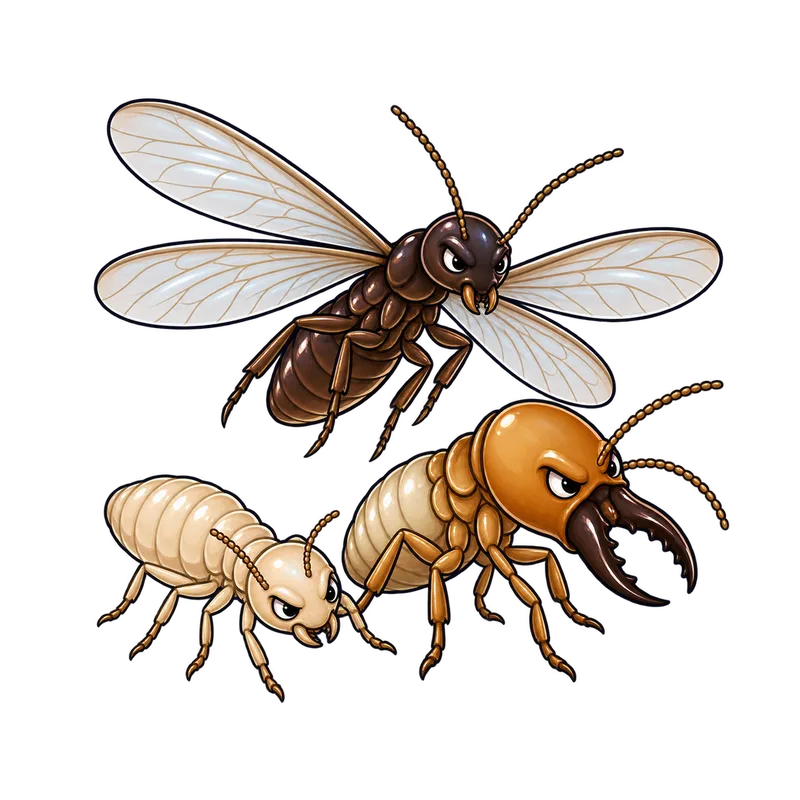
Southeastern drywood termites are wood-dwelling pests native to the southeastern United States that live entirely inside dry, seasoned timber without needing outside moisture or ground contact. They leave behind tiny, neat conical piles of hard fecal pellets measuring under 1/25 of an inch long.
What is actually going on
You are wiping down the windowsill on a warm June evening after a long day, and you notice a tiny, neat little pile of what looks like coarse pepper or miniature grains of sand sitting right there in the corner. You brush it away, only to find another exact pile of it the very next morning, accompanied by a scattering of translucent wings that look like they belong to miniature flying bugs. You tap the painted wooden sill with your knuckle, and instead of a solid knock, it gives you that flat, hollow paper sound that instantly makes your stomach drop. What you are looking at is the quiet handiwork of southeastern drywood termites, scientifically known as Incisitermes snyderi.
These insects are wood-dwelling pests native to the southeastern United States, ranging from South Carolina down through Florida and across to eastern Texas. Unlike their subterranean cousins that build mud tubes up your foundation walls and require a constant connection to damp soil, southeastern drywood termites live entirely inside dry, seasoned timber. They do not need outside moisture or ground contact because they get all the hydration they need from digesting the wood cellulose itself, and they manufacture their own water internally as a metabolic byproduct.
They spend their entire lives hidden away inside structural beams, attic rafters, and window frames, quietly eating out broad, smooth chambers that run both with and across the wood grain. They leave just a fragile, paper-thin wooden veneer on the outside, which is why your framing can look completely normal on the surface while being hollowed out like honeycomb on the inside. You usually only know they have moved in when they start cleaning house.
That cleaning process involves tiny round operational openings measuring roughly 2 millimeters across, known as kickout holes. The termites push their accumulated waste out of these openings into the open air, which explains those neat little conical piles of sand-like droppings accumulating on your windowsills or floorboards. Their main dispersal flights happen at dusk or nightfall during May or June, which is why you often find winged adults, or alates, fluttering near porch lights or trapped behind window glass just as summer gets started.
How to tell for sure
Spotting the signs of these insects is mostly a matter of looking at the debris they leave behind rather than catching the insects themselves, since they rarely expose themselves to the light. You usually start by scanning for small, neat, conical piles of hard pellets directly beneath wooden beams, door casings, or attic rafters.
When you collect a sample of that material and examine it under a 10x magnifying glass or a low-power hand lens, you can confirm whether you are dealing with drywood termites or something else entirely. Their fecal pellets are hard, elongated structures measuring under 1/25 of an inch long, with rounded ends and six flattened or concavely depressed sides separated by longitudinal ridges. Those six concave faces are formed by rectal glands squeezing every last drop of moisture out of the waste before excretion.
This detail rules out wood-boring beetles immediately, because true powderpost beetles produce a soft, flour-like powder, while deathwatch beetles drop coarse, gritty particles that lack those six distinct longitudinal ridges. You can also check for small, round exit holes that look clean or are temporarily plugged with a dark wood paste.
If you spot winged bugs shedding their wings, you can usually tell termite alates apart from flying ants simply by checking their body shape. Termites carry straight, bead-like antennae, thick and unconstricted waists, and two pairs of wings that match each other in size and shape. Ants sport elbowed antennae, sharply pinched waists, and forewings that are quite a bit larger than their hindwings.
Even so, a plain-sight inspection cannot reliably tell Incisitermes snyderi apart from western drywood termites or other similar species. Getting a true species-level confirmation usually means sending intact soldier or alate specimens stored in 70% isopropyl alcohol off to a university extension entomologist or a licensed timber pest specialist for a close microscopic look.
What usually comes next
Once you have verified that you are dealing with drywood termites rather than subterranean species, your main practical choice is figuring out whether you have a small, localized spot issue on your hands or a widespread problem that has spread across multiple structural parts. Setting up subterranean termite control methods like trenching the soil or putting out ground bait stations will do nothing against drywood termites because these bugs never touch the dirt.
For small, easy-to-reach, and well-contained infestations, a licensed operator can go with a localized drill-and-treat method. This takes 1/4-inch holes drilled right into the infested wood galleries about 1 foot apart, followed by injecting approved termiticidal dusts or liquids straight into the chambers where the colony is eating.
If the infestation runs deep, covers a wide area, or sits in hard-to-reach wall spaces and roof rafters that a drill just cannot touch, your options change to whole-building treatment. This generally involves putting a tent over the entire structure and pumping in a gas fumigant like sulfuryl fluoride so it can soak into every crevice of the framing.
For moveable wooden furniture, pieces, or art, you can also look at non-chemical heat options through specialized facilities, which heat the items to 140 degrees Fahrenheit for 4 hours or freeze them down to 15 degrees Fahrenheit for 4 days.
Keep in mind that finding old droppings does not automatically mean the bugs are still active, since drywood termite waste lasts for a long time and can sit inside abandoned tunnels for decades. To see if anyone is still living there, sweep up the current pile completely, tape a fresh piece of paper under the spot, and check it again a week later to see if new pellets have been kicked out.
When to get help
You need to ring up a professional timber pest inspector when the damage goes beyond a few stray pellets and you think load-bearing joists, rafters, or headers might be structurally weakened. A trained inspector brings special tools to tap on the wood and figure out if your framing is still holding strong or if it needs to be shored up right away.
Putting up a whole-structure tent and running a gas fumigation job must only be handled by licensed, certified structural pest control operators who follow strict state safety rules and clearance testing steps. Never try to manage or apply structural fumigants on your own.
If an inspection turns up unusual or high-consequence invasive wood-boring pests, check your local agricultural rules, since certain areas have mandatory reporting laws that mean you have to notify government agriculture departments officially.
If you or anyone else in your home runs into unexpected health issues, trouble breathing, or skin irritation linked to pesticide exposure or bug bites, talk to a doctor or reach out to your local poison control center immediately.