
What do termites look like?
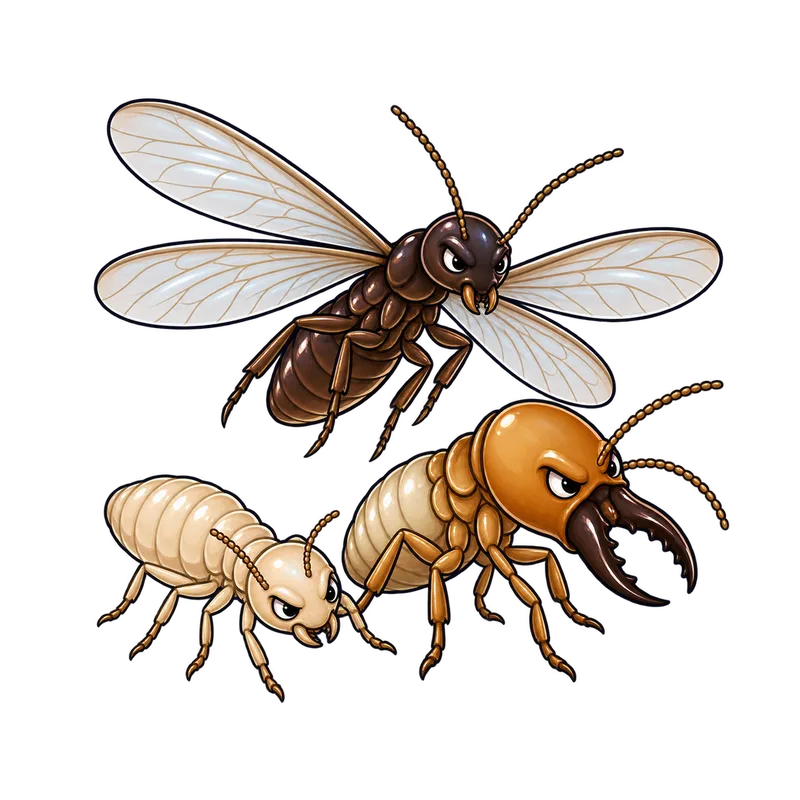
Termites are small, soft-bodied insects whose appearance depends entirely on their job within the colony. Most workers are pale, creamy-white, and wingless, usually measuring between 3 mm and 6 mm long, while winged swarmers have darker bodies ranging from deep brown to jet black.
What is actually going on
You are wiping down the kitchen counter on a bright Saturday morning when you spot a tiny bug crawling near the baseboard. You pick up a glass to trap it, squinting to see if it is just an ordinary ant or something that should make your stomach drop. People talk about termites as if they are invisible ghosts that chew through your living room while you sleep, but the truth is less mysterious once you know what you are looking at.
Termites are small, soft-bodied insects that spend almost their entire lives hidden away from light and open air. Because they do not have a single universal appearance, what a termite looks like depends entirely on its job within the colony. Most of the insects you would ever find inside a timber framing or a subterranean gallery are workers, which are pale, creamy-white, and completely wingless. They are small, usually measuring between 3 mm and 6 mm long, and they look rather like tiny grains of rice with legs.
If you happen to catch the colony during its seasonal reproductive phase, however, you will see a completely different creature. These are the winged swarmers, and they are built to travel out into the open world. They feature darker, pigmented bodies ranging from deep brown to jet black, depending on the species, along with four translucent wings of identical length. People often mistake them for flying ants, which causes a great deal of unnecessary panic or, worse, misplaced confidence when the real culprit goes unnoticed.
If you are trying to figure out whether the insect on your windowsill is a termite or an ant, you usually only need to check three simple physical features. You do not need a microscope for this, just good lighting and a bit of patience.
First, look at the waistline. An ant has a sharply pinched, hourglass-shaped waist, while a termite has a broad, thick waist where the thorax joins the abdomen without any narrow constriction. Think of an ant as wearing a tight corset and a termite as wearing a straight cylindrical tube.
Second, look at the antennae. Ant antennae are hinged and bent sharply in the middle, looking like an elbow. Termite antennae are straight and resemble a microscopic string of tiny, round beads standing out from the head.
Third, examine the wings if the insect is a swarmer. A flying ant has two large front wings and two much smaller hind wings. A termite has four wings that are all the exact same length and shape, usually folding flat over its back and extending well past the tip of the abdomen.
You should also consider what you might find besides the insects themselves. Subterranean termites usually leave behind muddy shelter tubes on foundation walls, using a mix of soil and excrement to travel safely across concrete. Drywood termites, on the other hand, do not use mud. Instead, they push tiny, hard, six-sided fecal pellets out of small round kickout holes in infested wood. These droppings feel gritty, like coarse sand or tiny footballs, which completely separates them from the fine talcum powder left by wood-boring beetles or the coarse sawdust left by carpenter ants.
How to tell for sure
Once you have checked the bug, the droppings, or the timber and think you might have termites, your main job is figuring out if you are dealing with a live infestation or just a lost wanderer. Spotting one winged termite outside near a porch light on a balmy evening does not mean your house is collapsing. But discovering dozens of dropped wings on an indoor windowsill, or heaps of those six-sided pellets under a wooden beam, usually points to a colony close by.
Right then, fight the temptation to grab a bug spray from the supermarket and start dousing your baseboards. Ordinary surface sprays typically only knock out the few bugs in plain view, leaving the rest of the colony safely tucked away deep inside the wood or dirt. Instead, grab a flathead screwdriver or the handle of a pocket knife and gently push against the suspect timber. If the surface caves in without much effort or makes a dull, hollow sound when tapped, the damage is already happening.
Gathering a few intact bugs, especially soldiers with their big, tough heads or winged adults, can come in handy if you want to pin down the exact species. Drop them into a small vial with rubbing alcohol instead of water so they stay intact for a proper ID. Just keep in mind that spotting structural damage means you have moved way past a simple ID exercise, and you now need someone to check out the actual framing.
What usually comes next
You ought to call in a licensed pest control professional the moment you spot structural damage, mud tunnels on your foundation, or swarms inside the house. Termites eat away from the inside out, frequently leaving just a paper-thin skin of wood on the outside while hollowing out the joists and studs keeping your roof over your head. Since figuring out if load-bearing wood is still safe requires special gear and know-how, getting a pro to inspect the place makes good sense before you start any repairs or treatments.
Chemical termite treatments, dirt barriers, bait stations, and tent fumigations are tightly controlled and have to match the registered product labels. In just about every region, applying termiticides is a job for a licensed commercial operator, not a weekend DIY project.
When to get help
As far as health goes, termites do not bite, sting, or spread human diseases, and they certainly do not go after human skin or hair. If anyone in your house is dealing with mysterious bites, skin rashes, or ongoing irritation, do not blame those symptoms on termites. Take those worries to a doctor, an urgent care clinic, or your local poison control center right away to track down the real cause.