
Drywood termites vs subterranean termites: what is the difference?
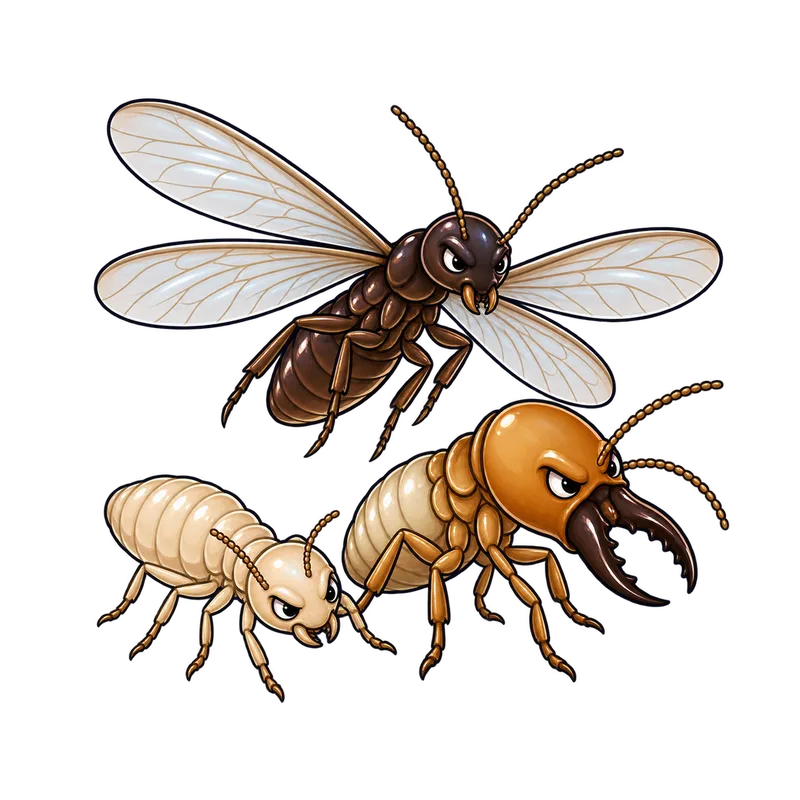
The difference between drywood termites and subterranean termites is where their colonies live. Subterranean termites nest in damp soil and travel to your home through mud tunnels, while drywood termites live entirely inside the wood they eat. Subterranean colonies can cause severe damage in months, whereas drywood colonies work slowly over years.
What is actually going on
Picture this: you are sweeping the kitchen floor on a Sunday morning and notice a small pile of what looks like coarse sand or pepper spilled under the window frame. Or maybe you are in the garage, and there is a weird brown streak running up the concrete foundation wall, about as wide as your finger. Both of these are termite signs, but here is the thing: they are signs of two completely different animals, and mixing them up can cost you real money.
The difference between drywood and subterranean termites comes down to one question: where does the colony live? Subterranean termites live underground. Their bodies are soft and dry out fast in open air, so they nest in damp soil and commute to your house through sealed mud tunnels they build over concrete, brick, or anything else in the way. Think of them as commuters with an underground city and a climate-controlled highway up your foundation. Drywood termites, on the other hand, never touch the ground at all. They live their entire lives inside the wood they are eating, pulling what little moisture they need out of the timber itself. They are more like squatters who moved into your door frame and never plan to leave.
This is not a trivia distinction. It changes everything about how you find them and how you get rid of them. Subterranean colonies are huge, often tens or hundreds of thousands of individuals, and they can seriously damage structural wood in months. Drywood colonies are small, sometimes just a few thousand insects, and they work slowly over years. One is a fast-moving army with a supply line to the soil. The other is a quiet tenant slowly hollowing out your window trim.
How to tell for sure
The good news is that each type leaves fingerprints, and they are different fingerprints. For subterranean termites, look for mud tubes. These are flattened, earthen tunnels, usually a quarter to a half inch wide, running up foundation walls, piers, plumbing penetrations, or along expansion joints. If you break one open and it is active, you may see pale, soft-bodied workers inside. You might also notice baseboards or flooring that look blistered or sunken, because subterranean termites eat the soft part of the wood grain and leave the harder layers, like someone licking the filling out of a wafer cookie and leaving the wafers. Press a thumb on that surface and it may crunch through.
Drywood termites leave droppings instead. They push their waste out of tiny round holes, about the size of a pinhead, and it collects in neat little piles below the infested wood. Under a magnifying glass, each pellet is hard, dry, and six-sided with ridges along its length, like a microscopic wooden peppercorn. That detail matters because people constantly confuse this with other things. Powderpost beetles leave a fine flour-like dust, not distinct pellets. Carpenter ants push out coarse shavings mixed with bits of dead insects. Subterranean termites produce no dry pellets at all, since their waste is liquid and gets used as mortar in their tunnels. So if you have dry, six-sided pellets, subterranean termites are off the suspect list.
What about the winged swarmers that show up near windows? First, confirm they are termites and not flying ants, because this trips everyone up. Check three things. Termites have a thick, straight waist with no pinch, while ants have a narrow wasp waist. Termites have straight, beadlike antennae, while ants have elbowed ones. And termite wings come in two equal pairs, while ant forewings are noticeably bigger than the hindwings. Once you know it is a termite, color and size give you a hint about which kind. Drywood swarmers are usually larger, around half an inch with wings, with reddish-brown heads, and in places like California they swarm on warm autumn afternoons. Subterranean swarmers are usually smaller and dark brown to black, often appearing on warm spring days after rain. Usually, but not always, since species vary by region, which is why the pellets-versus-mud-tubes evidence is more reliable than the insect's outfit.
One more trap worth mentioning: a probe test settles most arguments. Press a screwdriver gently into suspect wood. If it punches through a thin shell into hollowed galleries packed with moist mud, that is subterranean. If it opens into dry, smooth-walled chambers that spill hard pellets, that is drywood.
What usually comes next
This is the point where the difference stops being a fun fact and starts being a bill. The treatments for these two pests barely overlap, and paying for the wrong one is a pricey way to learn entomology the hard way.
Say it is subterranean termites. The problem lives in the ground, so the fix has to happen in the ground too. That means either a continuous chemical barrier worked into the soil around and under the foundation, or a baiting system that the workers haul back to the colony themselves. The whole idea is to sever the building from the nest. Spraying the baseboard where you spotted them does essentially nothing. The colony is sitting safely underground, and it will just route around your little counterattack like traffic around a closed lane.
Now say it is drywood termites. Soil treatment is pointless here, because there is nothing in the soil to treat. A small, contained infestation in one window frame, for example, can sometimes be handled with localized treatment straight into the galleries. A widespread or hard-to-reach infestation usually means whole-structure tent fumigation, the big tarp operation that makes your house look like the circus came to town. Fumigation reaches termites hiding inside timbers everywhere at once, which is exactly what you want for drywood and exactly useless for subterranean, since it leaves nothing behind in the soil where those colonies actually live. Plenty of people assume fumigation "treats termites," full stop. It does not.
So the real decision in front of you is not "which treatment" but "which termite," and the evidence you gathered above answers that. Pellets and kickout holes point one way, mud tubes and mud-packed galleries point the other. If the signs are ambiguous, or you found both, that is your cue to stop guessing. The next step involves either drilling into your slab or gassing your house, and neither of those is a guess-friendly activity.
When to get help
Honestly, both of these warrant a professional inspection, and not because anyone is trying to sell you something. Termites work hidden inside wood and behind drywall, so what you can see is usually just the tip of the colony. Subterranean infestations in particular can hollow out load-bearing sills and joists while the surface still looks almost normal, which is why a licensed inspector who knows how to sound and probe structural wood is worth the call. The treatments themselves, soil injection around a foundation or whole-structure fumigation, legally require licensed applicators in most places, and there is good reason for that. Soil termiticides applied near wells, drains, or heating ducts can contaminate water or indoor air, and fumigation is a controlled operation, not a weekend project. Whatever product gets used, the label governs how it is applied, and a licensed pro is accountable to it.
One reassurance before you spiral: termites do not bite, sting, or spread disease to people. They are a threat to your house, not your body. If you or someone at home has a rash, a bite, or a skin reaction that worries you, that is a separate question for a doctor or poison control, not something to pin on the termites.
The short version: find the evidence, read it correctly, then let a licensed professional confirm which tenant you are actually evicting. The pile of peppercorns and the mud highway are telling you two different stories, and now you can read both.