
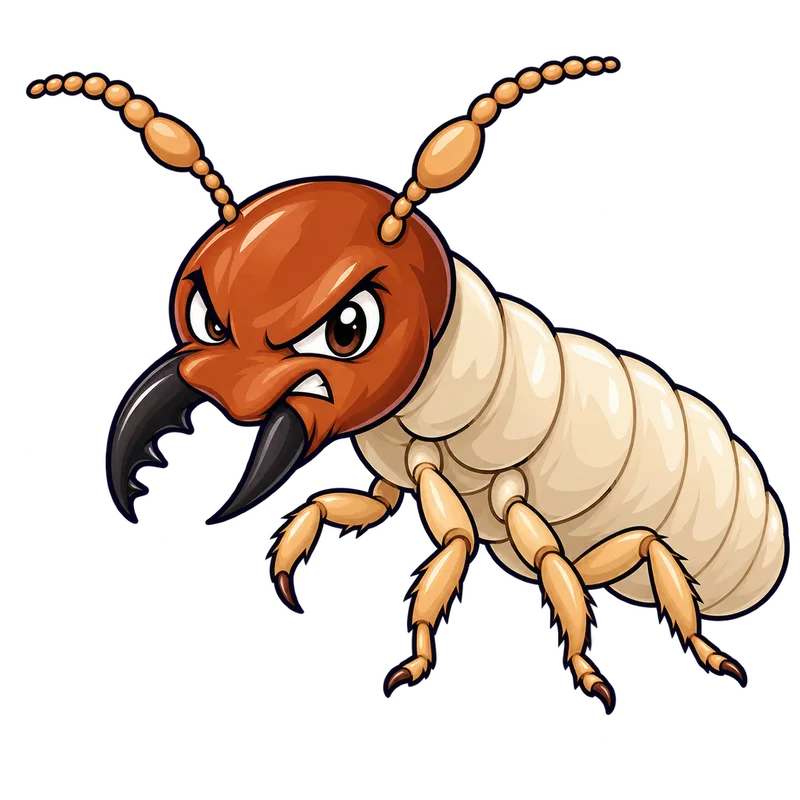
Western drywood termite
Incisitermes minor
- Size
- 11 to 12 mm total length including wings
- Color
- Reddish-orange-brown head and thorax, dark brown to black abdomen
- Habitat
- Non-decayed dry wood without soil contact
- Diet
- Cellulose from sound dry timber
- Life cycle
- Gradual metamorphosis from egg through nymph and alate or soldier
The Western drywood termite, known scientifically as Incisitermes minor, is a wood-eating insect native to western North America that lives entirely inside dry, sound timber without any connection to the soil. If you spot a winged adult resting on a windowsill, you are looking at a creature measuring 11 to 12 mm in total length when its wings are folded flat across its back. That flash of color is your best first clue: the head and thorax are a distinctive reddish-orange-brown, while the abdomen is a contrasting dark brown to black. Under a magnifying glass, the wings appear smoky dark black with heavy veins, and they extend well past the tip of the abdomen.
Identity
People often confuse these swarmers with subterranean termites, but the differences are straightforward. Subterranean swarmers are uniformly dark brown or jet-black with brownish-gray wings. If you find tiny, hard pellets piled on a windowsill or beneath a wooden beam, look closely at them. Western drywood termite droppings are less than 1/25 inch long, shaped like elongated ovals, and feature six distinct flattened or concavely depressed sides with longitudinal ridges. Wood-boring beetles make fine powder or tiny round pellets, but these termite droppings look like miniature six-sided seeds.
Habitat & behaviour
Unlike subterranean species that build mud tubes up foundation walls to fetch moisture from the ground, this termite lives a strictly hidden life entirely enclosed within dry wood. It needs no soil contact and no external water source because it manufactures metabolic water internally by breaking down cellulose. While it thrives in wood with a moisture content of around 10%, it can survive in timber dried down to a remarkably parched 2.5% to 3%.
When these termites feed, they do not follow the grain of the wood like some insects do. Instead, they chew straight across both the soft springwood and the hard summerwood indiscriminately, hollowing out clean, continuous chambers with smooth, sandpapered interior walls. Because they keep their galleries meticulously clean, they push their waste pellets out of tiny, round kickout holes measuring about 2 mm across. Those pellets tumble down to form conical piles on the floors, baseboards, or furniture below. When they are not actively kicking out waste, they seal those holes tightly with a paste of wood fragments and excrement.
Visual variations
You will not find a true sterile worker caste here, unlike what you see with ants. Instead, unspecialized young termites called nymphs or pseudergates do all the heavy lifting in the colony, from carving out galleries to grooming one another and feeding the rest of the group. These young ones are soft-bodied, wingless, eyeless, and range from cream-colored to white. Because they keep their developmental plasticity, an immature can molt into a soldier, a supplementary reproductive, or a winged adult depending on what the colony needs to survive and grow.
Soldiers are larger than the immatures, growing up to 12 mm long with an elongated, rectangular orange-brown head and heavy, dark, pointed mandibles. Under magnification, the left mandible shows two distinct inner teeth, and the third segment of the antenna is noticeably enlarged and elongated. The primary reproductives, or alates, are the ones that leave the colony during annual dispersal flights. After they land, shed their wings along a built-in fracture line, and find a crack in a piece of wood, the founding king and queen seal themselves inside a small royal cell to start a new family.
Why it matters
This insect is one of the most economically destructive structural pests in the regions where it thrives, capable of hollowing out attic rafters, window frames, door jambs, and wooden furniture over a period of years. Because colonies grow slowly and feed deep within structural timbers while leaving only a paper-thin outer veneer intact, an infestation can remain hidden for a long time before someone pokes through a hollow baseboard or discovers a pile of six-sided pellets.
Finding pellets or swarmers inside closed living spaces confirms an active internal infestation, but seeing a swarm outdoors near a dead tree branch or a utility pole does not necessarily mean your house is compromised. Because these termites live entirely within the wood, traditional soil treatments around a foundation will do nothing to stop them. Localized infestations can sometimes be managed by a professional injecting termiticide directly into the galleries, but widespread or hidden activity in framing requires whole-structure fumigation or thermal treatment performed by a licensed professional.
Similar species
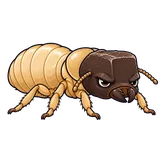 West Indian drywood termiteCryptotermes brevis
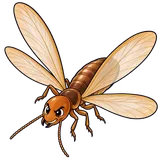 Pacific dampwood termiteZootermopsis angusticollis
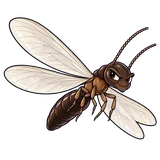 Eastern subterranean termiteReticulitermes flavipes
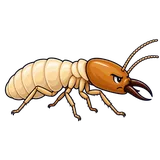 Western subterranean termiteReticulitermes hesperus
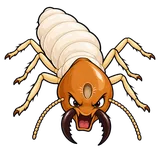 Formosan subterranean termiteCoptotermes formosanus
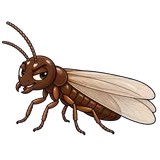 Asian subterranean termiteCoptotermes gestroi