
What does a spongy moth caterpillar look like?
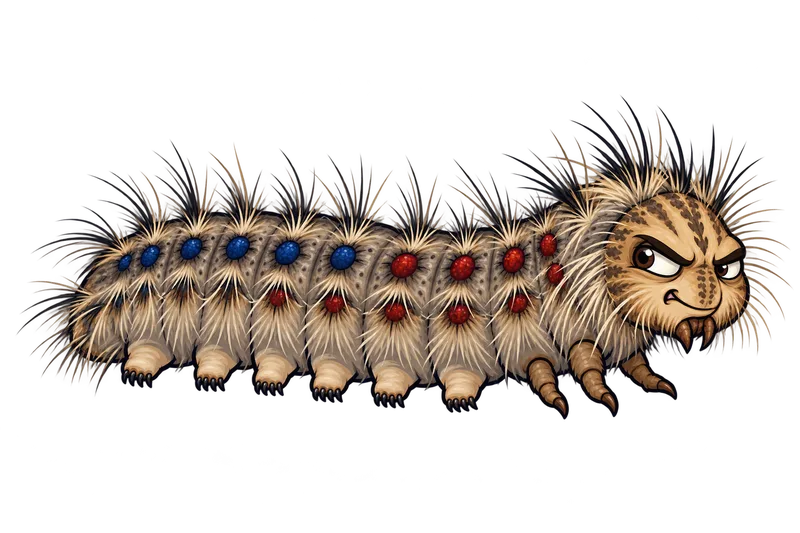
Spongy moth caterpillars hatch out as tiny, dark, first-stage larvae when spring weather warms up and apple or oak blossoms scatter their petals. Relying on a single visual blueprint can be difficult because detailed body pigmentation, hair tufts, and dorsal spot counts vary as they grow.
What is actually going on
You walk out to your back porch on a warm spring morning, coffee in hand, and notice a small, tan, oval patch stuck to the wooden railing. It looks almost like a piece of rough felt or suede glued right to the paint. You reach out to scratch it off, wondering if some critter left a mud dauber nest behind, but you are actually looking at the starting point of an invasive forest defoliator.
People usually call the adult insect the spongy moth, though older field guides and state extension bulletins still refer to it by its legacy common name, the gypsy moth. Scientifically known as Lymantria dispar, this insect spends the winter tucked away as an egg mass on trees, house siding, fence posts, or even the side of your camping trailer. The female moth lays anywhere from 100 to 1,000 eggs in each mass and covers them with a protective layer of tan hairs that gives the patch its characteristic suede-like texture.
When spring arrives and the weather warms up, those tan egg masses hatch out tiny, dark, first-stage caterpillars. If you happen to be standing near an apple tree or an oak tree right around the time the blossoms scatter their petals, you might catch these little larvae riding the breeze on fine silk threads. That dispersal wave is their grand entrance, and as they grow larger, they turn their attention to chewing through the surrounding foliage.
One detail worth pointing out is that while field guides are very good at describing what the egg stage looks like, you will not find a reliable, line-by-line visual blueprint for mature caterpillars in every basic source. Because detailed body pigmentation, hair tufts, and dorsal spot counts can vary and require careful verification, you usually want to rely on the whole picture, from the egg stage to the feeding damage, rather than trying to match a single crawling bug to a fuzzy picture on the internet.
How to tell for sure
If you are trying to figure out what you are looking at, start by checking the exact texture and appearance of the egg mass. An active, unhatched spongy moth egg mass usually measures about 30 to 60 mm long by 20 to 30 mm wide, and it feels firm, spongy, and velvety to the touch because of the dense protective hairs.
If the eggs have already hatched and gone, the physical clues change in a very noticeable way. Spent egg masses usually appear sun-bleached, fading to a pale cream or off-white color, and the surface looks like a tiny salt-shaker top dotted with numerous pin-sized emergence holes where the caterpillars chewed their way out.
Do not assume that every hairy caterpillar you spot building a silky tent in a tree branch is a spongy moth, as tent caterpillars and other native web-builders often cause similar confusion. Spongy moth larvae generally scatter across the leaves rather than building a communal web nest right in a tree fork, and they are notorious hitchhikers that turn up on outdoor furniture, firewood piles, and recreational vehicles.
If you suspect you have found an unusual infestation, remember that physical appearance alone cannot tell you whether you are dealing with the standard European strain established in eastern North America or the high-risk Asian strain monitored at international borders. Official confirmation for those specific strains usually requires molecular laboratory testing rather than a casual visual inspection in your backyard.
What usually comes next
Spotting a tan, felt-like egg mass on your property means your best practical move is to remove and destroy it before spring arrives and the hatching wave begins. Simply scraping the patch onto the ground does not work, because those eggs can easily survive a winter on the soil and hatch right on schedule when the weather warms up.
To handle this properly, grab a flat scraping tool like a sturdy butter knife, a pair of protective gloves, and safety goggles to keep stray hairs out of your eyes. Pry the entire egg mass away from the surface, making sure you catch the material cleanly.
Once you have the mass scraped off, you need to execute a reliable destruction protocol. You can either crush the collected eggs thoroughly or drop them into a bucket filled with water mixed with household liquid soap or bleach, leaving them to soak in that two-day dunk for a full forty-eight hours before discarding the liquid residue.
If you miss the egg-scraping window and find yourself watching tiny caterpillars emerge around the time your fruit trees drop their blossoms, you might consider targeted biological options. Homeowners dealing with early-stage feeding often look to registered biological sprays containing Bacillus thuringiensis, commonly known as Dipel, but timing that application to match the end of the initial larval dispersal wave is critical for it to work properly.
When to get help
There are moments when a backyard DIY approach is no longer enough and you need to bring in outside help. If you discover severe leaf defoliation across large shade trees, or if you find spongy moth egg masses and caterpillars in a region that is supposed to be pest-free, you should contact your local agricultural extension office or national biosecurity authority, such as the USDA, the Canadian Food Inspection Agency, or the Ministry for Primary Industries, to report the sighting.
High canopy treatments also demand professional intervention. Spraying towering trees or managing heavy infestations across a large property usually requires a licensed commercial pesticide applicator who has the right equipment and safety gear to handle the job without risking surrounding property or plant health.
You also need to pay attention to your own physical safety when dealing with these insects. Contact with hairy caterpillars can cause skin rashes, irritation, or allergic reactions for sensitive individuals, and certain regional look-alikes possess sharp, irritating hairs that make handling them a genuinely bad idea.
If you or someone in your household develops a severe skin rash, experiences eye contact with caterpillar hairs, or shows signs of a systemic allergic reaction, stop what you are doing immediately and reach out to a clinician, an urgent care facility, or your local poison control center for professional medical guidance.