
Are bald-faced hornets found in Washington State?
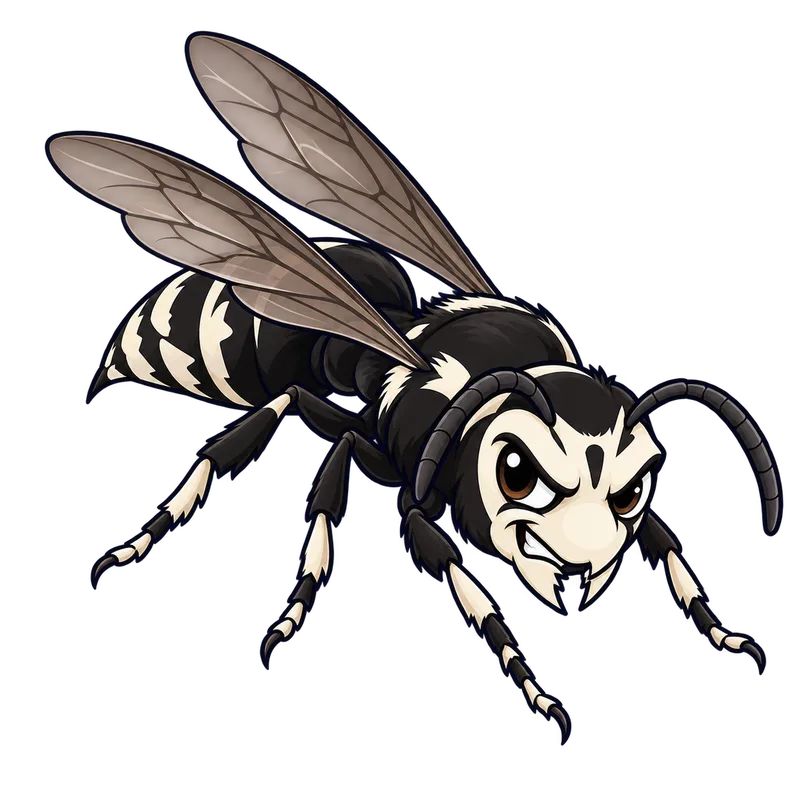
Yes, bald-faced hornets are definitely found in Washington State, where they are native and quite common in forests and neighborhoods. These black-and-white aerial nesting wasps measure about one-half to three-quarters of an inch long and feature a striking pale ivory face.
What is actually going on
Imagine standing on your back deck in August, trimming back an overgrown plum tree, when you notice a large, grayish ball hanging from a high branch. It looks like it is made of textured paper-mâché, about the size of a football, and several black-and-white insects are buzzing purposefully around a small hole at the bottom. Your first thought is probably that you have a hornets' nest on your hands, and your second is wondering if those are the headline-making hornets you have been reading about on the news.
Yes, bald-faced hornets are definitely found in Washington State, and they are quite common here. They are native to the region, making themselves at home in forests, suburban neighborhoods, and rural areas alike. Despite the name hanging at the front of their identity, they are not true hornets at all. True hornets belong exclusively to a different group originating in the Old World, whereas our native bald-faced hornet is actually a large species of aerial-nesting yellowjacket.
This naming quirk creates quite a bit of confusion every summer. When state agricultural programs launch surveillance campaigns for invasive species like the Northern giant hornet, residents frequently send in photos and specimens of bald-faced hornets, worried they have spotted an exotic invader. Knowing that our local paper-nesting wasps are well-established natives helps clear up a lot of that seasonal panic.
How to tell for sure
If you want to know what you are looking at without getting close enough to regret it, size and facial markings usually give the game away. A typical bald-faced hornet measures about one-half to three-quarters of an inch long, which is roughly the length of a standard adult thumbnail. Their most striking feature is right on the front of the head: a pale ivory or white face that stands out sharply against an otherwise jet-black body, accompanied by matching white markings near the tip of the abdomen.
It helps to compare them to what they are not. The Northern giant hornet, which kept state agencies busy before being declared eradicated from Washington, is a massive insect reaching up to two inches in length with a solid yellow-orange head. If what you are looking at is closer to the size of a large paperclip and wearing what looks like a miniature white hockey mask, you are almost certainly looking at a native bald-faced hornet.
Nest architecture is another reliable clue. Bald-faced hornets build those exposed, suspended gray paper structures high up in trees or tucked under roof eaves. Invasive yellow-legged hornets tend to construct reddish or muddy-colored paper nests, while the Northern giant hornet nests underground in rodent burrows or soil cavities rather than hanging in the air.
What usually comes next
When you spot an active nest on your property, your next move usually depends entirely on where it is hanging and how close people walk to it. If the paper globe sits high up in a remote tree or far back along your fence line, the safest bet is simply to leave it be. These insects are native predators that hunt other garden pests, and a colony far away from daily foot traffic will rarely cause any trouble.
Things change quickly if the nest hangs right beside your front door, above a children's swing set, or directly over a busy pathway, because that creates an immediate stinging risk for anyone walking past. If you plan to tackle a close threat near your living space using a store-bought aerosol spray, keep in mind that the product label is legally binding. You have to follow every single direction on that can about protective gear, timing, and spray distance, and never try to mix your own chemical concentrations to make it stronger.
When a nest is hidden inside a wall cavity, sitting too high up for a safe ladder climb, or you simply prefer not to deal with angry wasps, the best move is to call a licensed pest professional who brings the right safety equipment and heavy-duty gear to take it down.
When to get help
There are times when a backyard bug problem turns into something you should hand over to the state or a medical professional. If you happen to spot a truly enormous, suspicious insect that is longer than your thumb and features distinct yellow legs, keep your distance and skip the DIY approach. Grab a photo from a safe spot and send it straight to the Washington State Department of Agriculture online reporting page so specialists can check if an invasive species needs tracking.
On the health side, getting stung by one of these wasps usually brings sharp pain, swelling, and redness that you can handle at home with a cold pack and basic care. Their stingers are smooth, meaning they can strike repeatedly if you bother the nest, and they release chemical signals that tell the rest of the colony to join the attack.
If someone takes multiple stings or starts showing signs of a dangerous allergic reaction like trouble breathing, dizziness, swelling around the face, or hives spreading across the skin, call emergency services right away or reach out to poison control at 1-800-222-1222.