
Does home insurance cover termite damage in Australia?
No, standard home and contents insurance policies in Australia almost universally exclude termite damage. Insurers classify wood-eating insect attacks as a maintenance failure rather than an unexpected accident, leaving property owners to pay for repairs that frequently land between two thousand and ten thousand dollars.
What is actually going on
Picture standing in your kitchen on a quiet Sunday morning, coffee in hand, only to notice the paint on the door frame looks a little bubbled. You press your thumb against the wood and it sinks straight through, revealing a hollow shell packed with gray mud. Your heart drops because you immediately think of your home insurance policy and wonder if this is the moment you finally file a claim to get it fixed.
Unfortunately, standard home and contents insurance policies in Australia almost universally exclude termite damage. Insurers treat these wood-eating insects, which locals commonly call white ants, as an environmental hazard rather than an unexpected accident. They view a termite attack much like they view rust or wood rot. It happens over time, and the financial responsibility falls squarely on the property owner because routine maintenance and protective barriers are supposed to stop it before it starts.
Insurance is designed for sudden, unpredictable events like a storm ripping the roof off or a kitchen fire breaking out. Because subterranean termites can chew through internal framing for months without giving you a single hint, insurance companies classify the resulting destruction as a maintenance failure rather than an insurable disaster. Unless you hold a specialized niche rider on your policy, which is exceedingly rare and generally prohibitively expensive, you will be paying for those chewed-up studs and skirting boards out of your own pocket.
Post-construction termite treatments and repairs in Australia frequently land anywhere between two thousand and ten thousand dollars, depending on how far the colony has traveled and how much structural timber needs replacing. It is a bitter pill to swallow, especially when you have faithfully paid your insurance premiums every single month. But understanding that safety net does not exist forces a shift in how you look at property upkeep. You realize that keeping those destructive little pests away is the only real protection you have.
How to tell for sure
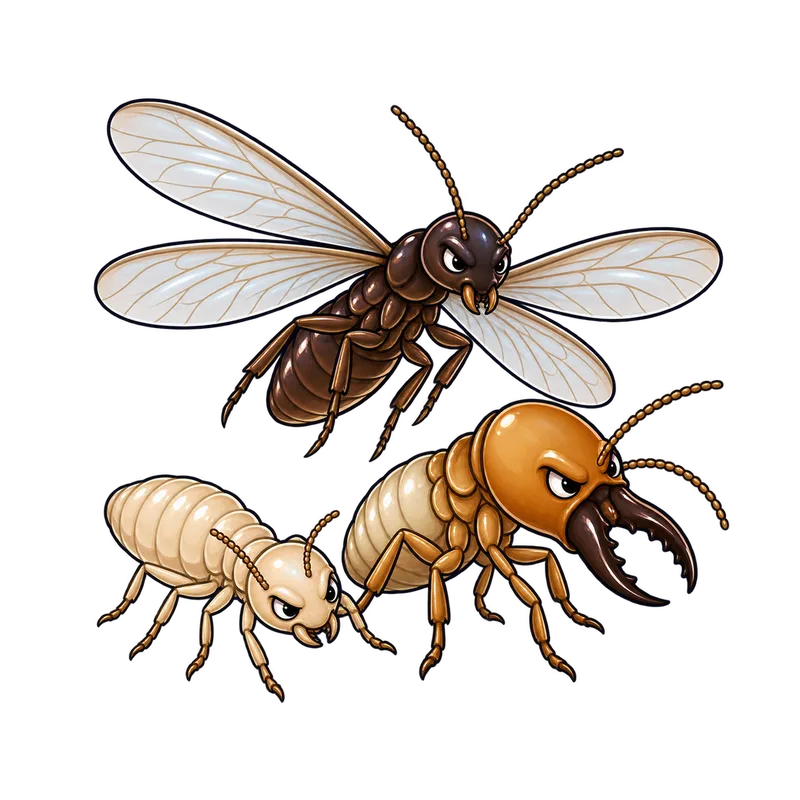
Before you start tearing down drywall, you need to know what you are actually dealing with, because not every bug with wings spells disaster. Subterranean termites are locally referred to as white ants, but they are not ants at all. If you catch one crawling around, look at its waist. Ants have a narrow, pinched waist and elbowed antennae, while termites possess a thick, straight waist and beaded, straight antennae.
You usually spot the evidence long before you spot the insects themselves. Look for mud shelter tubes running up your brick foundations or concrete piers. Termites build these earthen tunnels to protect themselves from dry air and sunlight as they travel from the soil to the wood in your house. If you tap on your skirting boards, door frames, or window sills and hear a hollow paper-like sound, or if your paint starts looking blistered and wavy, something is usually eating the wood from the inside out.
You might also find small piles of discarded translucent wings on a windowsill after a humid afternoon, which tells you that reproductive termites have swarmed to start a new colony. If you live anywhere in mainland Australia, the risk is real, though warmer coastal and humid northern regions face the heaviest pressure. In fact, Tasmania is the only state where termite management measures are not legally mandated under the building code, simply because the local climate does not support high-risk subterranean species.
When you find frass, which is insect droppings, the texture tells a story. True powderpost beetles leave fine, talcum-powder dust, while drywood termites kick out hard, six-sided pellets. If you suspect you have found European House Borers or West Indian Drywood Termites, remember that certain reportable species carry a strict legal requirement to notify government agricultural authorities.
What usually comes next
Once you find active damage or suspect a colony has moved in, your immediate practical decision involves choosing how to handle the cleanup and prevention. The golden rule here is simple, though it goes against every instinct you have. You should never spray visible termites with an off-the-shelf aerosol can from the supermarket. Hitting them with standard household bug spray just panics the colony, making them seal off that particular gallery and quietly redirect their feeding to another hidden wall in your living room.
Instead, you need to bring in a licensed timber pest inspector to perform a proper assessment following Australian Standards. A standard visual inspection is non-invasive, meaning the technician looks at readily accessible areas in your roof void, subfloor, and exterior walls without tearing down your plaster. If the damage is hidden deep inside structural cavities, you might need to authorize an invasive inspection where panels are drilled or removed so they can scope the true extent of the rot.
After the extent of the damage is clear, a professional pest management firm will typically recommend installing a complete management system. This usually involves chemical soil barriers, reticulation piping, or baiting stations placed around the perimeter of your house. Think of these barriers not as an impenetrable force field that kills every bug on contact, but rather as a treated zone that forces invading termites out into the open so they can finally be spotted.
You also need to look at what invited them in the first place. Check your concrete slab edges to make sure they remain exposed at least seventy-five millimetres above the soil so you can spot mud tubes early. Clear away any garden mulch, firewood stacks, or timber formwork touching the exterior walls, and make sure your external brick weep holes are never blocked by concrete paths or garden beds. Diverting your air conditioning and hot water overflow plumbing away from the foundation also starves the termites of the moisture they need to survive.
When to get help
There comes a point in every timber pest battle where do-it-yourself efforts completely run out of road. If you discover structural timber that has lost its load-bearing capacity, such as a sagging roof truss or a spongy floor joist that dips when you walk across it, you must bring in a licensed builder or a structural engineer immediately. Cosmetic repairs will not save a house whose skeleton is hollowed out.
You also need professional intervention whenever you plan to apply chemical termiticides or set up subterranean baiting networks. Licensed pest controllers hold the training and legal authorization required to apply registered termiticides safely under product label directions, keeping your family and pets out of harm's way while targeting the entire underground nest.
If you bought your home recently and a pre-purchase timber pest report failed to mention massive, long-standing termite damage that was clearly visible in accessible areas at the time, you may need to speak with a legal professional about pursuing a claim against the inspector's professional indemnity insurance. While your standard home insurance will turn you away, an inspector who missed obvious warning signs during a paid assessment carries professional accountability for their oversight. Stay observant, keep your subfloor dry and clear, and never hesitate to call in a licensed specialist the moment you suspect the white ants have moved in.