
Larder beetle vs carpet beetle: what different sources should you check?
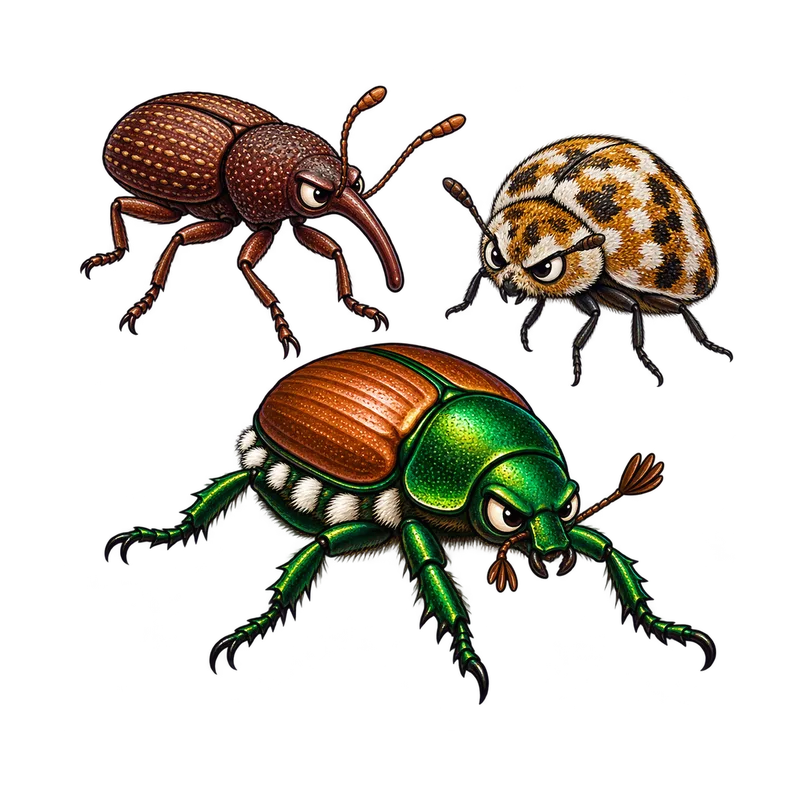
Checking for larder beetles or carpet beetles depends entirely on which scavenger you are dealing with, as their daily habits lead them to different areas. Larder beetles require checking pantries, wall voids, and attics for high protein items or dead insects. Carpet beetles require inspecting baseboards, air ducts, wool rugs, and neglected corners where hair collects.
What is actually going on
Picture walking into your kitchen on a quiet Sunday morning and spotting a medium-sized dark beetle with a pale yellow band across its back strolling across the counter. Or perhaps you notice small, irregular holes chewed through your favorite wool sweater in the back of the closet, accompanied by tiny shed skins that look like hollow insect ghosts. When you start trying to figure out what is crawling around your house, it is easy to assume any bug munching on your belongings must be coming from the same place.
The question of what different sources you should check actually depends entirely on whether you are dealing with larder beetles or carpet beetles. Even though both belong to the same family of scavengers called Dermestidae, their daily habits and feeding preferences lead them to entirely different parts of your home. Larder beetles focus heavily on high-protein animal matter like cured meats, pet food, and animal hides. Carpet beetles, on the other hand, feast on the structural keratin found in natural animal fibers like wool, silk, feathers, and fur.
Knowing what you are tracking down changes where you need to look. If you suspect larder beetles, checking the pantry or a bag of dry dog food is a reasonable first step, but you also have to check hidden spaces like wall voids and attics. If you are dealing with carpet beetles, your inspection needs to sweep across baseboards, air ducts, wool rugs, and neglected corners where pet hair and lint collect.
How to tell for sure
Identification always comes before control. Adult larder beetles are usually about one-quarter to one-third of an inch long, dark brown to black, and marked by that unmistakable pale yellow band across the front half of their wing covers, which features six dark spots. Carpet beetles are much smaller, usually ranging from one-tenth to one-quarter of an inch. Some carpet beetle adults look like tiny, rounded ladybirds covered in an intricate mosaic of yellow, white, and brown scales, while others are solid, shiny black or dark brown.
The larvae are where things get even more telling, especially if you take a close look with a hand lens. Larder beetle larvae grow up to half an inch long, are covered in stiff dark hairs, and feature two distinct, upward and backward curved horn-like spines on their tail end, known as urogomphi. Carpet beetle larvae look completely different. Varied carpet beetle larvae carry bundles of spear-shaped barbed hairs called hastae, while black carpet beetle larvae are carrot-shaped with a long, brushy tail tuft of golden-brown hair.
One common belief is that finding larder beetles means your pantry is overrun, but that is not always the case. In many residential settings, the primary reservoir for larder beetles is actually a collection of dead overwintering insects like cluster flies and boxelder bugs, or a deceased rodent trapped inside an inaccessible wall partition, floor void, or attic. Larder beetles do not typically attack clean woolen fabrics unless those items are heavily contaminated with food oils, grease, or blood. Carpet beetle larvae, however, will readily chew through clean animal fibers and can also trigger carpet beetle dermatitis, which is an allergic reaction to those microscopic larval hairs rather than an actual insect bite.
What usually comes next
Once you have figured out what is crawling around, you need a sensible plan of attack, which usually starts with thorough cleaning and physical removal. For carpet beetles, reach for the vacuum to clean out larvae, adult bugs, cast-off skins, and hidden dust bunnies from baseboards, floor crevices, and the edges of rugs. Take that vacuum bag right outside, seal it up in plastic, and toss it in the trash. For larder beetles, your job is to track down the hidden protein source, which might be an ancient bag of dog food out in the garage or a pile of dead cluster flies tucked away in the attic insulation.
When you are dealing with infested sweaters and blankets, freezing is a solid way to sort the problem out without buying harsh chemicals. Put the clothes into sturdy plastic bags, squeeze out the extra air, and seal the bags tight. Keeping them at minus four degrees Fahrenheit for 7 days will finish off every life stage of the bug. Leave them sealed inside those bags for up to 24 hours after taking them out so they can warm up slowly. That little trick keeps condensation on the outside of the plastic instead of soaking your favorite woolens.
You can also keep pantry pests away by moving dry foods, grains, and pet kibble into thick glass, heavy plastic, or metal containers with tight lids. If you rely on cedar chests to keep moths and carpet beetles away from your sweaters, remember that cedar oils only work on tiny newly hatched larvae, and cedar furniture past 36 months old has lost its protective punch entirely.
When to get help
There are times when cleaning and freezing just will not cut it, and knowing when to call in outside help keeps everyone safe and sound. If anyone in the house develops strange skin rashes, stubborn itching, red bumps, or trouble breathing, have them talk to a doctor or a skin specialist right away for proper medical care.
If you keep finding larder beetles because of dead rodents or dormant insects trapped inside your walls, you will need to bring in licensed pest control professionals who know how to drill into voids, apply dust treatments, and seal up the structure. And if you ever suspect you have stumbled upon the heavily regulated Khapra beetle in imported food shipments or grain storage, you must report it immediately to state or national agricultural authorities.