
What kills bed bug eggs?
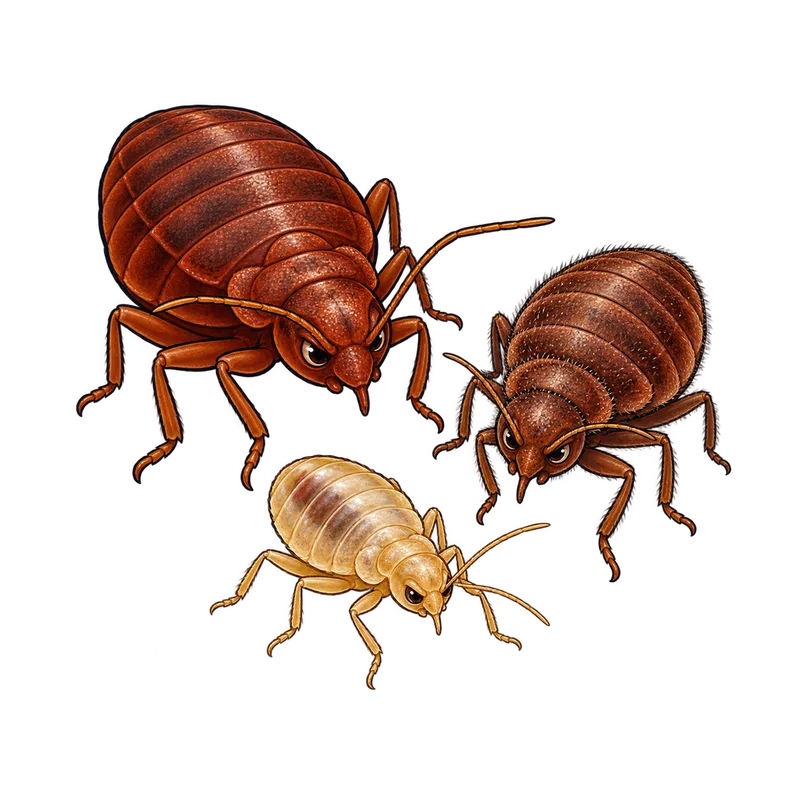
Bed bug eggs are killed by direct physical heat or specialized chemical agents that penetrate their protective shell, because standard liquid pesticides fail against unhatched eggs. Effective methods include thirty minutes in a household dryer on high heat for washable items, or commercial steam units delivering moist heat above two hundred twelve degrees Fahrenheit.
What is actually going on
You are standing in the middle of your bedroom on a Tuesday evening, holding a flashlight in one hand and an old credit card in the other, peering intently into the wooden crevices of your bed frame. You spotted a few tiny, pearly-white specks glued so tightly inside a screw hole that they refuse to budge even when you scrape at them. Those are bed bug eggs, and finding them usually prompts a sudden wave of panic about how to get rid of them for good.
To kill bed bug eggs, you have to bypass the chemical sprays that work so well on adult bugs. Most standard liquid pesticides you buy at the hardware store will leave active residues that kill crawling bugs over time, but they fail entirely against unhatched eggs. The egg shell acts as a sturdy biological armor that shields the developing embryo from desiccation and standard chemical residues. If you rely solely on a typical spray bottle treatment, those eggs will simply incubate and hatch right on schedule, leaving you wondering why the infestation bounced back two weeks later.
The reliable way to destroy bed bug eggs is through direct physical heat or specialized chemical agents that can penetrate that protective shell. Because female bed bugs cement their eggs deep inside dark cracks, mattress seams, and screw holes using a fluid that acts almost like superglue, simple vacuuming or routine surface wiping will not clear them out. You need targeted methods that reach a lethal temperature or use vapor to destroy the embryo inside before it has a chance to emerge.
At normal room temperature, those tiny white eggs take about six to ten days to hatch, developing distinct red eye-spots right before they pop open. That biological timeline explains why a single treatment is rarely enough. Even if you manage to wipe out every crawling adult in the room today, any unhatched eggs left behind will release a fresh wave of hungry nymphs a week or so later, making a planned follow-up step essential for true eradication.
Bed bug eggs are tiny, measuring only about one millimeter in length, which makes them roughly the size of a pinhead or a grain of salt. They usually appear pear-white, elongate, and pear-shaped, and they are firmly glued to surfaces rather than resting loosely like dust or lint. If you look at them under a magnifying glass after a few days of incubation, you can usually spot tiny red eye-spots developing inside the shell.
People often confuse these eggs with debris, mold spores, or lint, but the key giveaway is their secure attachment to the substrate. You will usually find them tucked away in hidden harborages such as the tufts and seams of a mattress, the wooden joints of a box spring, behind loose wallpaper, or inside the threaded screw holes of a bed frame.
It is also important to rule out look-alike pests before you start treating the room. If you happen to find similar eggs or small bugs near an attic or a chimney, you might actually be dealing with bat bugs or bird bugs instead of the common bed bug. Distinguishing between them usually requires a close look at the tiny hairs on the thorax, the shield-like segment right behind the head. Bed bug hairs are strictly shorter than the width of their eye, while bat bug hairs are equal to or longer than that eye width, a detail that usually demands a ten times magnification lens to verify properly.
How to tell for sure
Once you confirm the presence of eggs, your most practical decision is choosing between high-heat treatment for washable items and professional thermal remediation for structural voids. If you are dealing with removable textiles, clothes, or plush items, skip the hot water wash and head straight for the clothes dryer. Throwing dry items into a household dryer on high heat for thirty minutes acts as a lethal sauna that destroys all hidden eggs without requiring you to wash every single piece of clothing you own.
For the mattress, box spring, and structural frame, your decision shifts toward containment and professional intervention. Putting certified, escape-proof zippered encasements over your mattress and box spring traps any existing eggs and bugs inside an impenetrable barrier, preventing newly hatched nymphs from feeding so they eventually starve.
At the same time, if the infestation extends deep into wall voids, baseboards, or complex furniture joints where household appliances cannot reach, your best path is usually to engage a licensed professional. They can deploy commercial steam units that deliver moist heat above two hundred twelve degrees Fahrenheit, or use whole-room thermal remediation systems that raise ambient temperatures between one hundred twenty-eight and one hundred forty degrees Fahrenheit for up to ninety minutes to penetrate every cold spot in the room.
What usually comes next
You should involve a professional pest management service when an infestation spans multiple rooms, affects a multi-unit apartment building, or proves resistant to basic household containment efforts. Apartments and shared housing structures require coordinated inspections of adjacent units because bed bugs easily travel through wall voids and electrical chases, meaning that treating a single room will just lead to a swift reinfestation from surviving eggs next door.
You also need professional assistance when dealing with whole-room thermal remediation or structural fumigation, as these methods require specialized industrial equipment, precise temperature monitoring in hidden voids, and strict adherence to safety regulations. Applying restricted chemical fumigants without professional training poses severe health risks and violates federal and state pesticide laws.
When to get help
On the medical side, remember that skin marks alone cannot confirm a bed bug infestation, since twenty to thirty percent of people show no visible reaction to bites at all. If you or someone in your household experiences severe itching, a spreading skin rash, systemic allergic reactions, or signs of a secondary bacterial infection from scratching, stop trying to diagnose the issue at home and consult a licensed physician, an urgent care clinic, or your local poison control center right away.