
What should Minnesota homeowners inspect on ash trees for emerald ash borer?
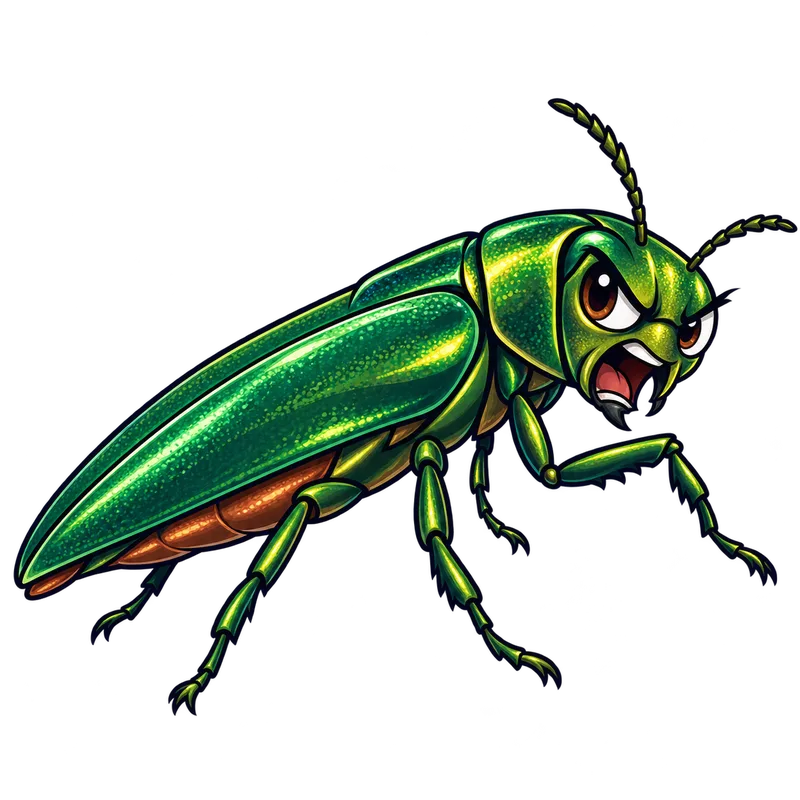
Minnesota homeowners should inspect their ash trees for top-down branch thinning, vertical bark splits, distinct D-shaped exit holes measuring a few millimeters across, and woodpecker activity known as blonding. You also need to check the upper canopy to see if it has lost more than half of its leaves, which determines whether the tree can still be saved.
What is actually going on
You are standing in your yard with your morning coffee, looking up at the ash tree by the driveway, and you notice the top branches look a bit thin and sparse. It is easy to chalk that up to a dry summer or normal aging, but if you live in Minnesota, that top-down thinning is often the first quiet warning sign of emerald ash borer. These metallic green beetles do not start chewing at eye level where you can easily spot them. Instead, they fly straight for the upper canopy, where the females lay tiny eggs in the bark crevices.
When those eggs hatch, the larvae bore straight into the inner bark and start carving out winding, flat, serpentine feeding tracks packed with sawdust-like excrement. That internal damage acts like a dam, completely severing the tree's internal plumbing. Water and nutrients can no longer reach the upper branches, which is why the crown starts dying back while the lower trunk might still look deceptively green.
As the infestation moves down from the canopy over the next few seasons, the tree tries desperately to keep itself alive. You might notice a sudden, dense cluster of leafy sprouts bursting directly from the lower trunk or root collar, which is basically a botanical panic response to upper vascular failure. At the same time, the tree tries to heal over the internal larval tunnels by growing callus tissue beneath the bark, resulting in long vertical splits that stretch for a few centimeters.
How to tell for sure
Do not wait to find a live beetle to confirm what is happening, because those metallic green adults are rarely sitting still where you can inspect them. Instead, look for the physical signatures they leave behind on the wood. Walk around the trunk and scan for vertical bark splits, and check accessible bark areas for distinct, D-shaped exit holes that measure precisely a few millimeters across. You can picture that hole as roughly the size of a small letter D punched right into the bark.
You will also want to look closely at the woodpecker activity on the tree. When birds figure out there is a feast of beetle larvae hiding underneath the bark, they go to work stripping off the dark outer layers. This leaves behind bright, light-colored patches on the trunk that foresters call blonding. If you see peeling bark on the main stem, pull back a loose piece to check for those flat, S-shaped larval galleries packed with waste in the cambium layer.
One common doubt you might have is whether those holes could belong to something else, like a native wood borer or a carpenter ant. Native ash borers usually leave round or oval exit holes rather than crisp D-shaped cuts. Also, make sure your tree is actually an ash before you start panicking over every borer symptom. True ash trees feature opposite branching and compound leaves, setting them apart from look-alikes like boxelder or mountain-ash.
What usually comes next
Once you spot these warning signs, you have to decide whether the tree is worth trying to save or if it has crossed the point of no return. If the upper canopy has lost more than half of its leaves and shows severe dieback, the vascular system is too far gone for chemical treatments to do any good. At that stage, trying to treat the tree is just throwing money at a stump in waiting, and removal is usually the only sensible path forward.
For trees that still retain a mostly healthy crown with less than half of the canopy compromised, preventive chemical treatments can buy you some time. Systemic insecticides work by moving up through the tree's vascular system to poison the larvae feeding inside the bark. You cannot just spray the leaves in mid-summer and expect results, because contact sprays only touch the surface. Systemic treatments like soil drenches have to go down through the roots during the active spring uptake window, typically in April or May, before the pest population gets completely out of hand.
If you decide to take down a heavily infested ash tree, or if branches snap off because the dead wood has become brittle and dangerous, you have to be very careful about what you do with the leftover timber. Never haul unseasoned firewood out of your immediate county or regulated area. Transporting infested wood is the primary way this pest jumps to new forests and neighborhoods, which is why local firewood quarantines exist for a reason.
When to get help
There comes a point in any structural pest situation where a homeowner needs to step back and hand the keys to a professional. If you need to apply high-potency systemic treatments via direct trunk micro-injections, that job requires specialized gear, specific licensing, and a certified arborist who knows how to drill and dose the tree without causing unnecessary harm.
Safety is the other major factor that should push you toward calling an expert. Ash trees killed by emerald ash borer dry out and lose structural integrity with alarming speed. When major limbs or main trunks become brittle, they can snap unexpectedly under the weight of a heavy wind or a winter snowstorm, threatening your roof, your power lines, or anyone walking underneath. Large trees with significant canopy dieback require professional rigging, chainsaws, and heavy equipment to bring down safely without damaging surrounding property.
If you spot emerald ash borer signs in an area where the pest has not been officially documented yet, or if you find yourself outside a known quarantine zone, contact your local state agricultural extension office or forestry agency to report the detection. They track the spread closely and can give you guidance tailored specifically to your local region and municipal ordinances.