
Which official sources track emerald ash borer in Minnesota?
Tracking the local spread of emerald ash borer in Minnesota relies on state agricultural departments, forestry divisions, and university extension networks. These official state resources maintain regional data and quarantine maps, though identifying a new infestation often starts with everyday people reporting suspicious tree decline.
What is actually going on
You are standing in the backyard with a cup of coffee, looking up at the ash tree by the fence, and you notice the top branches look a bit thin and sad. Someone mentioned the emerald ash borer is moving through the region, and now you want to know who is actually keeping tabs on this thing in Minnesota.
While federal groups handle the big picture across North America, tracking local spread usually falls to state agencies and university extension networks. You will typically find the most relevant regional data, quarantine maps, and local sighting reports through state agricultural departments and forestry divisions, even if every single local database link changes or hides behind a shifting web page.
It is easy to assume someone is automatically tracking every single tree on your street, but much of the early warning system relies on a mix of professional traps, aerial surveys, and everyday people reporting suspicious tree decline. If you are trying to figure out whether the pest has officially landed in your specific county, you have to look past federal summaries and check the resources maintained right inside the state.
How to tell for sure
Do not panic just because an ash tree is dropping a few leaves in the heat of July, but do not ignore the warning signs either. You are usually looking for a combination of clues rather than a single smoking gun, starting with the canopy and working your way down the trunk.
The most reliable physical evidence of the beetle is the exit hole left behind when the adult emerges from the bark. These holes are usually shaped like a capital letter D, measuring 3 to 4 mm in diameter, with one flat side and one curved side. If you spot round or oval holes, you are usually looking at a different native insect, not this specific borer.
Beneath the bark, the larvae carve winding, serpentine galleries that get packed tight with sawdust-like waste. This feeding damages the internal water and nutrient transport system, which leads to vertical bark cracks measuring 5 to 10 cm long as the tree tries to heal itself. You will also usually see heavy woodpecker activity, because birds love to strip away the outer bark to hunt for the plump larvae hiding underneath.
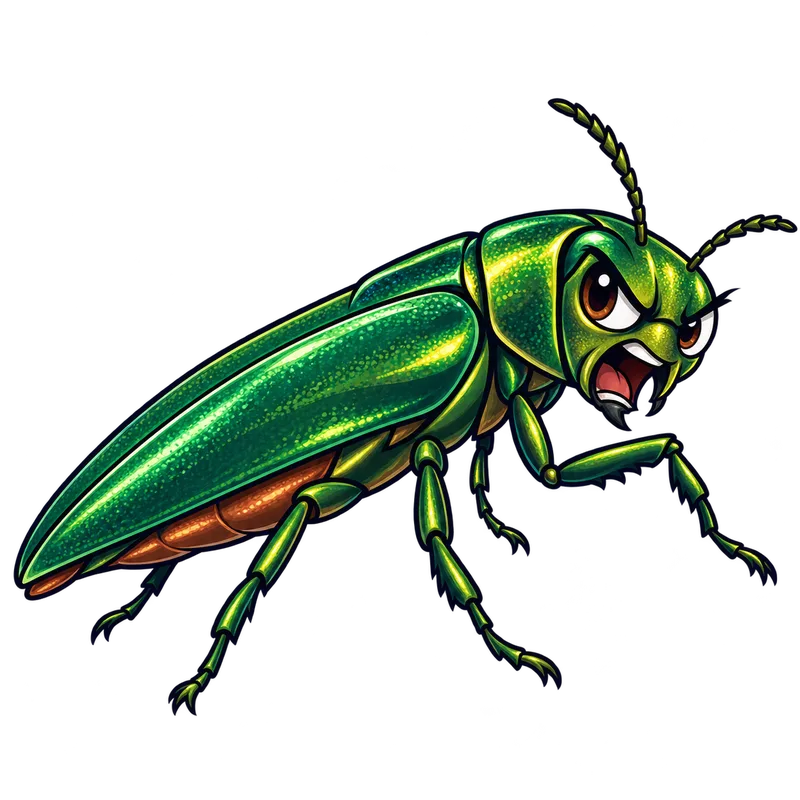
Adult beetles themselves are small, slender, and bright metallic green, usually measuring 7.5 to 13.5 mm long. Because many harmless native insects share a metallic green color, confirming a beetle visually usually requires a 10x magnification hand lens to check its fine anatomical details, or an expert review by a plant diagnostic clinic.
What usually comes next
Once you spot the signs or confirm that your county is part of an active infestation zone, you have to decide whether your ash trees are worth saving or if it is time to plan for removal. This choice usually depends entirely on the current health of the tree and how much canopy has already died back.
If an ash tree has lost more than 30% to 50% of its canopy, trying to treat it with insecticides is usually a waste of time and money. Systemic treatments rely on a healthy, functioning vascular system to suck the active ingredients up from the roots and carry them into the branches. When the internal plumbing is already destroyed by years of larval feeding, the medicine simply cannot get where it needs to go.
For trees that are still mostly healthy and caught early, chemical management usually involves systemic options like imidacloprid applied as a soil drench around the base, or emamectin benzoate injected directly into the trunk by a professional. These treatments are typically applied in April or May before the active feeding season ramps up. Contact sprays using active ingredients like permethrin or bifenthrin are sometimes used on the trunk bark in early May and early June to catch adult beetles before they lay eggs, but these require precise timing.
Regardless of whether you treat or remove, the most critical rule is stopping the human-assisted spread. Moving unseasoned firewood across county or state lines is the easiest way to give these pests a free ride to new territory, so the best practice is always to buy and burn your firewood locally.
When to get help
There comes a point where DIY tree inspection stops being practical and you need to bring in outside help. If you suspect an emerald ash borer infestation in a county or area where the pest has not been officially documented yet, you should contact your state department of agriculture or a university extension diagnostic lab so they can verify the finding.
You also need a professional certified arborist whenever a treatment requires specialized equipment, such as direct trunk injections of emamectin benzoate. Trying to drill and inject chemicals without proper training can easily harm the tree further.
Safety is the final deciding factor. Ash trees that die from a borer infestation dry out and become brittle with terrifying speed. If a dead or declining ash tree is looming over your roof, your driveway, or utility lines, do not attempt to prune or drop it yourself. Hire a professional tree service with the right rigging equipment and heavy machinery to take it down safely before a storm finishes the job for them.