
Which termite signs in a Florida home suggest a drywood species?
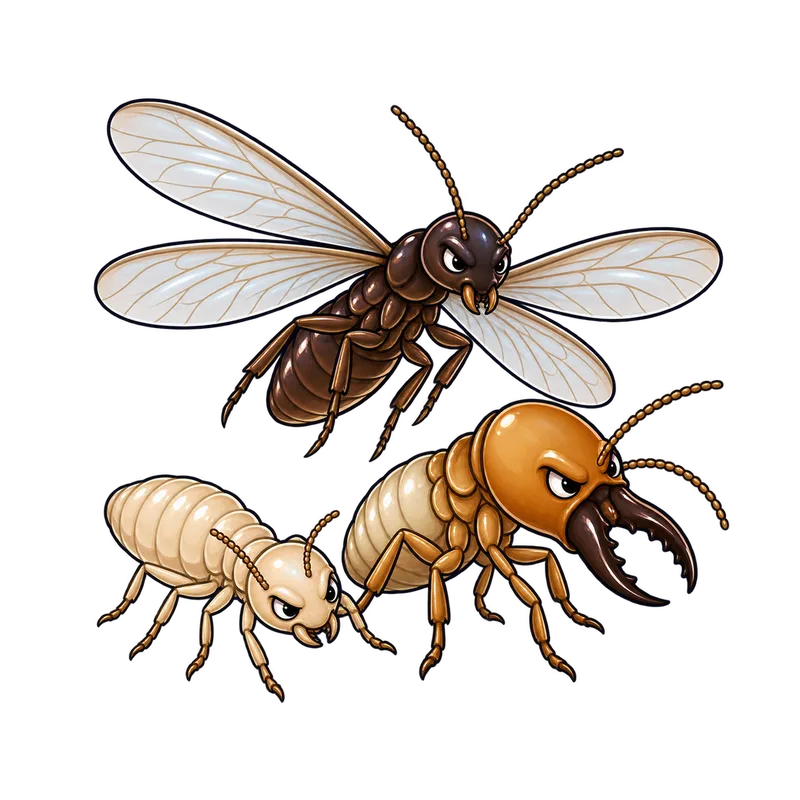
Drywood termites in a Florida home are suggested by conical piles of hard, six-sided fecal pellets, clean cross-grain wood galleries completely free of soil, and discarded wings found without any mud tubes. Confirming an active infestation depends on whether a fresh pile of pellets reappears in the exact same spot within three to seven days after cleaning.
What is actually going on
Imagine walking into your Florida guest bedroom on a quiet Tuesday morning and spotting a tiny, neat mound of what looks like coarse pepper sitting right on the white baseboard. You wipe it away with a damp paper towel, figuring it is just dirt tracked in from the porch, only to find the exact same little pyramid waiting for you in the exact same spot twenty-four hours later. That is usually your first introduction to a drywood termite infestation, and it is a completely different beast than the subterranean variety most homeowners worry about.
In a Florida home, a drywood infestation is primarily indicated by hard, elongate, six-sided fecal pellets dropped from tiny kickout holes into conical piles, clean cross-grain wood galleries completely free of soil, and discarded wings found without any mud tubes. Unlike subterranean termites that need a subterranean expressway of wet soil and saliva-mixed mud to survive, drywood termites check into a piece of sound timber and never leave. They spend their entire lives sealed inside the wood, eating their way through rafters, window sills, and door frames while generating moisture internally as a metabolic byproduct of digesting cellulose.
You might wonder why their waste looks so strange compared to ordinary sawdust or insect droppings. It comes down to their biology. Drywood termites process wood in an environment so efficient at water conservation that their hindguts use specialized rectal plates to squeeze out every drop of moisture before expelling the waste. That mechanical compression stamps six flattened sides and six distinct longitudinal ridges onto every single pellet. When the colony needs to clean house, they push these dry, sand-like pellets through tiny round exit ports, creating those telltale conical piles on the floor or window sill below.
How to tell for sure
Finding suspicious debris is one thing, but confirming a drywood species requires looking closely at physical details that set them apart from other wood-munching pests. You usually want to start with a magnifying glass because the definitive proof is microscopic.
The primary sign is the frass pellet itself. Individual drywood termite pellets average less than one-twenty-fifth of an inch long and feature those characteristic six concave sides and six ridges. If you sweep up a pile and see fine, flour-like powder instead of hard, distinct little barrels, you are usually looking at true powderpost beetles rather than termites. If the piles contain gritty, oval pellets, you might be dealing with anobiid beetles. Carpenter ants, by contrast, leave behind messy heaps of fibrous, sawdust-like wood shavings mixed with discarded insect parts because they do not actually eat the wood they excavate.
You should also look closely at the damage pattern inside the wood. Drywood termites chew indiscriminately across the grain of the timber, cutting through soft springwood and hard summerwood alike to carve out broad, smooth chambers. Subterranean termites eat only the soft springwood, leaving hollowed-out rings that look like a layered sandwich filled with mud and mastic spotting.
Take a look around window sills and light fixtures for discarded wings as well. Native southeastern drywood termites typically swarm at nightfall during May or June, while introduced species have their own distinct swarming seasons and physical traits. Finding shed wings indoors in the complete absence of earthen mud tubes strongly points to an established drywood colony hidden somewhere in the structure.
What usually comes next
Once you spot those characteristic pellets or wings, you have to figure out whether you are looking at an active colony or just the ghosts of a dead one. Pellets can sit quietly tucked inside dry gallery walls for years, only getting shaken loose when someone slams a heavy door or stomps across the floor overhead.
The most practical first step is a simple cleaning test. Vacuum or wipe away every trace of the pellet pile, clean the surface thoroughly, and keep an eye on that exact spot every day for three to seven days. If a fresh little pyramid of six-sided pellets pops back up, you have active termites currently chewing through your framing. If nothing shows up after a week, those pellets might just be historical debris from an old infestation that bit the dust long ago.
When you confirm active re-emergence, the choice generally comes down to how far the problem has spread. For isolated, easy-to-reach infestations in a single door frame or window trim, a licensed professional can run a localized treatment by drilling small holes into the galleries and injecting approved dusts or liquid formulations. When colonies are widespread, hidden deep within structural wall studs, or scattered across multiple rooms under the roof rafters, whole-structure tent fumigation is usually required to reach every hidden nook where these insects might be feeding.
When to get help
Termites do not sting, carry human pathogens, or transmit infectious diseases, and a soldier termite pinching your skin if handled carelessly poses no systemic health threat. However, the structural risks are entirely real. Because drywood termites hollow out wood from the inside while leaving a paper-thin outer shell completely intact, major load-bearing beams, roof rafters, and joists can lose their structural integrity without showing obvious outward signs until something sags or fails under a heavy load.
You should bring in a licensed pest control operator immediately if you discover pellet piles in multiple rooms or attic locations, if probing with a tool reveals hollowed-out structural framing, or if you cannot tell whether you are dealing with drywood termites, aggressive Formosan subterranean termites, or wood-boring beetles. Trying to inspect a dark attic yourself also carries very real physical hazards, such as misjudging a ceiling joist and plunging your foot right through the drywall below.
Leave the diagnostics and structural applications to the professionals regulated by state agricultural authorities. If you or anyone in your household experiences unexpected allergic reactions, respiratory distress, or suspected pesticide exposure during any pest control procedure, contact a clinician, urgent care facility, or poison control center right away.