
Why are swallow bugs in the house?
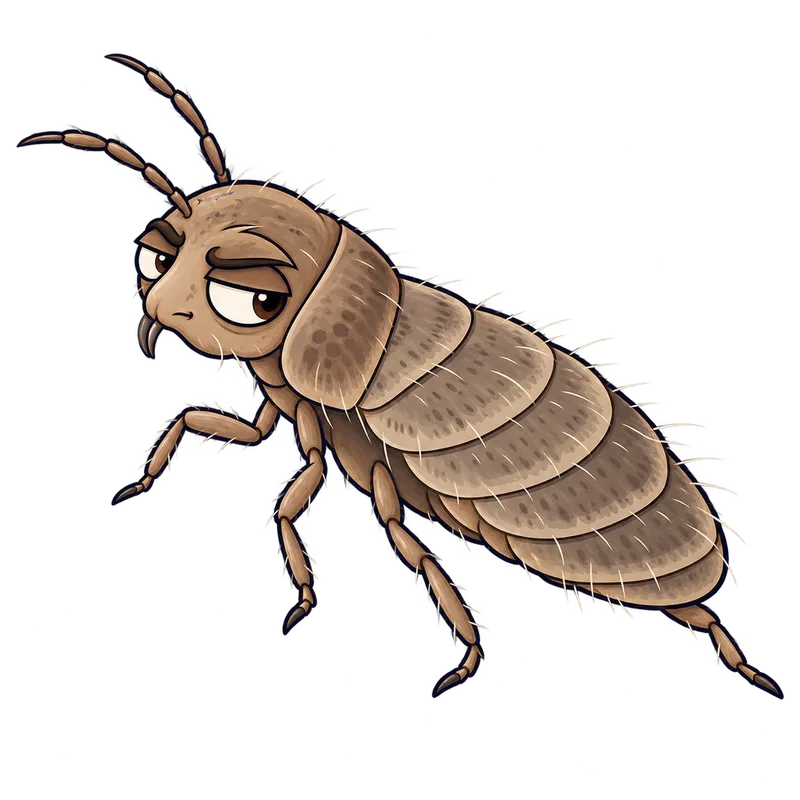
Swallow bugs show up inside houses in autumn because cliff swallows migrate south and leave behind empty mud nests on exterior eaves. Cut off from their natural bird hosts, these hungry insects wander through tiny cracks and windows in search of food.
What is actually going on
You walk into your upstairs guest bedroom on a crisp October morning and notice a small, flat, brownish bug crawling slowly down the window frame. Naturally, your stomach drops because it looks uncomfortably like a bed bug. Then you see another one near the ceiling trim, and maybe a third one by the chimney mantle. If you step outside and look straight up, you will likely spot the reason on the exterior eave: a cluster of dried, jug-shaped mud nests built by cliff swallows during the summer.
Swallow bugs show up inside human living spaces because their natural hosts have just checked out. Cliff swallows and barn swallows use these mud nests to raise their young through the warm months, and swallow bugs live right inside the nests as parasites, feeding on the birds. When autumn arrives, the swallows abandon the nests and migrate south for the winter.
Left behind in empty mud shells, the bugs find themselves suddenly cut off from their only food source. Driven by severe hunger, these wingless insects start wandering. They crawl through tiny structural cracks, around window casings, down through attic access points, and past electrical outlets until they spill out into your rooms.
You might wonder why they bother coming inside if humans are not birds. The truth is that hungry swallow bugs are not picky about who they bite when they are starving, and they will readily bite humans, cats, or dogs in a desperate search for a meal. However, they cannot reproduce or sustain a long-term population on human blood alone. They are obligate avian parasites, meaning they need bird blood to complete their life cycle. Once the wandering bugs finish burning through their remaining energy, they simply die out on their own as long as they cannot get back to a bird host.
Trying to figure out what you are looking at is usually the hardest part because swallow bugs, bat bugs, and common bed bugs look almost identical to the naked eye. An adult swallow bug is about the size of an apple seed, oval, flattened, and reddish-brown when unfed. If it has recently fed on a stray host, it will look swollen and darker red, while tiny immature nymphs can be no bigger than a poppy seed.
A standard magnifying glass or a quick snapshot on a smartphone usually will not cut it for a confident identification. If you bring a specimen to a local university extension office or an entomology lab, they will place it under a high-powered microscope to look at features you cannot see from your couch.
They usually check two specific diagnostic markers. First, they look at the final two segments of the insect antennae. In a swallow bug, those two segments are nearly equal in length, whereas in a common bed bug, the very last segment is only about half as long as the one before it. Second, they measure the tiny fringe hairs along the sides of the middle body shield against the width of the insect eye. On swallow bugs and bat bugs, those fringe hairs are as long as or longer than the eye width, while bed bug hairs are distinctly shorter.
How to tell for sure
Since you cannot easily run those checks on your own kitchen table, your best clue is simply looking around your room. Finding a few flat bugs near an upper-story window, a vaulted ceiling, or an attic hatch in autumn or early spring usually points straight to an exterior bird nesting site rather than an interior bed bug infestation.
The most practical choice you face right now is to stop yourself from tearing apart your bedroom or throwing out expensive mattresses. Panic tends to make people buy harsh indoor bug bombs or trash their furniture, which completely misses the mark because swallow bugs do not infest beds or breed in sofas.
What usually comes next
Your best move is to focus entirely on the boundary between the outside and the inside of your house. Since these bugs are drifting in from exterior bird nests under your roofline, indoor chemical treatments on your bedroom baseboards will accomplish very little. Instead, you need to seal off their pathways. Once the weather cools down and the migratory birds are completely gone for the season, clear away the old mud nests from your eaves and block interior entry gaps with caulk or silicone sealant around window frames, attic hatches, and light fixtures.
If you are dealing with nests high up on complex rooflines or if you are not entirely sure whether you are fighting swallow bugs, bat bugs, or regular bed bugs, contact a licensed pest control professional. They can handle high-elevation exclusion work safely and verify the exact pest so you do not waste time treating the wrong part of the house.
When to get help
There are moments when a do-it-yourself approach stops making sense and you need to hand the problem over to someone else. If the swallow nests are attached to a high third-story eave or a steep roofline where climbing a ladder puts you at serious risk of injury, call a professional contractor who has the right scaffolding and safety gear.
You should also involve a professional if you suspect the bugs coming out of your walls are actually bat bugs instead of swallow bugs. Bats can carry rabies, and finding mammalian parasites in your attic means you are dealing with a different set of safety risks that require specialized wildlife exclusion rather than simple nest removal.
If you are waking up with itchy red welts, remember that skin marks alone cannot tell you which bug bit you. If the bites become severely inflamed, painful, or show signs of a secondary bacterial infection from scratching, go see a clinician or a doctor for proper medical evaluation and treatment.
Finally, remember that native swallows and their active nests are protected under federal wildlife laws in the United States, meaning you cannot legally knock down active nests containing eggs or chicks during the spring and summer breeding season. If you manage a large commercial property or find yourself tangled in complicated local wildlife regulations, consult your state wildlife agency or a licensed pest management operator before making any structural changes to the building exterior.