
Are emerald ash borers found in Oregon?
Official records do not confirm that emerald ash borers are established in Oregon right now. You can check the daily monitoring maps from the Oregon Department of Agriculture to get a definitive reading for your specific county. Moving unheated ash firewood across county or state lines remains the absolute easiest way to spread these pests.
What is actually going on
Picture walking down your street on a warm July afternoon, looking up at the ash trees lining the sidewalk, and wondering if that metallic green beetle making the news in other states has finally crossed the border. It is a reasonable concern if you live in the Pacific Northwest and care about the local canopy.
The short answer is that official records do not confirm that emerald ash borers are established in Oregon right now. While these destructive wood-boring insects have marched across vast stretches of North America and even turned up in neighboring British Columbia, you usually have to check the daily monitoring maps from the Oregon Department of Agriculture to get a definitive reading for your specific county.
It helps to understand how this insect travels. Adult beetles can fly short distances on their own, but the real jump dispersal happens when someone tosses a bundle of firewood into the back of a truck, drives a few hours away, and leaves it sitting at a campsite. That hidden hitchhiker scenario is how an isolated pest population suddenly pops up hundreds of miles from the nearest known infestation.
The life cycle of this beetle is relentless once it takes hold. In late spring and summer, adult females deposit eggs in bark crevices. Upon hatching, the larvae bore straight into the inner bark and cambium layer. Over the following months, they feed on the phloem, creating a winding maze that eventually blocks off every lane of the tree's internal water grid.
How to tell for sure
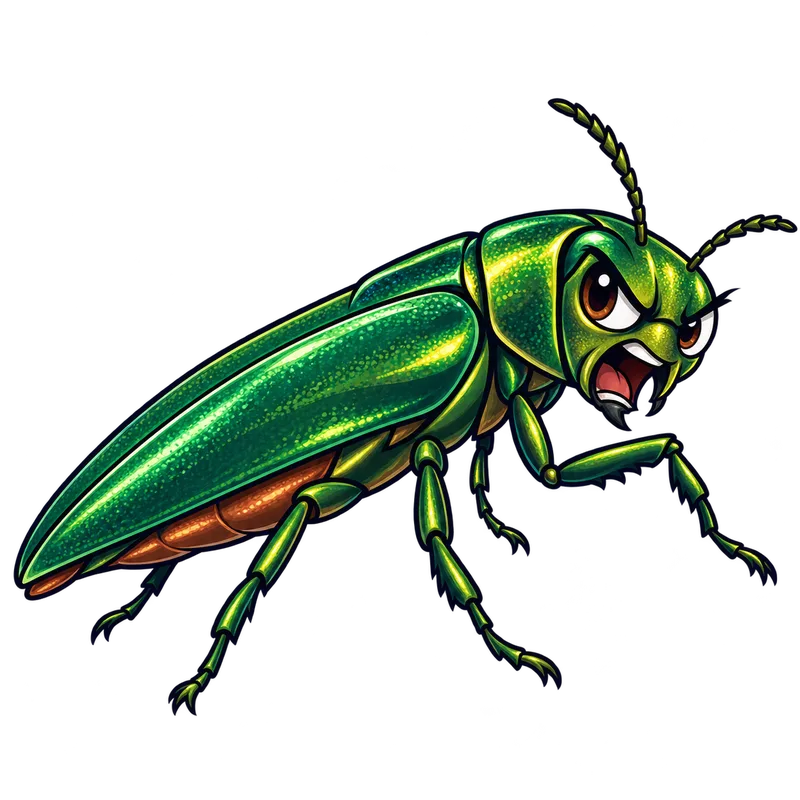
If you are staring at a declining ash tree in your yard and want to know what is killing it, you usually need to look past the leaves and inspect the bark. The adult beetle itself is quite small, measuring only about one-third of an inch long, with a slender, iridescent metallic green body that can easily catch your eye if it lands on your shirt.
The most reliable sign of trouble is the exit hole left behind when a mature adult chews its way out of the trunk. Take a tiny hole punch shaped like a capital letter D and stamp it straight through the bark. That is the exact shape and size of the exit hole, measuring around three to four millimeters across, which sets it apart from the round holes left by native beetles.
Beneath that outer bark, the larvae carve a winding, serpentine highway that looks like a compressed letter S, packed tightly with fine sawdust called frass. As those tunnels multiply, they girdle the vascular system and trigger classic symptoms. You usually see the upper canopy thinning out from the top down, epicormic shoots sprouting frantically around the base of the trunk as the tree tries to survive, and vertical bark cracks five to ten centimeters long over dying tissue.
Another telling indicator is woodpecker activity. Woodpeckers forage intensively for overwintering larvae, stripping away the dark outer bark layer and leaving bright, light-colored patches across the trunk that foresters call flecking or blonding.
What usually comes next
Noticing odd damage on your ash tree means you have to decide what to do next, and those choices depend on how much of the tree is still green. If an inspection shows that the tree has already lost more than half of its upper branches, the internal water grid is usually too far gone for treatments to save it. At that point, your best move is usually taking the tree down and planting something else in its place.
If you are dealing with a healthier tree and want to keep it alive, timing is everything. Preventive chemical treatments usually go on in the spring when active root uptake and sap movement help pull insecticides right up into the canopy. Homeowners sometimes pour liquid drenches around the roots, while tree specialists use gear to pump treatments directly into the trunk, much like getting an IV drip at the doctor.
If you are pruning dead wood or hauling logs for a weekend campout, do yourself a favor and keep that wood local. Moving unheated ash firewood across county or state lines remains the absolute easiest way to spread these pests to places that have not seen them yet.
When to get help
Some jobs are simply too big or complicated for a DIY weekend, and that is when you step back and call in professionals. Standing dead ash trees dry out fast and turn brittle, meaning heavy limbs or the whole trunk can snap without warning. Taking down an unstable tree hanging over a driveway, utility lines, or a walkway takes an insured arborist with proper rigging equipment.
You also need certified help if you are looking at strong trunk treatments, since some of the most effective options require a commercial pesticide license to buy and use. Local wildlife rules also matter when you are dealing with dead trees. Woodpeckers, songbirds, and even bats frequently use hollow ash trunks for nesting, which means those active wildlife spots are protected by law and cannot just be cut down.
Since the emerald ash borer is a heavily monitored quarantine pest, finding unusual bugs or damage in an area where the beetle is not officially recorded means you should pick up the phone and call the state department of agriculture or federal plant health authorities right away.