
Cabbage looper vs other green caterpillars on brassicas: what differs?
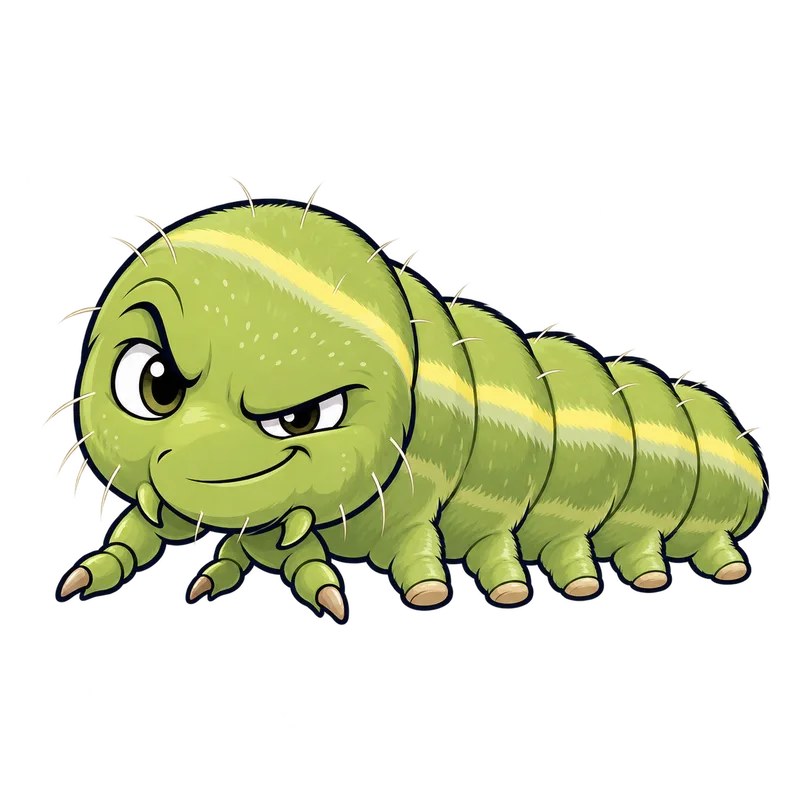
Cabbage loopers and other green caterpillars on brassicas differ in their movement, body texture, and size. The cabbage looper moves with an arching inchworm gait and grows up to 1 and 1/2 inches long, while the imported cabbageworm crawls straight, looks velvety, and reaches 1 and 1/4 inches.
What is actually going on
You walk out to the garden with your morning coffee, crouch down beside the brassicas, and notice your prized broccoli leaves look like somebody went at them with a hole puncher. Naturally, you flip a leaf over and find a green caterpillar chewing away. But before you grab the spray bottle, you have to ask yourself which green caterpillar you are actually looking at. Not all of them cause the same trouble, and treating them effectively depends entirely on telling them apart.
The main culprit people usually run into is the cabbage looper. Unlike standard caterpillars that glide along smoothly like a tiny train, the cabbage looper moves with an unmistakable arching, inchworm gait. It lacks prolegs in the middle of its belly, so it has to pull its rear end up to meet its front, forming a loop every time it takes a step. It grows up to 1 and 1/2 inches long, wears a smooth pale green suit with thin white pinstripes down its back and sides, and completes its entire lifecycle in about a month.
Right alongside it, you will often find the imported cabbageworm. This one looks like it is wearing a fine coat of green velvet because its body is covered in micro-hairs, accented by faint yellow lines. It moves in a straight, uniform crawl rather than a loop, and stays a bit shorter at about 1 and 1/4 inches long. Then you have cutworms, which are stout, dull gray or brown caterpillars that hide in the dirt by day and chew through plant stems at the soil line by night. When you unearth a cutworm, it curls right up into a tight C-shaped ball.
How to tell for sure
Watching how the pest moves usually gives away its identity faster than anything else. If it humps its back into a high arch as it crawls across your kale leaf, you are looking at a cabbage looper. If it glides forward in a straight line and has a plush, velvety texture under close inspection, you have an imported cabbageworm. For a definitive check on loopers, a hand lens will usually confirm the missing middle prolegs that force that strange walking style.
Cutworms require a different approach because you rarely see them out in the open during daylight hours. If a young brassica transplant is suddenly severed right at the soil surface overnight, scratch around the surrounding dirt with your finger. Unearthing a stout, greasy-looking gray or brown caterpillar that immediately curls into a tight C-shape usually confirms a cutworm attack.
You usually cannot identify these pests by the damage alone. Ragged holes, skeletonized leaves, and bored-out heads can look nearly identical regardless of which species caused them. Always look for the live insect and check its physical traits and movement before deciding how to handle it. Furthermore, visual checks on mature larvae give you reliable results, but tiny first-generation hatchlings or empty feeding holes usually do not provide enough evidence for a positive ID.
What usually comes next
Once you spot the culprit, you need to make a practical choice about how to protect the rest of the patch. For cutworms on new transplants, a physical barrier works best before any damage happens. You can place a stiff 3-inch cardboard collar around each stem, pushing it 1 inch deep into the soil and leaving 2 inches above ground with a tiny clearance around the stem to keep ground-dwelling caterpillars away.
For leaf-chewing loopers and cabbageworms, biological options are usually the most sensible first line of defense. Bacillus thuringiensis, commonly known as Bt, is a natural soil bacterium that works as an ingestion toxin. You generally mix 2.0 to 3.0 tablespoons of the liquid concentrate into 1 gallon of water and spray it thoroughly over the plants.
The most important detail with Bt is making sure you coat the undersides of the leaves, because that is where the caterpillars sit and feed. If you spray only the top surfaces of the leaves, it is like holding an umbrella upside down while the pests stay completely dry underneath. Bt has a zero-day wait time before harvest, but remember that the caterpillar has to eat it to work. The insect will stop feeding within hours of swallowing the bacteria, even though it usually takes 1 to 3 days to actually die and drop off the plant.
When to get help
Most home garden caterpillar issues resolve nicely with handpicking, physical barriers, or timely biological sprays, but certain situations call for an outside opinion. If you apply Bt or other approved treatments correctly and the crop damage continues to march aggressively ahead anyway, you might be dealing with a heavy population surge or late-instar larvae that have outgrown the effectiveness of microbial sprays.
You should also consult a local extension agent or a professional if you cannot figure out whether your brassicas are suffering from caterpillars, flea beetles, root maggots, or an aggressive plant disease. When chemical controls beyond simple biologicals enter the picture, always treat the product label as the final legal authority. Decisions regarding commercial-scale operations, restricted-use synthetic pesticides, or severe agricultural biosecurity threats belong strictly to licensed pesticide applicators who can inspect the site and apply local regulations safely.