
Are pill bugs insects?
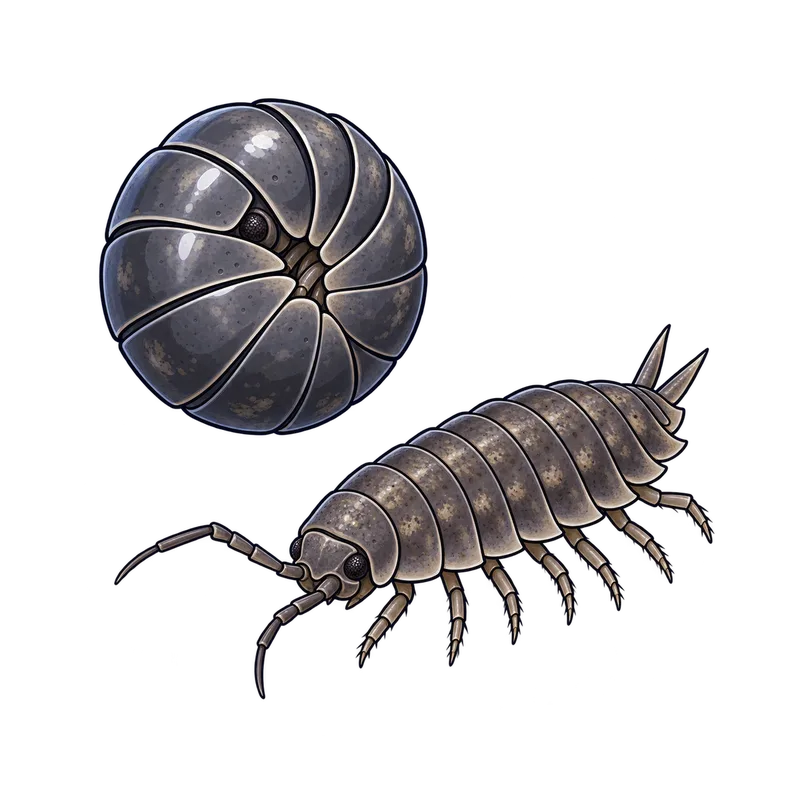
No, pill bugs are not insects because they are actually terrestrial crustaceans closely related to crabs, lobsters, and shrimp. If you count their legs and find fourteen of them arranged in seven pairs, you are looking at an isopod rather than an insect.
What is actually going on
You walk across your basement floor in your bare feet, step down onto something small and hard, and pick up what looks like a tiny, slate-gray armadillo curled into a ball. You probably call it a roly-poly, a pill bug, or maybe even a woodlouse depending on where you grew up. Because it creeps around on the floor with multiple legs, the natural assumption is that you have just stepped on an insect. It shares your basement with spiders and silverfish, after all, so it must be part of that same crew.
Except it is not an insect at all. If you look at its family tree, a pill bug is actually a terrestrial crustacean, making it a close relative of crabs, lobsters, and shrimp rather than beetles, ants, or roaches. Think of them as tiny land crabs that decided to trade the ocean for damp garden soil millions of years ago. They still carry their ancient biology around with them, which explains a lot about how they behave and why they end up dead in your laundry room.
Insects wear a dry, waxy suit of armor and breathe air through tiny holes along their sides, which lets them march around dry living rooms without a care. Pill bugs do not have that luxury. They breathe through modified, gill-like structures tucked underneath their abdomens. Because those gills need constant moisture to function, pill bugs are tied to damp environments. They do not want to live in your house because your house is too dry. When they wander inside through a gap in the foundation, they are usually lost, looking for moisture, and running out of time.
This also explains why you never have to worry about them taking over your pantry or chewing through your wooden floorboards. They do not possess the mouthparts or the biology to damage your home, eat your clothes, or nibble on your drywall. They are strictly outdoor scavengers that feed on decaying leaves, fungi, and rotting wood. When they cross your threshold, they are essentially fish out of water, trapped in a concrete desert where they will quickly dry out and die unless they find a way back outside.
You do not need a microscope or an entomology degree to figure out what is crawling across your patio, though a quick glance with your phone camera can help. Insects always have six legs attached to their middle section, and their bodies are neatly divided into three distinct parts. If you count the legs on your mystery visitor and find fourteen of them arranged in seven pairs along its sides, you are usually looking at an isopod rather than an insect.
Once you establish that you are dealing with an isopod, the next question is usually whether it is a pill bug or its very close cousin, the sowbug. Both measure about a quarter of an inch long and share that familiar slate-gray or brown color, but they have one major party trick that separates them. If you gently nudge the creature and it curls up into a tight, armored sphere, you usually have a pill bug. If it stays completely flat and you notice two little tail-like appendages sticking out of its rear end, you are looking at a sowbug.
Those rear appendages on the sowbug are not just for show, as they actually help the creature absorb water from damp soil. Pill bugs rely entirely on their ability to roll into a ball to protect their soft underside and trap whatever little humidity they have left inside their shell. Both creatures are completely harmless to humans. They do not bite, they do not sting, and they do not carry diseases that can harm you or your pets.
If you are finding tiny, fast-moving pests that jump when you get close, those are springtails, which are actual insects that also love moisture. If you see something long, flat, and covered in silvery scales with three distinct bristles on its tail, that is a silverfish. Pill bugs move rather sluggishly by comparison, plodding along like tiny armored tanks that would much rather hide under a rotting log than race across your baseboards.
How to tell for sure
The smartest practical move when you spot pill bugs indoors is to treat them like a free, battery-free moisture alarm for your house. Finding a few stray roly-polies crawling across the basement floor does not mean you need an exterminator or a heavy chemical treatment. It means somewhere nearby, dampness is finding its way in, or the outdoor soil is resting right up against your siding. Instead of grabbing a spray can, you want to focus on keeping them from getting inside in the first place through basic exclusion.
Take a walk around the outside of your foundation and look at the ground. If you have deep organic mulch piled high against the brick or siding, or if you have stacks of firewood and old leaf piles touching the house, you are basically rolling out a red carpet for isopods. Clearing a border of bare soil, gravel, or coarse sand right against your foundation creates a dry barrier that outdoor pests usually hate crossing.
Next, check your doorways and foundation gaps. A heavy-duty door sweep on the basement or garage door and a tube of silicone caulk for any cracks in the foundation will stop these slow-moving crawlers from wandering inside during a heavy rainstorm. Indoors, run a dehumidifier if your basement tends to stay damp. Once you drop the relative humidity below fifty percent, you strip away the moisture pill bugs need to survive, turning your home into a place they cannot possibly conquer.
What usually comes next
You almost never need professional help for pill bugs alone, because dry indoor air usually finishes them off within days. However, there are times when their presence points to a larger structural issue that requires an expert hand. If you are sweeping up dozens of live pill bugs every single day, your home is likely dealing with chronic water seepage through the foundation walls, a hidden plumbing leak under the floorboards, or severely compromised drainage that keeps your crawlspace constantly saturated.
In that scenario, calling a licensed waterproofing contractor or a structural specialist is the right move. They can fix the underlying drainage failures, regrade the soil sloping toward your house, or repair leaking pipes that are keeping the indoor humidity high enough for isopods to survive indefinitely. If those structural fixes still leave heavy seasonal migrations crawling through your living space, a pest management professional can apply exterior perimeter barriers or safe desiccant dusts in foundation voids to block the invasion.
When to get help
As for health risks, you can rest easy. Pill bugs do not bite humans, they do not damage your property, and they do not pose any threat to your family or pets. If you ever develop an unexplained rash, skin irritation, or physical symptoms you suspect are linked to household pests, skip the guesswork and talk to a clinician or healthcare provider to find out what is really going on.