
Do pill bugs have gills?
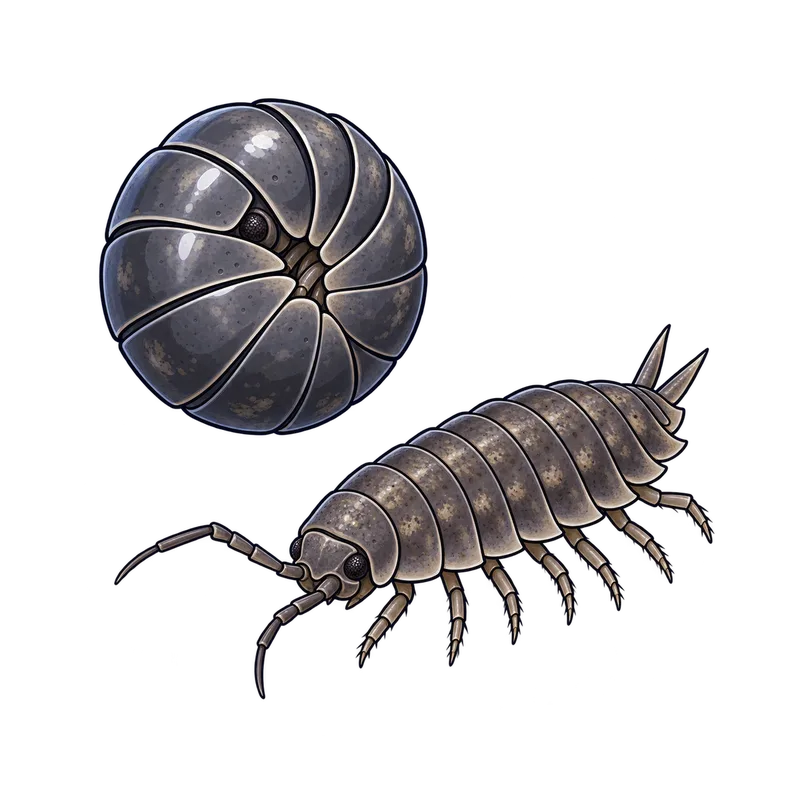
No, pill bugs do not have true submerged gills like a fish or a lobster. Instead, these land-dwelling crustaceans breathe air through specialized internal air pockets on their underside that open permanently to the outside through a single pore.
What is actually going on
Picture stepping out onto the back patio on a damp summer morning, lifting a flat patio stone, and uncovering a dozen slate-gray, armored little creatures scrambling to find shade. Someone nearby calls them roly-polies, and someone else mentions they must be some kind of insect. But if you were to ask whether those little shell-backed visitors have gills, the short answer is no, not in the way a fish or a lobster has gills. They do not possess active, submerged aquatic gills. Instead, they are land-dwelling crustaceans that breathe air through specialized, open tube-like structures located right on their underside.
That distinction tends to surprise people because pill bugs and their close relatives, sowbugs, belong to the order Isopoda, a group deeply rooted in the ocean. If you look at their family tree, their ancestors lived underwater and breathed through true gills. When these creatures made the evolutionary leap onto dry land, they brought an adapted respiratory system with them. They never developed the gated, closable breathing holes that insects use, nor did they keep submerged gills. Instead, they breathe through internal air pockets on their abdominal appendages that open directly to the outside air through a single, permanent pore.
Here is the catch that explains why you only ever find them in damp places. Unlike insects, which wear a thin waxy coating that seals in their body moisture, pill bugs lack a protective waxy layer on their outer shell. Their breathing pores stay permanently open and cannot be squeezed shut. Because gas exchange requires moisture, oxygen absorption is tied directly to water loss. If they wander into the middle of a dry living room with low relative humidity, they lose body water continuously through evaporation and transpiration. A stranded pill bug in a dry house usually dries out and dies within a day or two, acting less like a resilient household pest and more like a marine creature stranded on hot sand.
How to tell for sure
Telling a pill bug apart from other tiny creatures in the garden or basement is usually straightforward if you know what to look for, though a few similar-looking neighbors often cause confusion. You do not need a laboratory microscope for a basic ID, but a simple hand lens can help if you want to inspect their underside.
First, consider the main two types you will encounter around a house, which are pill bugs and sowbugs. Pill bugs belong to the family that can roll into a tight, spherical ball when disturbed, turning their overlapping body plates into a miniature suit of armor that protects their soft belly. Sowbugs cannot roll up into a ball. If you touch a sowbug, it tends to scurry away rather than balling up.
Look closely at the rear end of the creature to confirm the distinction. Pill bugs have a smooth, rounded posterior without visible tail parts. Sowbugs feature a pair of prominent, pointed, tail-like appendages projecting from the rear. Those rear tips act almost like built-in capillary tubes that can siphon up liquid water from a damp surface. Both pill bugs and sowbugs feature seven pairs of walking legs as adults, though tiny hatchlings emerge with only six pairs before their first molt. If you turn one over and look with a magnifying lens, you can usually spot the pale, patch-like respiratory pores on the underside of the abdomen.
What usually comes next
Finding a few pill bugs wandering across a finished basement floor usually sends people reaching for a spray bottle of household insecticide. Before spending money on chemical treatments, consider that indoor chemical sprays are generally unnecessary and ineffective as a long-term fix. Since these animals cannot survive dry indoor air, individual stragglers are usually just dying visitors that wandered in from the damp outdoors through a threshold gap or a basement window well.
The most practical decision you can make involves cutting off their moisture supply and blocking their entry points right at the exterior foundation. Take a walk around the perimeter of the house and look at what is sitting right against the siding or foundation wall. If dense mulch or damp leaf litter is piled high against the bricks, you are giving them an ideal hotel. Creating a clear, dry barrier zone makes a massive difference.
Pulling organic mulch back to a safe distance, or maintaining a narrow band of bare soil, gravel, or river rock around the foundation, lets the soil dry out quickly in the sun. Without damp debris to hide under, the isopods move elsewhere. At the same time, check the weather stripping on exterior doors and use a silicone caulk to seal up any gaps around ground-level utility penetrations. Clearing away rotting wood, old cardboard, and stacked lumber from the perimeter of the building removes the rest of their favorite hiding spots.
When to get help
Most of the time, managing outdoor moisture and sealing up a few foundation gaps keeps these creatures where they belong, which is outside in the garden breaking down decaying plant matter. However, finding dozens of live isopods day after day indoors points to an ongoing moisture issue that deserves closer attention.
If you notice heavy, continuous migrations making their way inside even after you have cleaned up the exterior perimeter, or if you suspect water is pooling where it should not, you may need professional insight. Call a building manager or a contractor when indoor dampness stems from chronic foundation wall seepage, standing water in a poorly drained crawlspace, or broken sub-slab plumbing.
On the other hand, if commercial facilities, schools, or heavy agricultural pressures are involved, a licensed pest management professional can assess the situation and apply exterior barrier treatments safely according to the product label. When an unexpected water leak or seasonal downpour drives massive numbers of these ancient crustaceans toward your thresholds, fixing the underlying drainage is always the step that solves the problem for good.