
Are pill bugs isopods?
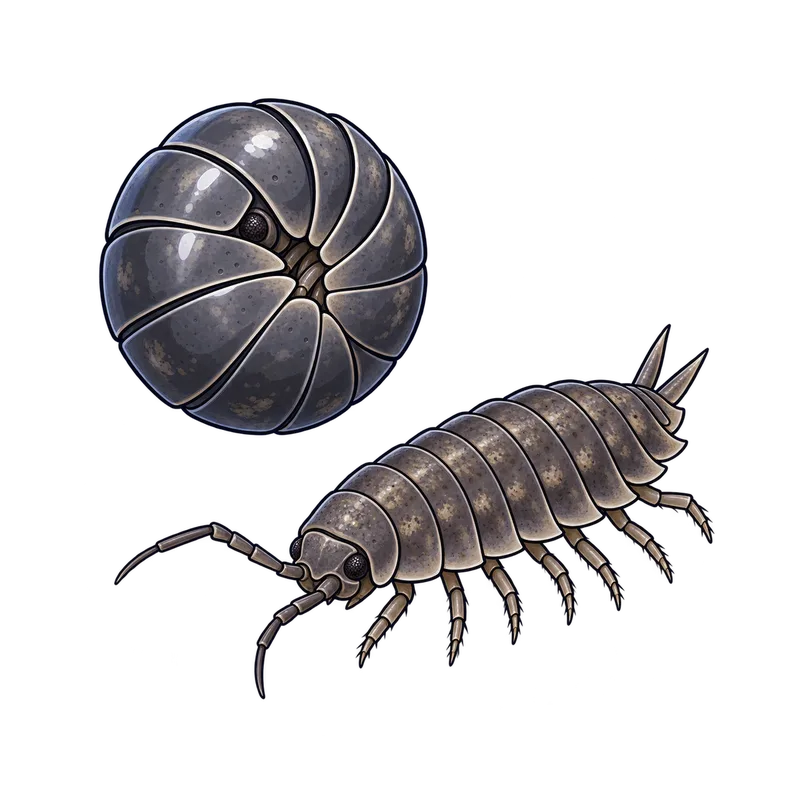
Yes, pill bugs are land-dwelling crustaceans and belong to the isopod group. This means they are actually much closer kin to a crab or a lobster than to any household insect. They sport fourteen jointed legs, an armored exoskeleton, and gills that require constant moisture to function.
What is actually going on
You walk down to the basement on a Tuesday morning to swap out a load of laundry and notice a small, dark, slate-colored ball sitting right beside the washing machine. You nudge it with the toe of your sneaker, and instead of scurrying off like a proper bug, it sits there like a tiny, inanimate pebble.
Yes, pill bugs are isopods. Specifically, they are land-dwelling crustaceans, which means your basement visitor is much closer kin to a crab or a lobster than it is to an ant, a beetle, or any other household insect. Finding one of these creatures indoors is a bit like finding a tiny, land-adapted lobster that lost its way, which explains why they dry out and die so quickly on an air-conditioned basement carpet.
If you look at the biology of the thing, the crustacean connection becomes obvious. Insects get by with six legs and three distinct body parts, but pill bugs sport fourteen jointed legs arranged in seven pairs. They carry a segmented, armored exoskeleton and breathe through specialized structures on their bellies that function much like gills. Because those respiratory structures need constant moisture to function, these creatures are tied to damp environments.
When you find them wandering across a concrete slab or a finished hardwood floor, they are usually lost. Outdoor weather extremes, such as a torrential downpour, a dry summer drought, or a heat wave that bakes the topsoil, often force them to migrate. They slip indoors through foundation gaps or weep holes looking for moisture, but standard indoor air is too dry for them. They cannot breed indoors, and most of them perish quickly from dehydration. Finding dead ones can even act as a natural moisture sensor for your home.
How to tell for sure
People often use several names for these creatures depending on where they grew up, calling them roly-polies or doodle bugs in North America, woodlice in the United Kingdom and Ireland, or slaters in Australia and New Zealand. Whatever you call them, telling them apart from their close cousins, the sowbugs, usually comes down to a simple field test.
At a glance, you are looking at an oval, brownish-gray arthropod measuring about a quarter of an inch long. To confirm what you have, gently nudge the specimen with a pencil or a fingertip. If it instantly tucks its head and legs inward and rolls up into a tight, hard ball with no gaps, you are looking at a true pill bug, acting much like a miniature armored tank locking its hatches.
If the creature refuses to roll up and instead scrambles away in a panic, you are likely looking at a sowbug, which resembles a low-slung sports car that cannot fold up. Sowbugs lack the skeletal hinges required for rolling into a sphere. If you inspect the rear end of a sowbug closely, you will usually spot two small, tail-like appendages sticking out from under the last body segment, which pill bugs keep tucked away.
What usually comes next
The smartest move when you spot these creatures inside is to skip the chemical sprays completely and focus on sealing gaps and managing moisture instead. Because they dry out and perish quickly in indoor air, treating your living spaces with an indoor pesticide is a waste of time and money.
Instead of reaching for an aerosol can, grab a broom and a dustpan or pull out the vacuum cleaner. Sweep up the stray visitors, dump the debris straight into an outdoor trash bin, and head outside to look at the perimeter of the house. Pill bugs manage to get indoors mostly because welcoming habitats sit right against the walls.
Take a walk around your foundation and inspect the flower beds. If you have thick piles of wood mulch, heavy layers of wet leaves, or stacks of firewood piled right against the siding, you are essentially rolling out the red carpet for isopods. Pull back the mulch to create a clean border of bare soil or river rock right against the house. Seal up any gaps in the foundation with silicone caulk, and check that your exterior doors and basement windows have tight weatherstripping to keep wandering crustaceans outside.
When to get help
Pill bugs are harmless scavengers that feed on rotting leaves and plant debris out in the garden. They cannot bite, they do not sting, they do not transmit diseases, and they certainly cannot chew through sound framing lumber, drywall, or your favorite clothes the way termites or clothes moths do.
If someone in your home shows up with strange skin bites, unexplained rashes, or skin lesions, do not point the finger at the pill bugs. Those kinds of symptoms call for a proper medical check, so you should talk to a doctor, visit an urgent care clinic, or call your local poison control center for advice.
You might want to bring in a licensed pest control professional only in certain situations. If you face a massive, non-stop invasion that refuses to slow down even after you seal up entry points, clear the mulch away from the foundation, and run dehumidifiers in the basement, it usually means there is a bigger drainage problem or a damp crawl space that needs a trained eye. Large commercial properties or facilities dealing with heavy outdoor pest pressure can also turn to a licensed applicator for heavy-duty perimeter treatments.