
Can mealybugs fly?
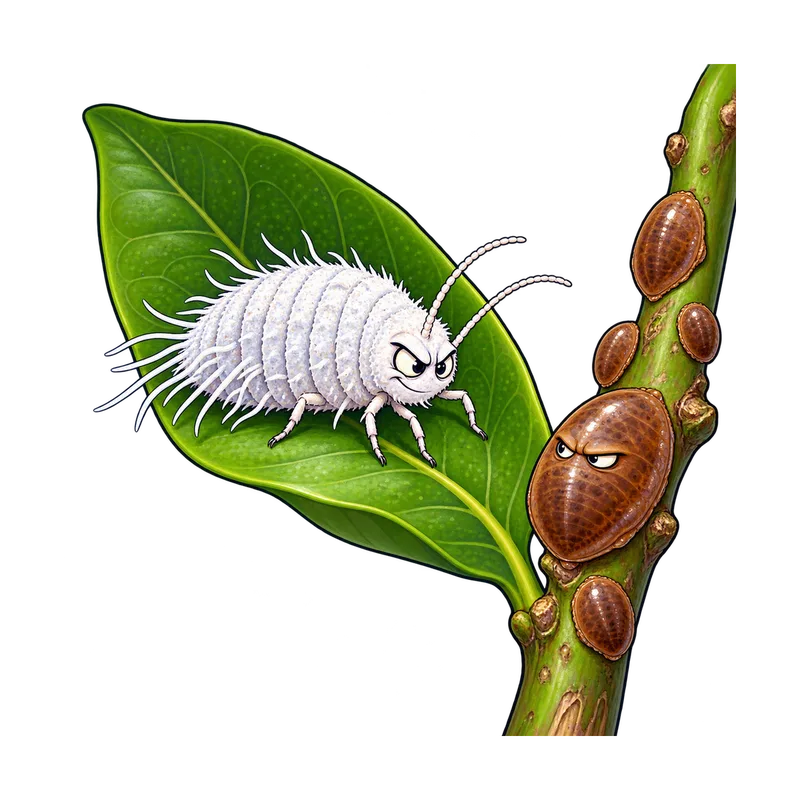
No, adult female mealybugs and the vast majority of the population do not fly because they remain entirely wingless crawlers. They spend their lives camped out on plant stems and leaves as tiny, slow-moving or stationary bumps of wax. If you see something actively flying around your indoor greenery, you are dealing with a completely different creature.
What is actually going on
You are standing by the kitchen window, coffee in hand, watching a purposeful line of ants march across the sill and vanish behind your favorite potted fern. You reach out to nudge the frond, spot a cluster of strange, cottony white specks clinging to the stems, and immediately wonder if those little pests are about to take flight and scatter across the whole room.
The short answer is no, mealybugs do not fly. If you are picturing a swarm of winged bugs lifting off your houseplants, you are almost certainly looking at a different insect entirely.
Mealybugs belong to a group of plant-feeding insects with piercing mouthparts that spend almost their entire lives camped out on plant stems and leaves. They survive by tapping into plant sap, drinking up far more liquid sugar than they can possibly use, and excreting the excess as a sticky substance called honeydew. Think of an infested plant as an open soda fountain for the local ant population. Worker ants love this sugary waste, which is why a heavy mealybug outbreak on an outdoor foundation shrub will almost always draw a busy highway of ants straight toward your exterior walls and windows.
While the available extension literature contains an explicit technical gap regarding detailed wing anatomy or adult male flight mechanics in mealybugs, general entomological consensus notes that female mealybugs and the vast majority of the population remain entirely wingless crawlers. They do not buzz around rooms, flutter toward desk lamps, or launch themselves through the air when you brush against their host plant. If something is actively flying around your indoor greenery, you are dealing with a completely different creature.
How to tell for sure
Spotting these pests usually involves looking for tiny, oval bugs covered in a powdery, waxy white coating that makes them look like they are dusted in flour or wrapped in miniature cotton balls. They usually huddle together in tight groups along leaf joints, stem grooves, and the undersides of foliage where they can feed undisturbed.
When homeowners report flying bugs around indoor houseplants, they are usually seeing fungus gnats. These are delicate, dark-colored flies that emerge from damp potting soil and flutter weakly around the base of the plant or buzz near nearby windows.
Another common mix-up involves winged ants or reproductive swarmers that occasionally appear near sunny window frames or exterior doors. If the insect has clear wings, slender waists, or antennae with distinct bends, it is usually not a mealybug. Mealybugs usually look like tiny, slow-moving or stationary bumps of wax rather than agile flying insects.
What usually comes next
Your best practical move is to check where the bugs actually live and cut off their supply chain before things get out of hand. If you spot ants inside, resist the urge to grab a can of bug spray and call it a day. Treating indoor ants while ignoring mealybugs on the foundation bushes right outside is like mopping a flooded kitchen while leaving the faucet running.
Take a stroll around the outside of your house and inspect ornamental plants, shrubs, and pots sitting close to the siding. If you find sticky honeydew residues or clusters of sap-sucking pests on those perimeter plants, your main task is cultural control. Simply trim back overgrown branches so they stop touching your exterior walls, window screens, or rooflines.
When you decide to use any pesticide on outdoor landscape plants or indoor ornamentals, you must strictly follow the product label instructions regarding dosage, application site, and host plant compatibility. Never exceed label rates, and remember that decisions regarding chemical interventions on large landscape trees or commercial properties usually belong to a licensed pest control operator or certified arborist.
When to get help
Most routine plant pests can be managed with basic pruning, careful washing, and proper plant care, but certain situations call for outside expertise. If an unidentified insect population is causing severe leaf drop, sudden dieback, or heavy damage across mature trees and valuable landscape plants, you should take a physical specimen or a high-resolution photograph to a local university extension diagnostic lab or a licensed horticulturist for a firm identification before applying any treatments.
You should also bring in a professional pest control operator if you discover structural ant nests embedded deep within wall voids, door frames, or foundational timbers, or if you are dealing with a massive greenhouse outbreak that outpaces standard methods.
Applying outdoor agricultural or systemic pesticides to indoor houseplants or edible crops without reading the product label poses severe environmental, health, and non-target contamination risks. If you or someone in your household experiences unusual symptoms, accidental pesticide exposure, or a suspected poisoning from chemical misapplication, contact your local poison control center or seek medical attention immediately.