
What are the main types of scale insects?
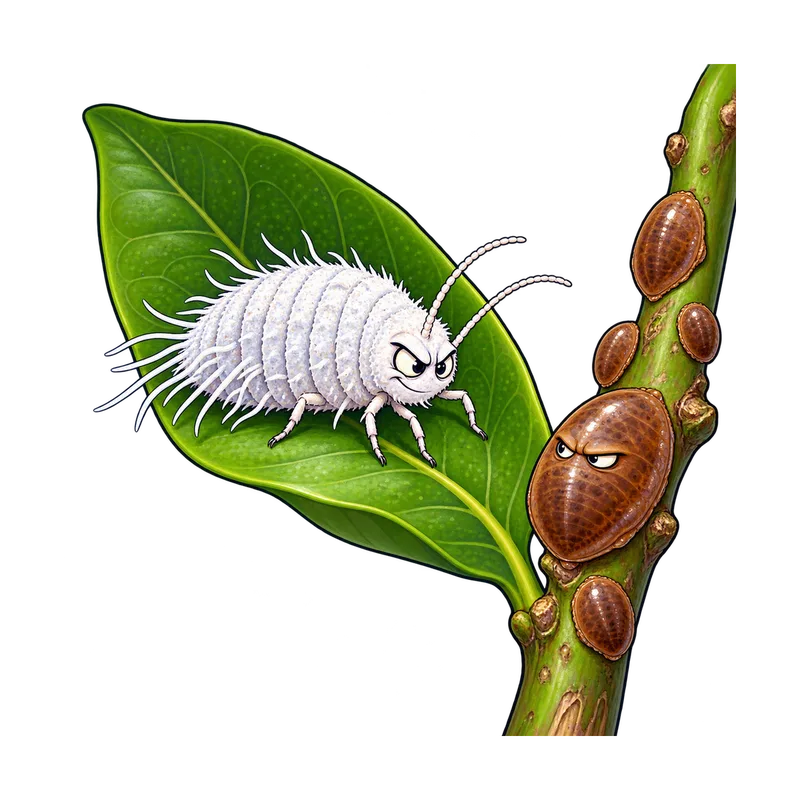
The main types of scale insects are armored scales, soft scales, felted or bark scales, and mealybugs. These groups are separated based on their body structures, waste handling habits, and protective coverings. Telling them apart matters because a treatment that wipes out one type will completely bounce off another.
What is actually going on
You walk out to the back patio on a warm June afternoon, run a hand along the hood of your parked car, and pull it back sticky. Looking up at the shade tree overhead, you realize the leaves look dusty, dull, and speckled with tiny, motionless bumps. You are probably dealing with scale insects, a remarkably successful group of sap-sucking pests that spend most of their adult lives hiding in plain sight. They do not look like ordinary bugs. Instead, they resemble tiny oyster shells, small bumps of wax, or miniature armored plates glued tight to the plant tissue.
The main types of scale insects are split into groups based on their body structures, how they handle waste, and the kind of protective covering they build. Entomologists and extension agents divide them primarily into armored scales, soft scales, felted or bark scales, and mealybugs. Telling them apart matters because a treatment that wipes out one type will completely bounce off another.
Think of an armored scale like a soldier standing beneath an unattached helmet. The insect sits under a hard, separate waxy cover or shield that you can pry off with a needle without harming the soft creature underneath. Soft scales, on the other hand, are built more like an armadillo. Their waxy or leathery outer shell is an integral part of their actual body wall and cannot be separated from the insect without tearing it.
How to tell for sure
The quickest way to figure out what you are looking at involves a handheld magnifying lens and a simple prying test. Take a 10x or 30x loupe and inspect the undersides of leaves, stem nodes, and bark crevices. If you spot tiny bumps, gently slide a fine needle under the edge of the protective cover. If the shield lifts away cleanly to reveal a soft yellow, orange, or purple body underneath, you usually have an armored scale on your hands. If prying tears the body tissue or the shell refuses to budge, you are usually dealing with a soft scale or a felted bark scale.
Another major clue sits on the surfaces surrounding the plant. Soft scales, felted scales, and mealybugs feed on the sugary sap inside the plant phloem and excrete large volumes of sticky liquid waste called honeydew. This liquid coats nearby leaves, patio furniture, and car windshields, quickly turning into a sticky glaze that gets colonized by black sooty mold fungi. Armored scales, by contrast, feed on individual cells rather than the phloem, and they never produce honeydew. If your plant is covered in sticky residue and black soot, you can usually cross armored scales off your suspect list entirely.
You will also want to keep an eye out for the mobile phase of the life cycle. Newly hatched scale insects, known as crawlers, are tiny, six-legged nymphs that wander across the plant looking for a place to settle. In most species, once a female crawler finds a spot and inserts her mouthparts, she usually stays put for the rest of her life, losing her functional legs as she matures. Mealybugs stand out as the exception here because they retain their legs and remain mobile, wandering into leaf axils and root crowns while wearing a powdery white wax coating.
What usually comes next
Your most practical decision centers on timing your actions to match the vulnerability of the crawler stage. Adult scale insects are notoriously difficult to control because their hard waxy shields or tough outer skins act like a barrier against water-based sprays, making adult treatments mostly a waste of time and effort. If you try to spray a mature, armored scale colony with soapy water or a contact spray, you will usually fail to touch the insect underneath while accidentally wiping out beneficial lady beetles and parasitic wasps.
Instead, you need to determine whether you are catching the infestation during the brief window when active crawlers are moving across the stems. Extension services usually track local degree-days to pinpoint when these crawlers emerge in your region. If you inspect your plants with a hand lens and find tiny, active crawlers roaming the bark, that is usually your signal that mechanical wiping, insecticidal soaps, or summer oils can actually reach the pest. If you miss that window and find only hardened adult shells, spraying is usually pointless until the next generation hatches.
When to get help
Scale insects are rarely a medical emergency for humans, but heavy infestations can bring down valuable trees and shrubs within a few years by draining their vigor and inviting secondary wood-boring beetles. If you are dealing with massive, mature shade trees in your yard, trying to manage a severe canopy infestation with small home sprayers is usually ineffective and unsafe. Large trees require commercial arborists equipped with high-pressure power sprayers or specialized tree injection equipment.
You should also reach out to local agricultural authorities or extension offices if you suspect you have encountered a regulated quarantine pest or an invasive forest threat, such as Red Pine Scale in susceptible pine stands outside known distribution areas. Biosecurity agencies track these populations closely to prevent wider ecological damage. If your plant health is in rapid decline despite your best efforts, contact a certified arborist or a university extension specialist for a definitive diagnosis and a managed local strategy.