
Why do scale insects leave sticky residue on leaves?
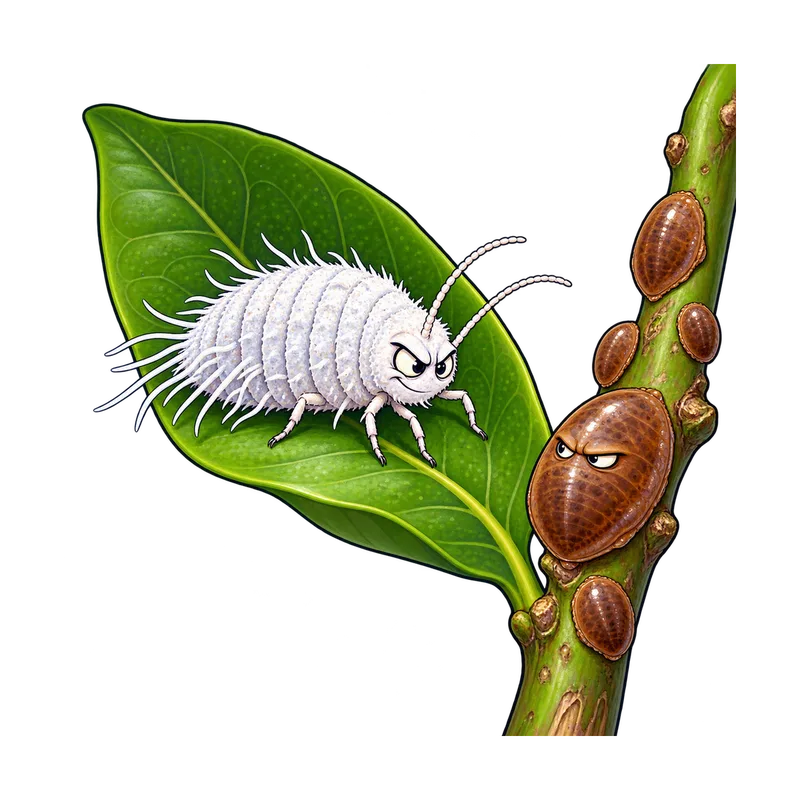
Soft scale insects leave sticky residue on leaves because they drink massive volumes of plant sap to get enough nutrition and constantly excrete the excess sugar water. This sugar rich liquid is called honeydew. Whether your plant gets sticky depends on whether you have soft scales or armored scales, since armored scales do not drop this waste.
What is actually going on
Imagine walking over to your favorite indoor fiddle-leaf fig or checking the patio citrus tree, only to find the leaves feel like someone spilled soda on them. Worse yet, there is a fine dusting of black soot covering the foliage. You wonder how dirt got onto indoor plants, but a closer look reveals the leaves are genuinely sticky.
The culprit is usually a soft scale insect, and that sticky stuff is essentially their waste product. Think of a soft scale as a tiny, stationary straw permanently tapped into the plant vascular system. Because plant sap consists mostly of water and simple sugars with very little protein, these insects have to drink massive volumes of fluid just to get enough nutrition. They act like leaky faucets, filtering out what they need and constantly excreting the excess sugar water out their rear ends.
This sugar-rich liquid is called honeydew. As it drips down from the stems and upper leaves, it coats everything underneath in a tacky film. It acts just like spilled soda on a kitchen counter, turning your plant leaves into biological flypaper. Airborne fungal spores drift by, land in the sticky mess, and feed on the sugar. That is what causes the dark, powdery coating known as sooty mold.
You might wonder why some scale-infested plants get sticky while others do not. The secret lies in the difference between soft scales and armored scales. Armored scales construct a hard, separate waxy plate over themselves and process sap differently, meaning they do not drop sticky honeydew onto the plant. If your leaves are sticky, you are dealing with soft scales or another sap-sucking pest like aphids or whiteflies.
How to tell for sure
Before you grab a spray bottle, you need to confirm what is actually living on your plant. Soft scales usually look like small, oval, slightly raised bumps along the stems or the underside of leaf veins. They do not look like typical bugs because they lack visible legs and stay completely stationary once they start feeding. They can blend in so well with the bark that people often mistake them for natural parts of the plant.
If you touch them, soft scales usually feel slightly leathery or waxy, and they are firmly attached to the plant tissue. You might also notice a parade of ants marching up and down the plant stems. Ants love honeydew just as much as you hate it, and they will farm the soft scales, actively protecting the colony from predatory insects like lady beetles in exchange for a sweet meal.
There is another clue worth checking. If you wipe a leaf with a damp paper towel and see a clear or yellowish sticky smudge, you have a honeydew producer. If the leaves are just dry, speckled with yellow dots, or showing branch dieback without any stickiness, you might be looking at armored scales or an entirely different issue.
What usually comes next
Once you spot soft scales, you have to decide how to handle them without making things worse. A very common mistake is running out to buy a bottle of synthetic fungicide because you see black sooty mold. Remember that sooty mold is just living on the surface sugar; it is not a plant disease attacking the leaves from the inside. Once you stop the scale insects from producing honeydew, the mold stops growing and can be washed away.
Another trap to avoid is grabbing household dish detergent to wash the leaves. Dish soap is designed to strip grease from dinner plates, and it will strip the natural waxy protective layer right off your plant leaves, causing severe chemical burn.
Instead, start with simple mechanical cleaning. For houseplants or small ornamentals, take a soft cloth, a cotton swab, or a soft brush dipped in 70% rubbing alcohol and gently wipe down the stems and leaves. The alcohol dissolves the waxy covering and kills the insects on contact. You can also wash the foliage gently with warm water and a labeled insecticidal soap that uses potassium salts of fatty acids.
If you are dealing with outdoor shrubs or trees, you might need to time a horticultural oil spray. Oils work by smothering the insects and their eggs, but you have to pay attention to the weather. Never spray horticultural oils when the temperature climbs above 90 degrees Fahrenheit, or you will risk frying the foliage. You also want to avoid applying them to oil-sensitive trees like Japanese maples, spruces, or walnuts. The best timing for oils or soaps is usually during the crawler stage in late spring, when the newly hatched nymphs are tiny, mobile, and unprotected by a thick waxy shell.
When to get help
Sometimes a plant issue goes beyond a quick DIY cleanup. If you are managing a massive shade tree in your yard, a towering magnolia, or an extensive landscape hedge covered in scale insects, household spray bottles and hand wiping will not cut it. Those situations require professional arborists or licensed commercial applicators who have the right equipment to reach high canopies safely.
You should also consult a local university extension service or a professional plant diagnostic lab if your plant is showing severe branch dieback, heavy leaf drop, or if you simply cannot figure out what kind of pest you are looking at. Trying to guess your way through heavy infestations with restricted-use chemicals can damage your plants further and waste your time. When an infestation threatens the survival of a mature plant, getting an expert opinion is the smartest next step.