
Soft scale vs armored scale insects: what is different?
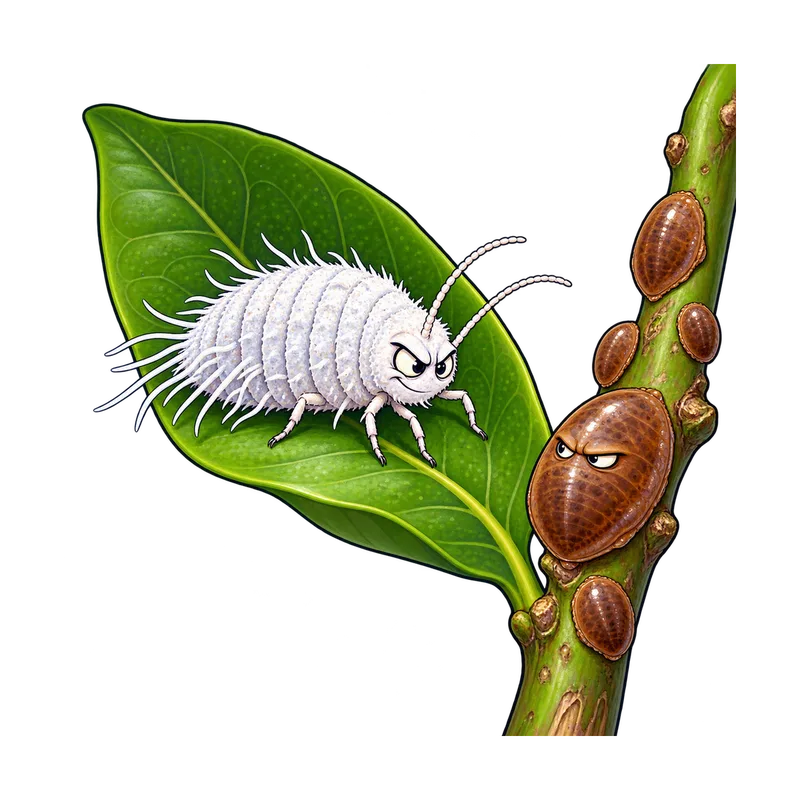
Soft scale insects and armored scale insects differ in their bodies, feeding habits, and messes. An armored scale has a separate waxy helmet you can lift off, while a soft scale has a fused waxy skin. Soft scales drink sap and excrete sticky honeydew, whereas armored scales puncture individual plant cells and leave surroundings completely clean.
What is actually going on
You're watering the lemon tree on the patio, or maybe giving the euonymus hedge by the driveway a once-over, and you notice little bumps on the stems. They don't move. They don't have legs you can see. They look like part of the plant, honestly, and for a while you assume they are. Then the leaves start looking dull, or you park under the maple and come back to a sticky windshield, and now you want to know what you're dealing with.
You've got scale insects, and the first thing worth knowing is that "scale" is really two different animals wearing a similar disguise. Soft scales and armored scales are separate families with different bodies, different feeding habits, and different weaknesses. That difference isn't trivia for entomologists. It matters because the treatment that fixes one can bounce off the other like rain off a raincoat.
Here's the core of it. An armored scale builds itself a hard little helmet out of wax and its own shed skins, and that helmet is completely separate from the insect underneath. Think of a tiny turtle wearing an oversized shell it could technically take off. If you slip a needle under the edge of that cover, it pops away cleanly and leaves a small, soft, yellowish body sitting on the bark, unharmed and slightly offended. A soft scale is the opposite. Its protective coating is its own thickened skin, fused to the body. Less a turtle in a shell, more a raised, waxy scab on the plant. Try to peel it and you tear the insect apart, because the cover and the bug are one piece.
The second big difference is what comes out the back end. Soft scales tap into the plant's phloem, the pipeline that carries sugary sap, and they process so much sweet fluid that they excrete the excess as sticky honeydew. That's the stuff glazing your car, coating the patio furniture, and growing black sooty mold on the leaves. Armored scales don't feed on sap at all. They puncture individual plant cells and drain the contents, like a pushpin stuck in the bark. No sap, no honeydew, no sooty mold, no ants throwing a picnic. Just quiet, localized damage: yellow stippling, cracked bark, sometimes a reddish halo around each scale on fruit.
How to tell for sure
The fastest clue is the mess. If your plant is sticky, if the leaves below the infestation are turning black with a powdery soot you can rub off with a thumb, or if ants are marching up and down the stems like they pay rent there, you're almost certainly looking at soft scales. That black coating, by the way, is not a plant disease. It's a fungus living on the honeydew, not on the plant, which is why spraying fungicide at it accomplishes nothing. Kill the scales, stop the honeydew, and the mold usually weathers away on its own.
If the stems are crusted with bumps but everything around them is dry and clean, suspect armored scales. Their damage shows up differently: speckled or yellowing leaves, rough or cracking bark, dieback at the branch tips, and on apples or peaches, those telltale red rings around each feeding spot.
For a definite answer, do the probe test. Take a fine sewing needle or the tip of a pocketknife and gently lift the edge of one bump. If the hard cover comes away like a tiny lid and leaves a soft body behind on the plant, it's an armored scale. If the whole bump moves as one piece, or tears rather than lifts, it's a soft scale. A cheap 10x hand lens makes this much easier, because these insects are small enough that squinting turns guesswork into confidence.
One more wrinkle worth knowing: the adults you see are basically furniture. Female scales settle on a spot as youngsters, and armored scale females actually shed their legs and antennae and never move again. The mobile stage is the crawler, a freshly hatched nymph with working legs that wanders around looking for a place to settle. Think toddler loose in the house versus adult who has picked a chair and is never getting up. You can monitor for crawlers by wrapping a piece of tape, sticky side out, around an infested twig and checking it weekly. When tiny yellow or orange specks start showing up stuck to the tape, the crawlers are out, and that timing matters a lot for what comes next.
What usually comes next
You might be thinking, do I really need to play bug detective before I do anything? Fair question. For the gentle stuff, no, not really. But the second you reach for a spray, soft versus armored stops being cocktail-party trivia and becomes the whole decision.
Start with the low-drama options, because they honestly do work on light infestations of either family. On a houseplant or a small shrub, scrub the scales off with a soft brush or a cloth dampened with soapy water, or dab them with 70% isopropyl alcohol. Limbs that are crusted like old barnacles can be pruned out in winter and destroyed. If ants are farming your soft scales for honeydew, put a sticky barrier around the trunk and cut off their commute. Once the ant bodyguards are gone, lady beetles and parasitic wasps usually wander in and do a surprising amount of the work for free.
If spraying is still on the table, this is where family matters. Insecticidal soap is good on soft scales and crawlers because it has to touch the insect's body to mess it up, and soft scale bodies are sitting right there under a thin waxy surface. Against a mature armored scale, soap mostly gives the helmet a nice bath. Horticultural oil, which smothers insects by coating their breathing pores, can creep under the edges of armor and is usually the better tool for that family, especially as a dormant oil application on bare wood in late winter.
Systemic products like imidacloprid soil drenches are where people most often set money on fire. They move through the plant's sap, so soft scales, which drink sap, get a lethal dose with lunch. Armored scales, which puncture cells instead of tapping the pipeline, often never swallow enough to care. If you drenched a tree and the scales basically shrugged, that mismatch is the likely reason, not a defective jug.
Whatever you use, the label is the law and the crawler window is everything, since contact sprays only work on the exposed young stage. Respect the oil rules too: never spray it above 90 degrees F, below 40 degrees F, in high humidity, or within 14 days of a sulfur application. Keep it off sensitive plants like Japanese maple, sugar maple, birch, beech, walnut and blue spruce, which can be badly burned or stripped of their color. And skip anything systemic or bee-toxic while the plant is blooming and bees are working it.
When to get help
A few bumps on a houseplant is a Saturday afternoon project. A big shade tree with dieback spreading through the canopy is not. Large trees need high-volume spray equipment to get coverage where scales actually live, and that is licensed applicator territory, especially since heavy infestations of species like San Jose scale can kill a young tree within a couple of years. If the tree is tall, valuable, or declining fast, call a certified arborist before you call it a loss.
The scale insects themselves are no threat to you. They do not bite, sting, or carry human disease, so the bumps on your bark are the only thing at risk. The chemicals are a different story. If anyone in the house gets a skin reaction from a spray, breathes in a drift, or a child or pet gets into a product, that is a call to Poison Control or a doctor, not a wait-and-see situation.
Finally, if what you are seeing does not match either description, or you are in a region with active invasive pest programs, check with your local cooperative extension office before treating. Some lookalike pests are regulated, and a few insects people mistake for scale are actually protected species in certain countries. A five-minute identification from someone who has seen a thousand of them beats a season of spraying the wrong thing at the wrong bug.