
What are soft scale insects?
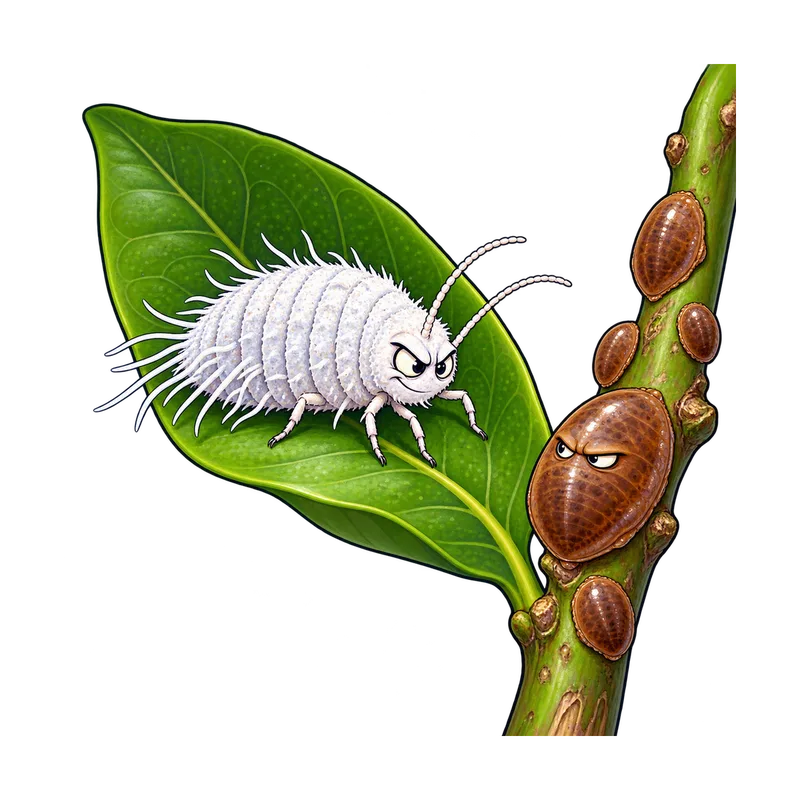
Soft scale insects are small, plant-feeding true bugs that anchor themselves to twigs and leaves to draw out sugary sap. Their protective coating is a thickened, waxy shell that forms part of their own body wall. They excrete sticky honeydew that causes black sooty mold to grow on plants.
What is actually going on
You step out onto the patio on a warm July afternoon, grab a chair, and notice your hands come away sticky. You look up at the prized maple overhead, and the leaves shine as though someone splashed soda across the canopy, with a dusting of dark, soot-like powder covering the upper surfaces. When you lean in closer to inspect a twig, you find tiny, smooth, brown domes or waxy bumps glued flat against the bark. You try to flick one off with a fingernail, but it refuses to budge. It is not an uninvited drop of tree sap or bird droppings. You are looking at a colony of soft scale insects, tucked into position and feeding on your plant.
Soft scale insects are small, plant-feeding members of the true bug order. Unlike their stiff cousins the armored scales, soft scales do not build a separate, detached shield overhead. Instead, their protective coating consists of a thickened, waxy, or leathery outer shell that is entirely part of their own body wall. If you were to pry an adult female soft scale loose, her entire waxy shell comes off as a single piece, whereas an armored scale leaves a naked insect behind while its hard cap pops away. They anchor themselves to twigs, bark, or leaf veins, sink thin, thread-like mouthparts deep into the plant plumbing system, and draw out vast quantities of sugary sap.
Because plant sap is mostly water and sugar rather than heavy protein, these insects must process huge volumes of liquid to get what they need. They excrete the excess as a sticky, sugary waste liquid called honeydew. That is where the sticky patio furniture and the black residue come from. The honeydew coats everything underneath the canopy, serving as a food source for a dark saprophytic fungus known as sooty mold. This mold does not actually parasitize the plant tissue itself, but it creates a dirty black layer that blocks sunlight and drags down the health and appearance of your ornamentals.
You might wonder why ants are constantly parading up and down the stems of an infested tree. Those ants are not there to eat the scales. They treat the scale insects like dairy cattle, harvesting the sweet honeydew. In exchange, the ants act as aggressive bodyguards, chasing away ladybugs, lacewings, and parasitic wasps that would otherwise swoop in to eat the scales.
How to tell for sure
Finding out what you are dealing with usually starts with a simple scratch test or a close look at the damage. Take a magnifying glass or a hand lens with 10x magnification and examine the bumps on the stems and leaf undersides. If the bump is a smooth, leather-like dome that is physically attached to the insect underneath, you are usually dealing with a soft scale. If the plant leaves are sticky and coated in black soot, that points directly to a soft scale or an aphid problem rather than an armored scale, because armored scales never excrete honeydew.
You can also look closer at the specific life stages depending on the season. In early summer, the eggs hatch into tiny, mobile first-instar nymphs called crawlers. These crawlers have functional legs and wander across the plant surfaces for about 24 hours to find a fresh feeding spot before they settle down, lose their mobility, and secrete their waxy coat. On certain turfgrasses or warm-season lawns, you might even mistake scales like the Rhodesgrass scale for tiny, waxy white fertilizer prills tucked into the crown nodes, often revealing purplish body patches if you look under enough magnification.
Field identification usually stops being reliable when you try to separate closely related species within the family Coccidae based solely on appearance. If you are managing a high-value shade tree or a commercial crop, collecting a twig sample and submitting it to a local university extension laboratory is usually the safest way to get a definitive identification before you invest time in a control plan.
What usually comes next
Once you confirm you have soft scales, you generally have to make one practical decision about timing and intervention. Because adult female soft scales develop a thick, protective waxy cuticle that shrugs off ordinary sprays, trying to treat mature scales in the middle of summer is usually a waste of product and effort. The single most effective vulnerability window is the crawler stage, when the newly hatched nymphs are still mobile and lack that thick waxy shield.
Your choice of control usually comes down to physical removal, biorational sprays, or disrupting the ant guards. For a few houseplants or small patio ornamentals, you can physically wipe the stems and leaf surfaces using a soft cloth or cotton swab dipped in rubbing alcohol, or wash the foliage with tepid water and a mild insecticidal soap solution. For outdoor woody plants, insecticidal soaps or dilute horticultural oils are typically preferred over harsh synthetic chemicals, because soaps and oils help smother the crawlers and disrupt their cell membranes without leaving toxic residues that wipe out helpful predators.
You also have to factor in the temperature and the plant species before you grab a sprayer. Horticultural oils and insecticidal soaps can cause severe leaf burning or drop if applied when outdoor temperatures climb above 90 degrees Fahrenheit, and dormant oils must never be used on oil-sensitive plants like Japanese maples, beeches, walnuts, or spruce trees. If ants are present, breaking their access to the tree using sticky barrier bands on the trunk is often a strict prerequisite, because keeping the ants away allows natural predators like lady beetles and lacewings to move in and help suppress the scale population for you.
When to get help
There are times when a do-it-yourself approach is no longer practical or safe, and calling in professional support is the best move. If you are dealing with a massive, mature shade tree where the canopy is high out of reach, managing the infestation requires specialized high-pressure spray equipment and proper licensing. Leave restricted-use pesticides or large-scale canopy applications to certified commercial pesticide applicators or professional arborists.
If you or anyone else experiences accidental chemical exposure during treatment, contact a physician, an urgent care clinic, or poison control immediately. Always read and follow the product label on any pest control material you use, since the label instructions are legally binding and dictate safety gear, application rates, and environmental protections.
Be mindful of environmental hazards as well. Many botanical insecticides and spray oils can pose risks to non-target wildlife, beneficial pollinators, or aquatic life if they run off into nearby storm drains or streams. If your local trees are showing severe twig dieback, or if you suspect an unfamiliar or regulated invasive pest on imported stock, reach out to your local agricultural extension office or state department of agriculture for guidance.