
What are armored scale insects?
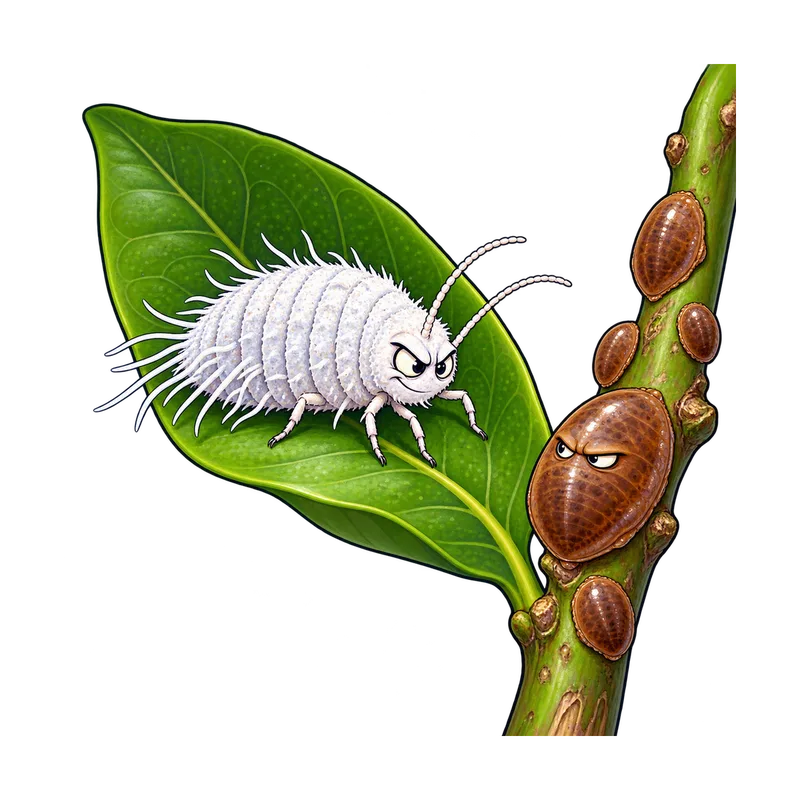
Armored scale insects are tiny sap sucking pests that hide beneath separate, protective waxy shields on the bark and leaves of trees and shrubs. These insects measure only a couple of millimeters across and do not produce sugary sticky waste. Managing them successfully depends entirely on targeting the vulnerable crawler stage or applying dormant oils.
What is actually going on
Imagine walking out to check a prized euonymus shrub or apple tree on a warm spring morning and noticing the bark looks strange, almost like someone sprinkled coarse gray ash or tiny oyster shells all over the twigs. When a finger brushes against the stems, they feel bumpy and rough, but unlike the sticky mess aphids usually leave behind, the patio stones and leaves underneath are completely bone dry and clean. You are likely looking at armored scale insects, tiny sap-sucking pests that quietly drain the life out of woody perennials while hiding beneath their own built-in roofs.
Armored scale insects belong to a large family of plant pests known scientifically as Diaspididae, and they differ fundamentally from their soft-bodied cousins. Imagine a miniature turtle shell or a hard plastic roof sitting loosely over the insect's body underneath. Unlike soft scales, whose waxy coverings are fused directly to them like a tough leather jacket, an armored scale builds a separate shield out of cast-off wax and shed skins. Once a female crawler finds a suitable feeding spot, she inserts her thread-like mouthparts into the plant tissue, discards her legs during her next molt, and remains permanently stationary beneath that protective helmet for the rest of her life.
One of the most reliable field clues about these insects is what they fail to do. Armored scale insects do not produce honeydew, which is the sugary, sticky waste that soft scales, aphids, and whiteflies pump out by the drop. If your car or patio table sitting underneath an infested tree is sticky and coated in black sooty mold, you can safely rule out armored scales. These insects keep their digestion internal and direct every drop of sap toward their own survival, which makes them uniquely tricky to manage compared to other garden bugs.
How to tell for sure
Spotting an armored scale infestation usually requires looking past the foliage and focusing directly on the stems, bark, and sometimes the fruit. The adult females are tiny, often measuring only a couple of millimeters across, and their physical appearance varies by species. Some resemble minuscule oyster shells clinging to a twig, while others form dense, overlapping crusts that give branches an ash-gray or white-washed appearance. You can usually confirm what you are dealing with by taking a closer look with a ten-power hand lens or a magnifying glass. If you gently pry up the waxy shield with a pin or a fingernail, you will usually find a tiny, soft, legless insect resting underneath, completely separate from the roof that protected it.
The damage pattern on the host plant offers another strong clue. Armored scales target the wood, foliage, and fruit of trees and shrubs, feeding on individual plant cells rather than the main sap-conducting phloem tubes. As they feed in large numbers, the leaves above often turn yellow, stipple, or drop prematurely, creating a sparse and stressed canopy. On fruit trees like apples or peaches, certain species leave behind distinct reddish rings around each insect on the skin. You will usually notice branch dieback starting at the tips of the branches and moving downward, and under heavy pest pressure, young trees or established limbs can decline and die within two to three years.
Timing your identification efforts matters because these insects go through a dramatic transformation. The only mobile phase in their entire life cycle is the newly hatched crawler, a microscopic nymph that looks like a speck of dust with legs. These crawlers emerge during specific seasonal windows depending on the species, scrambling out from under the mother's shield to find a fresh feeding site. If you examine the plant during these specific spring or summer emergence weeks, you might spot thousands of these tiny wanderers moving across the bark before they settle down, lose their legs, and build their permanent armor.
What usually comes next
When you discover an armored scale infestation on a valued plant, your immediate practical decision usually boils down to choosing between physical removal or precise chemical intervention based on the scale of the problem. If the infestation is confined to a single potted shrub, a young patio tree, or just a few isolated twigs, you can often bypass sprays altogether. For small populations, physically scrubbing the stems with a soft brush and soapy water or pruning out heavily infested branches before the spring hatch gives your plant an immediate reset without introducing chemicals into your garden ecosystem.
When the infestation covers entire hedges or mature shade trees, physical pruning stops being practical, which forces a choice about how and when to apply treatments. Because mature armored scales are protected by an impermeable waxy shield that completely repels water-based contact sprays, spraying adult bugs is a waste of time and effort. Success depends entirely on timing your applications to strike the vulnerable crawler stage, or alternatively, applying refined horticultural petroleum oils during the dormant late-winter season. These oils work by coating the twigs and smothering overwintering immature scales, but they require strict attention to weather conditions and plant sensitivities to avoid scorching tender foliage.
When to get help
There are times when a backyard gardener needs to step back and hand the problem over to someone with specialized equipment or legal authority. If your infestation involves large, mature shade trees with high canopies, home garden sprayers simply cannot reach the upper branches with the thoroughness required to control scale insects. Commercial arborists possess high-pressure spray rigs, mist blowers, and safety gear designed to treat expansive landscapes effectively and safely.
You should also involve a professional or your local university extension office when you cannot identify the specific scale species with confidence. Some destructive scale pests look remarkably similar in their early stages, and misidentifying them leads to poorly timed treatments that fail to protect your trees. If you suspect you have encountered a regulated, non-native quarantine pest on imported plant material or forest trees, state and federal agricultural authorities need to be notified so they can track and manage invasive species before they spread through local ecosystems.